The Internal Revenue Service (IRS) assigns a unique Employer Identification Number (EIN) to business entities that operate in the US. This nine-digit number is a type of tax identification number (TIN) and functions like a Social Security number (SSN) for businesses. Companies use EINs for tax filing and reporting purposes, letting the IRS track tax-related activities and check compliance with tax laws.
Businesses that operate in the US need an EIN to pay employees, open business bank accounts, apply for business licenses, and file tax returns. This is true even if the business owners aren’t physically in the country.
Nonresidents can obtain an EIN while living outside the US. They don't need an SSN or Individual Taxpayer Identification Number (ITIN); instead, they apply via fax, mail, or phone using IRS Form SS-4, and processing typically takes 5–15 business days by fax or 4–6 weeks by mail. Below is a guide on how to obtain an EIN while living outside the US, including the process, costs, and what happens after you obtain your EIN.
What’s in this article?
- What is an EIN and how does it differ from a TIN, ITIN, and SSN?
- How to get an EIN as a nonresident
- How much does an EIN cost?
- What are the tax obligations after you get an EIN?
- How to terminate your EIN
- How to operate a business in the US as a foreign entity
- How Stripe Atlas can help
What is an EIN and how does it differ from a TIN, ITIN, and SSN?
An EIN is a unique nine-digit number assigned by the IRS to identify a business entity for tax purposes—similar to how an SSN identifies an individual. Here’s how it contrasts with other tax IDs:
TIN: An umbrella term for all tax IDs issued by the IRS. EINs, SSNs, and ITINs are all types of TINs.
SSN: A number issued to US citizens and eligible residents to identify individuals for tax and Social Security purposes.
ITIN: A number issued to individuals who need a US taxpayer ID but aren’t eligible for an SSN, such as noncitizens who reside outside the country.
The IRS uses TINs in the administration of tax laws for individuals and businesses, and most businesses in the US need an EIN to operate. These include corporations, partnerships, and any company with employees. Sole proprietors might need an EIN if they have employees or meet certain conditions. EINs and TINs aren’t the same thing, but EINs fall under the category of TINs.
A business uses an EIN for tax filing, opening business bank accounts, obtaining business licenses, hiring employees, and more. It serves as a form of identification for the company in various legal and financial transactions. Although EINs are public information, businesses should use them discreetly—especially in public documents or online—to prevent identity theft or fraud.
Applying for an EIN: Applying for an EIN is straightforward and businesses in the US can do so online through the IRS website. The process is free, and the IRS issues the number immediately once the online application is completed. It’s important to use the official IRS website to avoid any unnecessary charges because third-party services might offer to obtain an EIN for a fee. Businesses can also apply by fax, mail, or phone, but online application is the fastest.
Changing your EIN: If a business changes its structure (e.g., from a sole proprietorship to a corporation), it’ll likely need a new EIN. Not all changes in structure require a new number so it’s important to check with the IRS or a tax professional.
EIN expiration: Once it’s issued, an EIN doesn’t expire. It remains with the business entity until the business is closed or the organization’s structure changes.
How to get an EIN as a nonresident
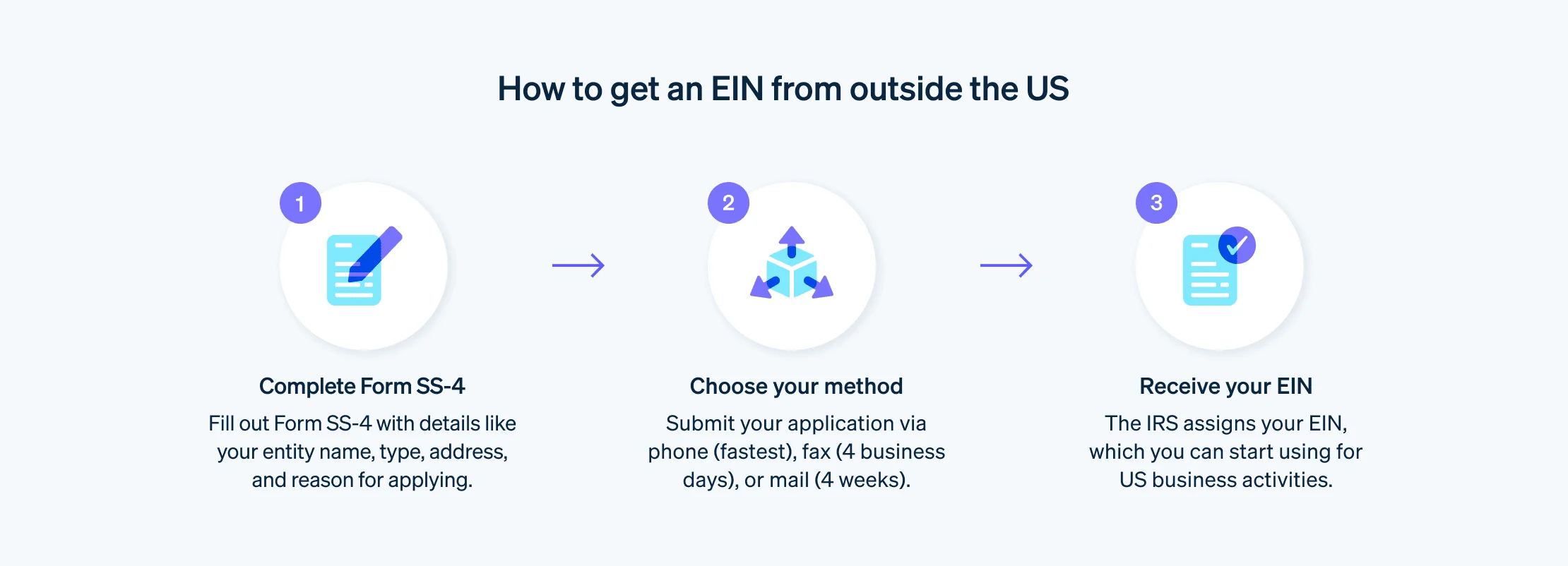
Nonresidents can follow these steps to obtain an EIN from outside the US.
Determine your eligibility and limitations
As a nonresident, you cannot apply for an EIN online—that method is reserved for entities with US addresses. However, you can apply via phone, fax, or mail.
Complete Form SS-4
All application methods require filling out Form SS-4 (Application for Employer Identification Number). As a foreign entity, indicate your foreign status and don’t include an SSN or ITIN if you don't have one.
Gather required information
Before you apply, gather certain documents and details. You’ll need:
Legal name of the entity
Principal business activities
Name and address of the responsible party
Reason for applying for the EIN
Choose how to apply
Your next steps depend on which application method you choose.
Apply by phone: Call the IRS at the international applicant number listed on the IRS website. The person who’s calling must be authorized to receive the EIN and answer questions about Form SS-4.
Apply by fax: Fax your completed Form SS-4 to the IRS. If you include a return fax number, the IRS can send your EIN within four business days.
Apply by mail: Mail your completed Form SS-4 to the IRS. This is the slowest method; it typically takes about four weeks to receive your EIN.
Requirements for nonresidents applying for an EIN
A nonresident who’s applying for an EIN for a foreign entity must provide the requested information on Form SS-4 detailed below:
Entity’s legal name: The official name of the business as registered in the country of origin.
Entity type: The type of entity (e.g., corporation, partnership) and any relevant details about the business structure.
Reason for applying: Why you’re requesting an EIN (e.g., to start a business, to hire employees, to open a business bank account).
Responsible party: The name and identifier for a designated individual who has control over or is entitled to the entity’s funds and assets. The identifier can be an SSN for US residents or a foreign passport number or similar identifying number for nonresidents. For non-US businesses, the designated responsible party is often a principal officer or controlling individual.
Mailing address: If the business doesn’t have a US mailing address, it can provide an international address instead.
Principal business activity: The primary nature of the business, including products sold or services provided.
Number of employees: If the business doesn’t have employees but will in the next 12 months, it can estimate the number of employees it’ll hire. This section should also indicate the employee type (e.g., agricultural, household).
First date wages or annuities were paid: This is relevant only if the business will have US-based employees.
How much does an EIN cost?
Obtaining an EIN from the IRS is free for all businesses, regardless of where they’re based. Although it’s free, there might be associated costs for businesses not based in the US if they hire tax professionals or legal advisers to help them work through the application process or understand their tax obligations in the US.
What are the tax obligations after you get an EIN?
Businesses that operate in the US must fulfill a series of tax obligations. Once you obtain an EIN, these tax obligations might apply:
Income tax filings: Businesses must file annual income tax returns. The specific form they must use depends on the business structure (e.g., Form 1120 for corporations, Form 1065 for partnerships, Form 1040 for sole proprietors).
Employment taxes: If the business has employees, it must withhold federal income tax, Social Security taxes, and Medicare taxes from their wages. The business also needs to pay the employer’s share of Social Security and Medicare taxes, along with federal unemployment tax.
Excise taxes: Some businesses are responsible for excise taxes if they manufacture or sell certain products (e.g., fuel, tires, tobacco), receive payment for certain services, or use various kinds of equipment, facilities, or products.
Estimated taxes: Business owners and entities might need to make estimated quarterly tax payments if they expect to owe $1,000 or more in tax when their returns are filed. This is especially relevant for entities that pass income through to the owners, such as S corporations and partnerships.
State and local taxes: Businesses need to be aware of and comply with any state and local tax requirements, which can include income, sales, property, and employment taxes.
Reporting: Businesses must provide their employees and the IRS with information returns (e.g., Forms W-2 and 1099) to report transactions, such as payments to independent contractors and employee wages.
How to terminate your EIN
Although the IRS doesn’t technically cancel an EIN (the number is never reassigned and remains associated with the business entity to which it was issued), these steps effectively close your business’s tax account with the agency:
File final tax returns: Your business must file a final tax return. This would be Form 1120 for corporations, Form 1065 for partnerships, and Schedule C (Form 1040) for sole proprietors. Check the box that indicates it’s a final return. If you have employees, you must also file the final employment tax returns, including final federal tax deposits of these taxes.
Pay outstanding taxes: Pay all outstanding taxes including income taxes, employment taxes, and any other federal taxes for which your business is responsible.
Issue final wage and payment reports: If your business had employees, issue final W-2 forms to employees and file them with the IRS. If you’ve paid independent contractors $600 or more during the business’s final year, issue a Form 1099-NEC to each contractor and file the completed forms with the IRS.
Cancel your business name: If applicable, cancel your business name with the appropriate state or local agencies.
Close your business account with the IRS: Send a letter to the IRS that includes the entity’s complete legal name, EIN, business address, and the reason for closing the account. If you have any IRS-issued licenses, permits, or other authorizations, return them with the letter. Indicate the date on which you stopped paying wages.
Notify state and local agencies: Inform state and local tax agencies and any other relevant agencies of your business’s closure. You might also need to cancel your state business license, state employer accounts, and any local permits.
Keep records: Maintain your business records for a minimum of three years after closing your business because the IRS might request information within this period. Some records, especially those related to employment taxes, should be kept longer.
How to operate a business in the US as a foreign entity
Foreign entities that operate businesses in the US must go through many of the same processes as US residents. Here’s what’s involved:
Research a business structure: Research and choose a suitable business structure. Common options for foreign entities include the corporation and the limited liability company (LLC).
Determine which state to incorporate in: Decide on which state to incorporate in. Delaware, Nevada, and Wyoming are popular because of their business-friendly laws. Consider factors such as tax rates, the legal environment, and the physical presence of your business.
Register your business: Register your entity by filing the necessary documents, such as articles of incorporation (for corporations) or articles of organization (for LLCs), with the chosen state’s secretary of state.
Apply for an EIN: Submit an application for an EIN with the IRS as outlined in this guide.
Open a business bank account: Opening a business bank account typically requires the business owner or a representative to be in the US to provide the EIN, incorporation documents, and identification.
Get insurance: Procure appropriate insurance to mitigate risks associated with your business activities in the US.
Comply with tax obligations: Understand your federal, state, and local tax obligations, including income taxes, payroll taxes, and sales taxes. International businesses might also need to consider tax treaties between the US and their home countries to avoid double taxation.
Follow laws when hiring: If you hire employees, comply with US employment laws regarding wages, workplace safety, nondiscrimination, and benefits. Obtain any necessary EINs at the state level, understand the obligations for withholding and paying payroll taxes, and familiarize yourself with labor laws.
Gather necessary licenses and permits: Obtain relevant federal, state, and local licenses and permits. These vary depending on the industry and business activities.
Acquire any immigration and work visas needed: If foreign nationals will work in the US, comply with immigration laws, including the requirement for the correct visas. This might involve L-1 visas for intracompany transfers, E-2 visas for investors, or H-1B visas for specialized employees.
Remain compliant with regulations: Maintain ongoing compliance with annual reporting, tax filings, and renewals of licenses and permits. Stay informed about changes in laws that might affect your business. Consult attorneys and accountants who specialize in international business, especially for complex matters such as international tax planning, intellectual property (IP) protection, and compliance with the Foreign Corrupt Practices Act.
How Stripe Atlas can help
Stripe Atlas sets up your company’s legal foundations so you can fundraise, open a bank account, and accept payments within two business days from anywhere in the world.
Join 75K+ companies incorporated using Atlas, including startups backed by top investors like Y Combinator, a16z, and General Catalyst.
Applying to Atlas
Applying to form a company with Atlas takes less than 10 minutes. You’ll choose your company structure, instantly confirm whether your company name is available, and add up to four cofounders. You’ll also decide how to split equity, reserve a pool of equity for future investors and employees, appoint officers, and then e-sign all your documents. Any cofounders will receive emails inviting them to e-sign their documents, too.
Accepting payments and banking before your EIN arrives
After forming your company, Atlas files for your EIN. Founders with a US SSN, address, and cell phone number are eligible for IRS expedited processing, while others will receive standard processing, which can take a little longer. Additionally, Atlas enables pre-EIN payments and banking, so you can start accepting payments and making transactions before your EIN arrives.
Cashless founder stock purchase
Founders can purchase initial shares using their IP (e.g., copyrights or patents) instead of cash, with proof of purchase stored in your Atlas Dashboard. Your IP must be valued at $100 or less to use this feature; if you own IP above that value, consult a lawyer before proceeding.
Automatic 83(b) tax election filing
Founders can file an 83(b) tax election to reduce personal income taxes. Atlas will file it for you—whether you are a US or non-US founder—with USPS Certified Mail and tracking. You’ll receive a signed 83(b) election and proof of filing directly in the Stripe Dashboard.
World-class company legal documents
Atlas provides all the legal documents you need to start running your company. Atlas C corp documents are built in collaboration with Cooley, one of the world’s leading venture capital law firms. These documents are designed to help you fundraise immediately and ensure your company is legally protected, covering aspects like ownership structure, equity distribution, and tax compliance.
A free year of Stripe Payments, plus $50K in partner credits and discounts
Atlas collaborates with top-tier partners to give founders exclusive discounts and credits. These include discounts on essential tools for engineering, tax, finance, compliance, and operations from industry leaders like AWS, Carta, and Perplexity. We also provide you with your required Delaware registered agent for free in your first year. Plus, as an Atlas user, you’ll access additional Stripe benefits, including up to a year of free payment processing for up to $100K in payment volume.
Learn more about how Atlas can help you set up your new business quickly and easily, or get started today.
The content in this article is for general information and education purposes only and should not be construed as legal or tax advice. Stripe does not warrant or guarantee the accurateness, completeness, adequacy, or currency of the information in the article. You should seek the advice of a competent attorney or accountant licensed to practice in your jurisdiction for advice on your particular situation.