SaaS platforms are surging despite the SaaSpocalypse

We’re seeing an unexpected boom in SaaS platforms right now. Stripe added more new platforms in the last three months than it did in the final six months of 2025. New platform businesses are up over 180% year over year during that same three-month period, and that pace is continuing.
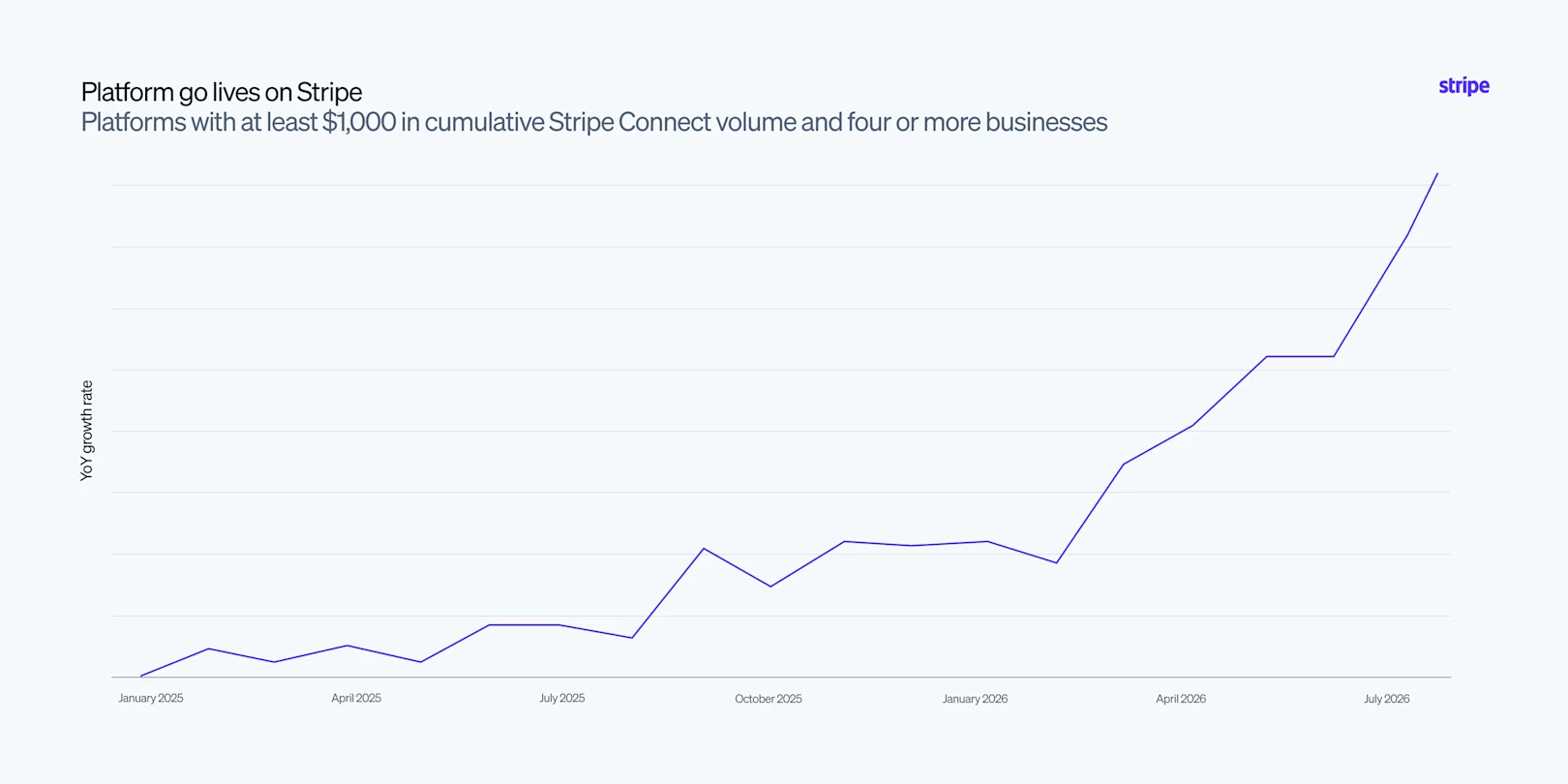
We reviewed the platforms that went live over the last three months via manual review, LLM classification, and heuristic checks, and found that they’re legitimate businesses with real customer activity. Platforms that went live in January 2026 are also reaching $1 million in payment volume at a higher rate than any previous cohort over the equivalent period.
This trend contradicts market expectations from earlier this year, as we recently examined on Stripe Economics. Beginning in late January, software companies shed roughly $1 trillion in market capitalization in 30 days. Investors worried that agentic AI would commoditize software by making it faster and cheaper to build. The headlines called it the “SaaSpocalypse.” In the months since, however, much of that decline reversed. Since then, SaaS equity prices have returned to roughly their pre-sell-off levels. While equity markets price future expectations, Stripe’s payment volumes capture what businesses are doing now. Stripe Economics research found that weekly transactions for the 100 largest non-AI SaaS companies on Stripe showed a brief dip, followed by a swift recovery and continued growth—an indication that performance was not as affected as market sentiment initially indicated.
Platforms offer a path to differentiation
AI has made software easier to build, which means companies need more than a good product idea to stand out from a growing field of competitors. As software itself becomes increasingly commoditized, building around the specific needs of an industry offers entrepreneurs another path to differentiation. Many of the most successful platforms on Stripe take this approach, often drawing on years of experience dealing with the problems those businesses face. Aesthetic Record, for example, brings together medical records, clinical workflows, patient engagement, and compliance in a platform tailored to medical aesthetics practices. Nonprofit platforms have a different set of specialized needs, including managing donor relationships and event registration, issuing tax receipts, and more. Bloomerang embeds those nonprofit-specific workflows and relationship data directly into its CRM.
This kind of deep industry knowledge is tough to replicate. Our data shows that strong SaaS platforms—whether horizontal or vertical—tend to share three characteristics: they run key workflows, such as scheduling or inventory management; they retain valuable business information, like customer histories or pricing logic; and they connect day-to-day operations to money movement. The more central a platform becomes to those operations, the more indispensable it will be.
“A high-signal indicator of platform defensibility is what breaks the day the customer turns it off,” said Eric Noeth, partner at global private equity firm Advent. “If operations keep running, the product is more exposed. If the business stops—claims don’t pay, cars don’t sell, trades don’t settle—the product is defensible and hard to dislodge.”
AI expands what platforms can offer
AI is changing what SaaS platforms can offer their merchants and how quickly developers can build on Stripe. As of August 2026, over 55% of new Stripe integrations now involve some form of AI assistance. Better documentation, integration blueprints, and agent-friendly tooling are making it faster and easier to build a complete platform integration.
At the same time, platforms are using AI to make the workflows they already own more effective: automating intake and onboarding, improving scheduling, personalizing customer outreach, prioritizing collections on overdue payments, reducing risk, and taking action on behalf of merchants.

The impact is visible in the quality of integrations: the number of self-serve SaaS platforms on Stripe building complete integrations is up roughly 360% year over year, a leading indicator that more platforms are moving beyond experimentation and building the full capabilities their merchants need.
Building durable software businesses in the AI era
The SaaSpocalypse was a useful warning for the software industry. AI will make some products easier to build, easier to copy, and harder to price on a per-seat basis. But SaaS platforms that help businesses run core operations—and increasingly help them move and manage money—are more deeply embedded. Platforms can become even harder to displace by helping merchants access capital, store funds, and spend with cards.
To learn how Stripe supports platforms navigating these shifts, check out Stripe docs or contact our team.