Solo founding is at an all-time high: Top performers have these traits in common

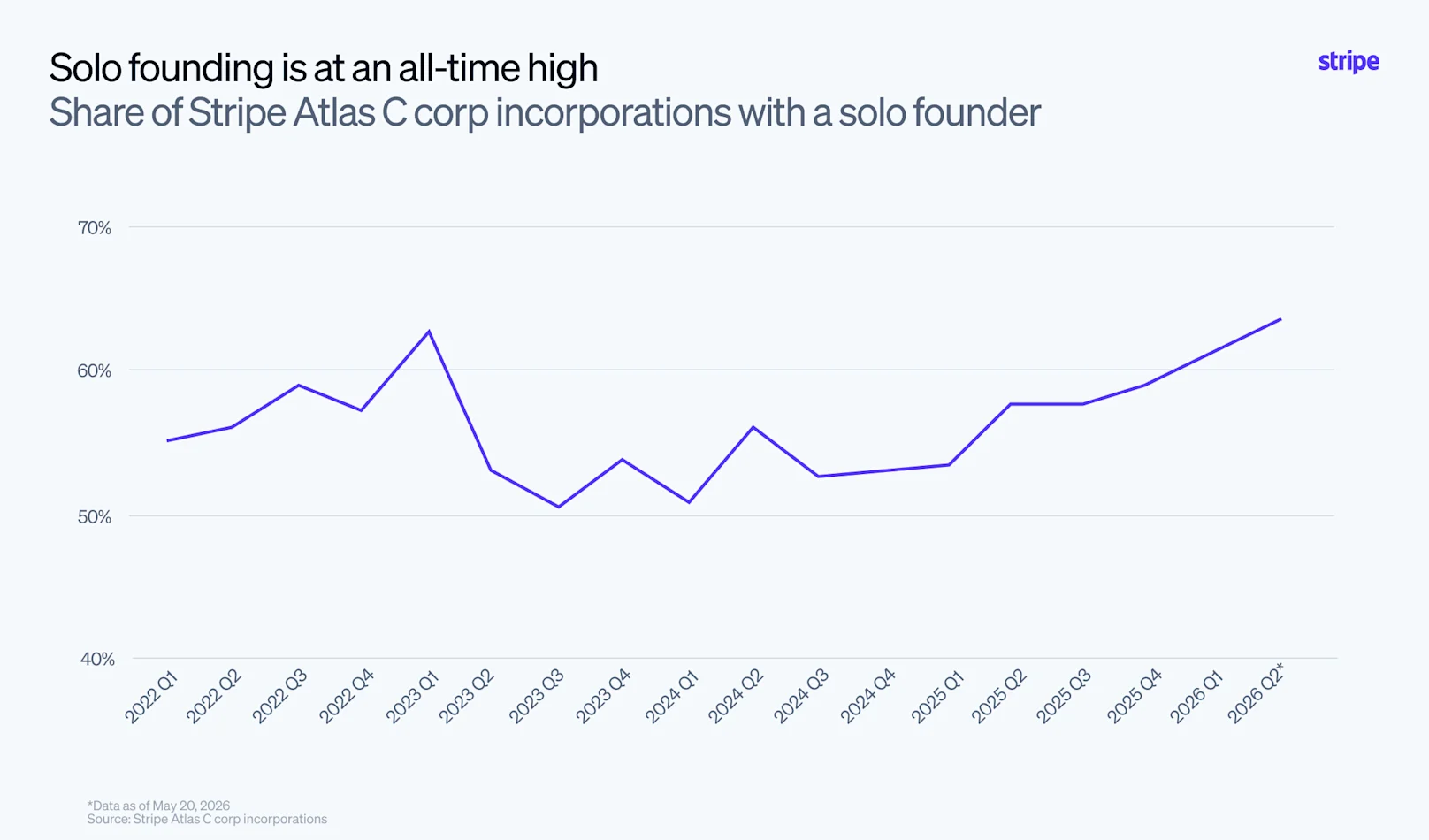
Solo startup founders, defined here as people who launched a startup through Stripe Atlas without any cofounders, account for 63% of C corps formed so far in the second quarter of 2026—an all-time high.
As more founders start companies on their own, the gap between typical companies and top performers is widening. Among solo-founded startups incorporated through Atlas, median initial six-month revenue in 2025 was down 23% year over year, while revenue at the top decile was up 19%.
Four years ago, top-decile solo founders made about 34 times the revenue of the median solo founder in their first six months. In 2025, that figure had grown to 61 times. The number of solopreneurs earning over $100,000 per year has increased a third since 2022.

As AI tools make it easier for one person to build, ship, support customers, and iterate, it’s worth asking what separates the companies that break out from those that don’t. To understand this divide, we analyzed thousands of solo-founded Atlas startups incorporated in 2022 and 2023, each with at least two years of revenue data. Within that group, we compared middle-decile solo founders with those in the top decile by total revenue in their first two years to understand what differentiates the strongest outliers. A few patterns among the top decile stood out.
1. They build AI-native products
The most successful solo founders are building AI-native products, meaning the product’s core functionality depends on AI models. Top-decile solo founders were about twice as likely as median founders to be building AI-native companies. The next generation of solo founders will be less defined by technical pedigree and more by speed,” says Marc Lou, who has founded 34 startups solo. “They’ll be no-code people focused on solving a problem, shipping crazy fast with AI, and cracking distribution on social media.”
By the two-year mark, AI-native solo startups generated almost twice the revenue of other solo-founded startups. Initially, we expected that result to be driven by a small handful of breakout companies inflating the average, but that’s not the case: revenue at the 99th percentile was nearly the same for AI-native and other startups. The difference comes from the broader distribution, with AI-native startups outperforming from roughly the 50th to the 95th percentile.

2. They sell globally from launch
In the first month, top-decile solo founders sold into an average of 10 countries, versus just three for median solo founders. That gap continued to widen over time. By month 24, top-decile solo founders were selling into 40 non-US countries, on average, compared to six for median solo founders.

Top solo founders also generated a much larger share of revenue from outside their home market. International sales accounted for 51% of revenue for top-decile solo founders, compared with 2% for median solo founders. Much of that difference came down to where founders were based: top-decile solo founders were slightly more likely to be located outside the US, so many sold into the US early. Since the US is often the largest and highest-spending market for software, selling there early can accelerate growth.
3. They build for businesses
Top solo founders were nearly 30% more likely than middle-decile founders to build B2B businesses. “I grew my SaaS to €10K MRR without ads by talking to users every day, only building features that multiple customers asked for, and focusing on being the best service in my specific niche,” says Pauline Clavelloux, who solo-founded four companies, including Refindie.
B2B solo founders performed better across the board. By month 24, revenue for the median solo B2B founder was more than four times that of the median solo B2C founder.
That pattern held among top performers. Solo B2B founders in the top decile earned nearly twice as much revenue as their B2C peers.

A common assumption is that this is mainly driven by funding, since B2B founders tend to raise capital more easily. The data suggests otherwise. Even among bootstrapped startups, solo B2B founders generated more revenue than solo B2C founders at both the median and the top decile.
4. They have higher customer retention early on
Top solo founders retained a much larger share of their first-month customers than middle-decile founders, suggesting they reach product-market fit earlier. “Validate with paying users before you invest too much time or money,” says Clavelloux. “Progress over perfection: launch fast and iterate often.”
Nearly 30% of customers at top-decile solo startups returned the following month, compared with 8% at middle-decile startups. By the sixth month, top-decile solo founders also began winning back churned customers—roughly three months sooner than middle-decile founders.

That early retention advantage pays off over time. By the start of the second year, customers acquired in the company’s first month were spending 47% more at top-decile startups than they were initially—about twice the increase seen at middle-decile startups.
This contrast was especially pronounced in B2B businesses. Among solo-founded B2B startups, top-decile founders retained first-month customers at six times the rate of median founders.

Part of the reason top solo founders retained more customers might be that they were much more likely to use recurring billing. Based on Stripe data, top-decile B2B and B2C founders were 26 and 20 percentage points more likely to use a recurring billing model than their middle-decile peers, respectively.

While these patterns highlight what many top solo founders have in common, they don’t show how solo-founded companies stack up against multifounder teams.
5. Multifounder startups tend to pull ahead over time, but the top solo founders are catching up
Early on, solo-founded startups brought in more revenue than multifounder startups, but that flipped by month 24: top-decile multifounder startups generated 53% more revenue than top-decile solo founders. That remained true even after accounting for investor funding.

However, the multifounder advantage almost evaporates when comparing the very best bootstrapped startups. At the 99th percentile, bootstrapped solo founders came close to bootstrapped multifounder startups after two years, with only a 5% difference in revenue. “The strongest solo founders tend to be incredibly resourceful and high-agency: they can build, write, and ship, but they also know how to extend themselves through great hires, advisors, and founder networks,” says Fatima Rizwan, who solo-founded Okara and TechJuice.

Get started as a solo founder
With Stripe Atlas, solo founders can set up a company, open a bank account, accept payments, and fundraise within two business days from anywhere in the world.
- Incorporation and equity: Incorporate your company, retrieve its EIN, set up founder equity vesting, and file 83(b) tax elections.
- Investor-ready documents: Your company’s legal documents are developed with Cooley, a leading law firm for startups.
- Resources to grow: Access $50,000 in partner perks, $2,500 in Stripe credits, and the ability to fundraise with SAFEs from the Dashboard.
Learn more about Stripe Atlas.