Best of both rails: Fiat infrastructure meets stablecoin speed
Reaching global markets with stablecoins and crypto
Runtime
Complete form to watch full video
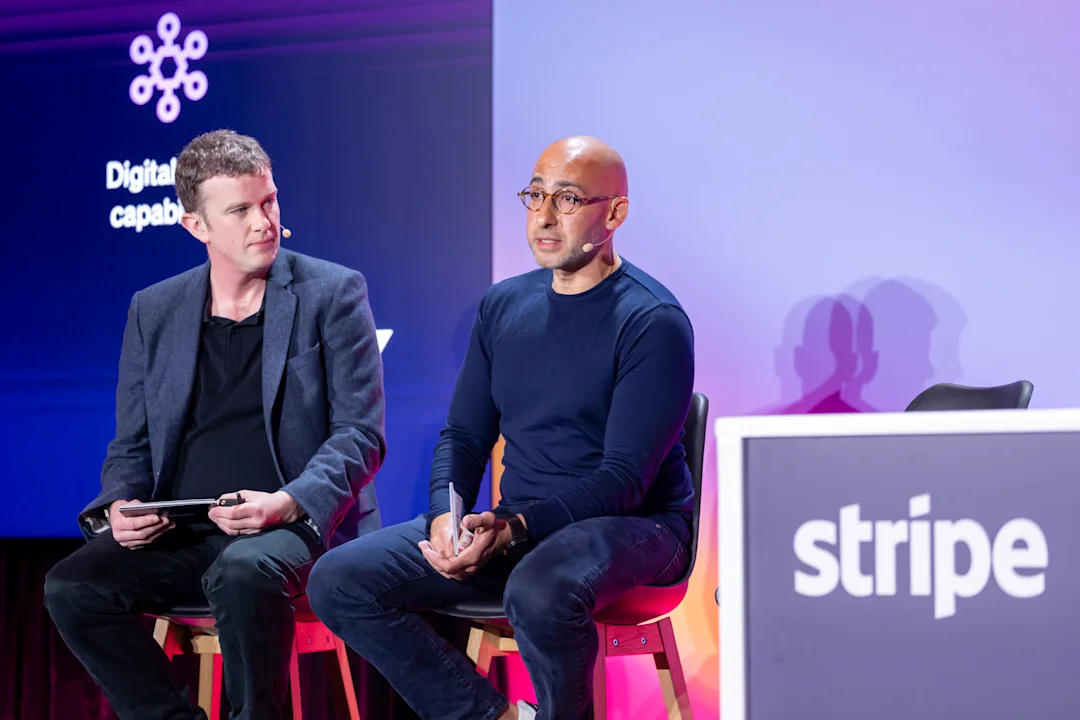
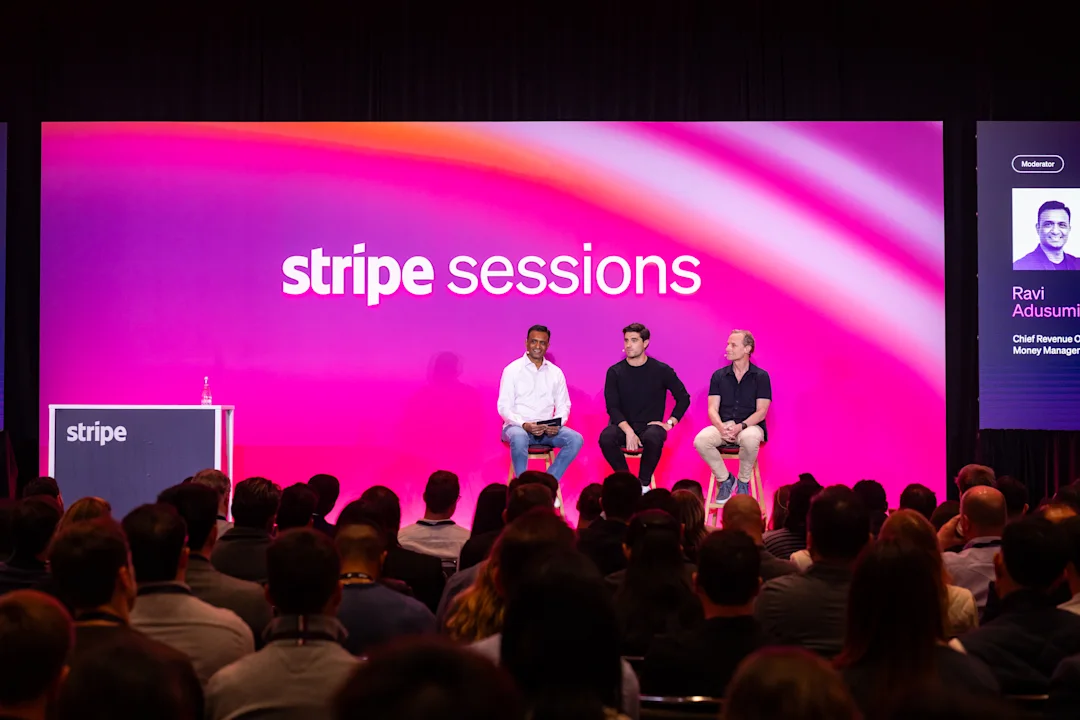
Cross-border payments and banking often require trade-offs: speed or cost, reach or reliability. Learn how fintech companies are combining Stripe’s fiat infrastructure with the speed and efficiency of stablecoins to reach users in more markets, move money faster across borders, and optimize yield and foreign exchange, often powering these gains with their own custom stablecoin.
Speakers
Manuel Godoy, Cofounder and CEO, Félix
Nader Souri, Managing Director, Head of Digital and Corporate Banking, BNY
Fergal Madigan, Global GTM Head of Financial Services and Insurance, Stripe
FERGAL MADIGAN: Hi, everyone. Thank you for joining us here this morning. Now, as you’re all aware, the reason that we’re here is we’re at a critical inflection point for the financial services industry. There’s a lot of risk in this moment as these two worlds, the fiat world and the stablecoin world come together, but there’s also tremendous opportunity. And as our guests will be sharing later today, enormous first mover advantage. But let’s get started by what we mean by both rails. My dad always said that jargon is a conspiracy against the layperson, and fiat rails in particular is an almost ridiculous term to describe something that is commonplace in every day. These are just the tools and technologies that we all use to manage and store money. These are credit cards, bank payments, and paper checks. And also networks that might be familiar to a more technical audience like SWIFT, Fedwire, or SPEI.
Now these fiat rails are powerful. Firstly, they exist at a truly institutional scale. You think about the number of financial institutions connected to the SWIFT network or the number of merchants and consumers connected by Visa and Mastercard. You’re talking about an almost ubiquitous level of institutional scale. Second, fiat rails are reliable and resilient. They process tens of trillions of dollars annually with very few unplanned outages or gaps in service. And finally, fiat rails are compliant and secure. They exist under formal government regulation and often with formal government backstops. Equally importantly, they set clear, transparent, and consistent rules for managing financial crimes, risk, and reporting.
However, fiat rails are imperfect. Depending on where you are in the world or the time of day, you may be unable to access your funds. Fiat rails are slow to settle. Access to cash may be unavailable when banks are closed. They also evolved in a haphazard fashion over the course of many decades, and so fiat rails are fragmented. They’re inflexible. And because of the number of intermediaries, they could be really expensive. So fundamentally, as a consumer or a business, funds that are in the realest sense, your money, may be very expensive to access or may be unavailable due to bank closures.
In more recent times, stablecoins have emerged as an alternative rail. Stablecoins are not a replacement for, but a complement for fiat rails. They address some of the gaps in the fiat rail infrastructure. First, these stablecoins are globally available. You can access them anywhere in the world with a stablecoin wallet. Secondly, they’re accessible 24/7. They can operate flows when you’re awake or when you’re asleep. Finally, stablecoins are cost-effective. Because of the lack of networks costs and the absence of intermediation, you could process stablecoin transactions for a fraction of a penny, which has a really revolutionary impact on enterprises and new founders starting fintech businesses. Stablecoins are also programmable. You could set conditional rules as to when, where, and how to move your funds.
So with stablecoin rails, money moves when you need it to. You can send a transaction from anywhere in the world to anyone else in the world at an ultra-low cost. You may think of these as parallel worlds, but in fact, they are converging. With the best of both rails, you get the reliability and institutional trust of fiat with the institutional-level ubiquity. You also get the 24 hour/7 speed and programmable efficiency of stablecoins with that ultra-low cost profile. Now it’s worth pausing for a second and discussing a little bit about how we got here. I think the key moment for me was the 2008 financial crisis. That’s when we first saw the emergence of the consumer technology we now know as fintech. This was wave after wave of innovation from neobanks like Monzo, digital brokerages to Robinhood, and remittance providers like Zepz.
What these companies have in common is they took the reliability, scale, and protection of fiat infrastructure, but they built a new technology stack—making financial services more efficient, affordable, convenient, and transparent. It was around this time that I also started to read about Bitcoin, the ultimate origin story of crypto. In the early days, it was a bit of casino. Lots of fad-ish speculation, lots of meme coins, lots of… Does anybody remember the initial coin offerings? But since then, crypto’s really grown up and stablecoins have found utility far beyond speculation. These were initially a mechanism to allow traders to access much needed liquidity. However, since then, stablecoins have found mass market utility. First, by providing a secure hedge to the dollar, hedging against volatile local currencies. Second, by enabling 24/7 payments, and now extending global commerce to new consumers and merchants across the world.
A settlement rail like the Senegal to France rail, that previously took 10 days, makes commerce all but impossible between two countries that share a common diaspora. With stablecoin rails, those transactions can be done in seconds, unbottling global commerce.
We’re seeing three powerful growth themes emerge from innovators in this sector. The first is to globalize your business. Take Umba, a Kenyan bank that has a remittances business to the European and US markets. What Umba does is it accepts fiat remittances from the EU and from the United States, and uses Bridge’s orchestration platform to take the power of stablecoin rails to settle the transaction efficiently. However, in Kenya, the local population receives their funds in local currency, in fiat, thereby bringing the power of the traditional banking account and the traditional banking license to bear. Second big trend is to build choice and value for your customers. Phantom is a crypto wallet, which uses Visa cards to allow customers to gain utility from their crypto holdings in the fiat world. Doing this requires complex infrastructure that combines the Phantom crypto wallet, virtual accounts from Lead Bank, and the Visa onchain platform.
Finally, reduce risk and friction from your fund flow. If you take Robinhood, Robinhood uses Stripe and the Payments Foundation Model powered by AI to reduce fraudulent transactions and while increasing the maximum authorization rate that it can get—that way ensuring fast, easy liquidity into the brokerage account. Wealth managers like Robinhood can also use stablecoin rails to access 24/7 trading, being able to place and settle securities transactions on the weekend when such things were previously impossible. So what does good look like here and how do you get started? Because the thing I really want you to all take away from this presentation today is: now is the time to build. And what we want to do now is to hear from two guests who are in the midst of building their best-of-both-rails business. Firstly, Nader, head of corporate banking for BNY.
BNY was formed a mere 226 years before Stripe. I haven’t quite figured out how many days that is before the singularity, but we’ll get back to you next week. BNY, like Stripe, also had brainy founders, and you can ask Nader about which Broadway musical I’m referring to after the presentation today. But from day one, BNY’s mission has been the same: to protect its clients’ assets and to manage their funds as efficiently as possible. They’ve been through waves of change and innovation—from the digital economy where they’ve built one of the best institutional grade API platforms, and now into the onchain world where they first served the crypto economy, and now we’re helping TradFi companies become DeFi companies. Let’s welcome Nader.
NADER SOURI: Thanks, Fergal.
FERGAL MADIGAN: So, Nader, BNY has a 240-year history of institutional trust.
NADER SOURI: I think we’re actually 241.
FERGAL MADIGAN: 241.
NADER SOURI: I think you missed a year.
FERGAL MADIGAN: Apologies. We’ll update the key cards for next time. Why does a bank like yours partner with the fintech economy, and how do you enable corporates and fintechs to enable, move, and store funds?
NADER SOURI: Yeah. Well, it’s a pleasure to be with you all today. So listen, if you really think about it, we’re a pretty unique company in many ways. We’re the world’s largest custodian. We have 60 trillion of assets under custody. We’re a big investment manager, but we also have a big payments business. And we do this for the service of institutions worldwide. So whether they’re corporates, endowments, foundations, pension funds, the largest banks in the world as well, like we count them as our clients. We don’t focus on the retail side of things. So there’s like a natural partnership element with fintechs and other companies that are servicing individuals, because there’s a strategic alignment there. We’re not going after that business. We are really an infrastructure, capital markets infrastructure provider.
So when it comes to stablecoins, and generally like digital assets at large, I think it’s worthwhile noting we’ve been involved for seven years in providing services to stablecoin companies, which actually is a pretty long time in the grand scheme of things. And it’s really because of the core services that we provide. They are in demand, and we are in service of our clients. So seven years ago, it wasn’t really mainstream or in vogue to service stablecoin issuers, but we did find a particular path around the usage of our custody services, our payment services, and beyond that really provides that institutional scale and trust as that foundational layer for which they can build upon. And so that’s a really key part of why we got involved.
FERGAL MADIGAN: Great. And we were sitting at the table last night with the former Speaker of the House, Patrick McHenry, who talked about the need to not over-rotate to the regulatory environment of today. So if you were advising a founder building a global payout platform, how would you advise them to manage their entire lifecycle, from issuance to operations, whilst making sure that they have the agility to comply with the regulatory landscape however it evolves?
NADER SOURI: Yeah. Yeah. And by the way, like seven years ago, it was, as you guys all know, the regulatory environment was ambiguous at best. And so that may also end up being the case in the future. What you have to do, number one, is figure out, number one: do you have a use case? Are you just issuing a stablecoin just to issue a stablecoin? Because I guarantee you there’s a lot of that going on. But if you actually have a use case, if you have a network effect, and if you have the ability to have stablecoins and payments as a core part of your business model, then you should partner with folks that have that regulatory scale, reliability, and trust. And I think that’s the key part. There’s sort of like three different buckets to make this work if you’re a founder and you’re thinking about, “Who do I partner with?”
So number one, you need someone, and maybe it’s you, who has the distribution and the network effect for this product. Number two, you need someone, and it may also be you, that is really the orchestration layer, the tokenization technology provider. And then number three, you need a very well-trusted financial institution. There’s like a really good saying—I won’t tell you who said it—but it’s like, “Crypto need banks more than banks need crypto.” And like, listen, I think the truth is somewhere in the middle there, but the reality is, that is the foundational layer. And when you have a trusted and scalable and provider that the regulators know, it makes things easier.
FERGAL MADIGAN: Yeah. I mean, it’s the most common question that I get is, “Are you building a parallel ecosystem here?” And it’s clearly just not the case that you need to choose between one or the other. The key message should be: “How does your user want to move, store, and manage their money, and how do you enable them to do that?” And so with that matter, we often hear that the biggest hurdle for fintechs is managing that. We’ve talked a lot about how the two worlds converge, but managing that gap where things fragment between the crypto and onchain world. How does BNY help fintechs build a unified stack that allows for that fiat crypto interoperability?
NADER SOURI: Yeah. Listen, the reality is that stablecoins, crypto, onchain activities, and the fiat world do operate in parallel worlds. They do not interoperate today. Now you need one for the other for the most part, but what we’re really focused on is as follows. Let’s say you have a deposit at a bank, maybe it’s BNY, maybe it’s somewhere else. It should be a pretty seamless experience to the end user to shift that deposit into, let’s say, a stablecoin, because you want to make a cross-border payment. And then let’s say you’re accepting a stablecoin, and you want to convert it into a money market fund to gather yield over a weekend. You should pretty easily do that into a tokenized money market fund. So that’s why we built, as the only global systemically important financial institution that has digital asset custody, because we want to effectively provide one experience to really collapse that divide.
It should be absolutely seamless, to a customer of a fintech, of what payment rail they need to use. It should be based upon, it should be dynamically routed to the right rail, fiat or otherwise, and it should be based upon cost, jurisdiction, and speed. Anything else is just us kind of getting way too technical. So at the end of the day, it’s the user experience, and behind the scenes, that’s how you interoperate between the different assets.
FERGAL MADIGAN: So obviously, a dollar is a dollar: it functions seamlessly with any other dollar and has the ultimate network effect in the global economy. We’ve started off with USDC and USDT. We’re starting to see a major proliferation of the brands. How do we manage this? Should a fintech issue its own coin? Should it use one of the existing high market cap coins? What are the right use cases for us to be focused on here?
NADER SOURI: Yeah. I mean, again, or should a bank issue its own, right?
FERGAL MADIGAN: Totally.
NADER SOURI: So we get that question a lot. Listen, I think it goes back to this. It’s just like any other business model, or like if you’re doing a strategy review of your business, it’s like if BNY started selling potatoes—we wouldn’t start selling potatoes. If you are a business where payments is a feature and not a core part of your strategy, sure, you can issue a stablecoin, but I would question what… It goes back to that original kind of metric. What’s the use case and what’s the actual network effect? Because ultimately, I think you’d be better served by utilizing a widely used stablecoin. However, if payments becomes a very core part of your business model, then there are advantages to issuing your own stablecoin. Number one, you generate the yield off of the reserves, so you’re kind of protecting your margins.
Number two, you’re reducing the amount of third parties involved, probably some banks as well. And so yeah, number three, you’re actually controlling the user experience. So that is definitely a choice.
FERGAL MADIGAN: I think the debate that we’re having right now about yield and rewards, or however you want to call it, is an important one, but it also risks taking us away from the actual utility of this rail and focusing on the efficiency gains and the speed gains and the access to liquidity gains that you get with or without the yield, I think. So Nader, it’s 2027. Europe has just retained the Ryder Cup. Where are we going to be in that 18-month time frame, and how do you see the best of both rails coming together?
NADER SOURI: Yeah. Well, I don’t know about the Ryder Cup. I’ll leave that to the side. But listen, I think it goes back to having one experience, multiple rails in the back. I love the examples that you put up of cross-border remittances, because those are very near and dear to my heart in terms of like family overseas—how do you send them money? It’s a pain. It’s an absolute pain. And if you can make that easy for people, or if you can extend a stable currency to folks living in places with unstable currencies, that is like a good, that’s a general good thing to do. But at the end of the day, the user experience, and I think the companies that will win the wallets and minds of their customers, it’ll be a seamless experience. You won’t even know whether you’re utilizing a stablecoin or not. So that’s ultimately, I think the best of both worlds means ultimately it’s one world and one experience.
FERGAL MADIGAN: Well, that was almost perfectly timed and a perfect way to end the discussion. Thanks, Nader. Thanks so much. I really appreciate having you with us.
NADER SOURI: Cheers.
FERGAL MADIGAN: I’d now like to welcome Manuel from Félix Pago. Félix was trying to solve the age-old problem with remittances, which is how do you get the distribution? And unlike, shall we say, traditional approaches, Manuel and team chose one of the highest distribution apps in Latin America, which is WhatsApp, using the power of WhatsApp’s distribution. They accept fiat pay-ins and use stablecoin settlement infrastructure to bring the best of both rails to life. Welcome, Manuel.
MANUEL GODOY: Thank you.
FERGAL MADIGAN: So Manuel, what was the problem you were trying to solve when you started Félix? Most remittances providers ask you to download a new app. You chose WhatsApp. Why and how’s it gone?
MANUEL GODOY: Definitely. And thank you for inviting me, by the way, to this panel. And it had a lot to do with what you guys were just discussing. I’ve been fortunate enough to live in many places around the world. I’m originally from Venezuela, but moved to the US 20 years ago, and then moved to Brazil, moved to Russia, spent a long time in the Middle East. Moving money globally has always been in a universal pain. But something that really kind of left a mark in me was when it was about 2018, I was living in Texas. My parents had also moved to the US. My mom calls me one day and she says, “Hey, we need to send money to your grandma,” who used to live in a rural town in Venezuela, and it was money for an emergency. And I was sure in my mind that her phone got misconfigured somehow, that I just needed to put the phone back in Spanish, so it could be easy for her, but it turned out that she was right.
It was super frustrating, one of the most frustrating experiences, because again, it was money for an emergency, and we couldn’t simply find a way to do it. And it had to do a lot with the situation in Venezuela at the time, the whole political situation, but we had to hack our way to send the money. We had to send a Zelle, somebody here in the US, a person would take the cash out in Venezuela, and drive it to my grandma.
And it stuck with me, right? But then sometime after that, I was in business school and literally sitting at a class and I saw a graph illustrating how remittances have been growing at exponential rate for the last 50 years or so. And the fact was our remittances to Latin America at the time, 80% of them were still originated in cash in stores. So imagine commuting to a store, 30 minutes, standing in line, paying outrageous fees, and then to then get the money back to your family. And that resonated, and I connected with my own personal story, because I started realizing that the problem is not just for Venezuela, right? It’s folks sending money to Mexico, why are not trusting digital apps? So that led us to go and literally stand outside Western Unions in Philly at the time and trying to talk to remittance senders, trying to convince them to talk to us to understand.
You can imagine us standing outside very suspiciously, “Hey, are you sending money to your grandma?” “Wait, what?” But we learned two key things. Number one, folks deeply trust that human experience of the store. And two, WhatsApp is already part of the process, because they would come out of the store, snap a picture of the receipt, and send it over WhatsApp. So after a lot of iteration and understanding, we said to ourselves, why not build the human experience on WhatsApp and emulate that, again, that experience, but also enable the communities of the digital payment. So that’s when we realized that our users are actually leapfrogging digital and going directly to conversational. And thankfully, that’s what led to what Félix is today, which is now 5% of the market share of Mexico, 3%, almost 3% of the market share of LATAM, and expanding into new corridors.
FERGAL MADIGAN: That’s amazing, Manuel. Why don’t we take a look at the product in action? You can see the screen down here that we can all see onstage, and I can just take us through it.
MANUEL GODOY: Yeah. So essentially, again, the user doesn’t have to download any apps. You just go to WhatsApp, and you just type “Hello.” Does it go? Yeah, there you go. So obviously, sorry for those that don’t understand Spanish, but this is just “Hello, Félix.” And there’s two cool things happening today on WhatsApp. So WhatsApp per se is allowing businesses like Félix to build these kind of intuitive interfaces with buttons and menus, but we also have an AI agent on the back that’s understanding what the user is saying. So in this case, for example, the user is saying, “I want to send 200 pesos.” And they can put it in dollars, they can send voice notes, and we want to understand what the user is saying. And again, we’re emulating the experience of the store, so we’re asking who they’re going to send to. We’re requesting the full name, that full name.
In this case, it’s my cofounder who always gets my money from these demos that I do. But the essence is that we’re running the compliance checks on the back, we’re running all these… We need to get all the information from the transaction just like it would happen in the store. And then at the end, we actually have to send the user outside WhatsApp, in a web app, to put their card, because inside WhatsApp, you cannot be PCI compliant, at least today. Hopefully, maybe Stripe can get something done at some point.
FERGAL MADIGAN: We’re on it.
MANUEL GODOY: Yeah, there you go. And boom, that’s it. And what’s cool is that once you pay, that’s what’s powered by Stripe, you get the receipt, right? And going back to the original story, this is what they share, and now we make it even easier to share that receipt to their family on WhatsApp.
FERGAL MADIGAN: Awesome. And how do stablecoins fit into the picture here? What’s the best of both rails in action for Félix?
MANUEL GODOY: Yeah. And it was clear to us that not only we had to build a very simple-to-use interface, but it also had to be at a decent price point, right, as cheap as possible. So again, being originally from Venezuela and having lived through a currency getting destroyed by central control, to me it was kind of almost obvious that crypto had to play a part in here, but we actually started looking at the data, right? So we started getting quotes from the traditional players, the traditional FX providers that would be on top of those fiat rails that we were showing, that by default—because they have all these complexities in their treasury operations—they passed down the cost to us.
So it didn’t make sense. We couldn’t price the product in a way that would make profits to Félix. So we started actually scraping trading data from the crypto exchanges here in the US and in Latin America—and all the crypto data, not just stablecoins, but also Bitcoin and Ethereum and the common tokens. I was starting realizing that the answer was pretty obvious. We could actually monetize, we could actually reduce the cost as much as possible, because a lot of the things that you said is global available, it’s programmable, it’s 24/7. But actually something that to me is more critical is that, we are trading the USDC in an open market, in an exchange, right? So we are skipping the intermediaries and going directly to buyers and sellers that want to trade. And eventually those costs, the costs that we’re having, are almost as close to the metal and to the interbank rates that are out there.
So it helps us reduce the cost as much as possible and pass the savings back to the user. But what’s also interesting, and you see in the interface, there’s no mention of stablecoin there, right? And it’s what you guys were discussing. It’s invisible to the user. I always say that it could be a donkey going through the border with the money. The user doesn’t care. What they care is that the money gets there as fast as possible.
FERGAL MADIGAN: So in about 30 to 40 seconds, Manuel, in terms of your product roadmap, in remittances, we’re often talking about adding value to the recipient. Where are you going with that concept, and what can we expect from Félix in the future?
MANUEL GODOY: Yeah. And obviously so far, we are serving the US sender. We want to maximize the optionality of the receivers. So we’re partnering with a lot of providers locally, so that they can get the money anywhere and maximize that amount. But we’re also enabling more services to the US sender, such as loans and savings. So again, so that the beneficiary can benefit from those services that the US sender can get here in the US.
FERGAL MADIGAN: Yeah. We’re unbelievably excited to see what we can build together with you and the Félix team. And thank you so much for joining us.
MANUEL GODOY: Thank you.
FERGAL MADIGAN: So just to sum up the common themes across those conversations, I mean, the number one thing is to choose the business that you want to be in. That’s the key to getting the best of both rails right. As Nader said earlier: “Don’t be in the business of selling potatoes.” However, financial firms have been in the business of selling financial potatoes for a long time. BNY has long since focused on providing asset safety and financial security to its clients. Félix focuses on solving the remittances problem, as you just heard so vividly from Manuel. Every company has an unfair advantage—use it. Second, use the right tools for the job. BNY invested in APIs. Félix understood how the power of WhatsApp to be able to handle the distribution question in remittances. Thirdly, own your customers’ needs and build with them. Whatever your version of hanging around the outskirts of a Western Union store, do that, and understand the pain points you’re solving for.
BNY has done a similar job in understanding how to bank crypto companies and take TradFi to DeFi. With that, I’d like to thank you all very much for joining us. It’s time to go build with the best of both rails. Thank you.