Text to Pay is a payment method in which a business sends a bill through a text message, and the customer pays with their mobile device. This technique simplifies the payment process by allowing customers to make payments through their phone without needing to log into a separate payment system.
The convenience and speed of Text to Pay make it a popular method for businesses and consumers: in a 2026 survey, 85.6% of customers reported signing up to receive text messages from businesses, indicating a potentially high level of acceptance for Text to Pay services among customers.
Text to Pay often uses a secure link within the text message that directs the customer to a payment interface where they can enter payment details, such as credit card information, to complete the transaction. The system benefits both businesses and customers by reducing the time spent on billing and payments.
Below, we'll cover how Text to Pay works, including which businesses can benefit the most from it, and the details of creating a Text to Pay strategy for your business. Here's what you should know.
What's in this article?
- How does Text to Pay work?
- What types of businesses use Text to Pay?
- Pros and cons of accepting Text to Pay for businesses
- How to create a Text to Pay strategy that fits your business needs
- What does Text to Pay cost to implement and use?
- Choosing between QR code payments and Text to Pay
- How Stripe Payments can help
How does Text to Pay work?
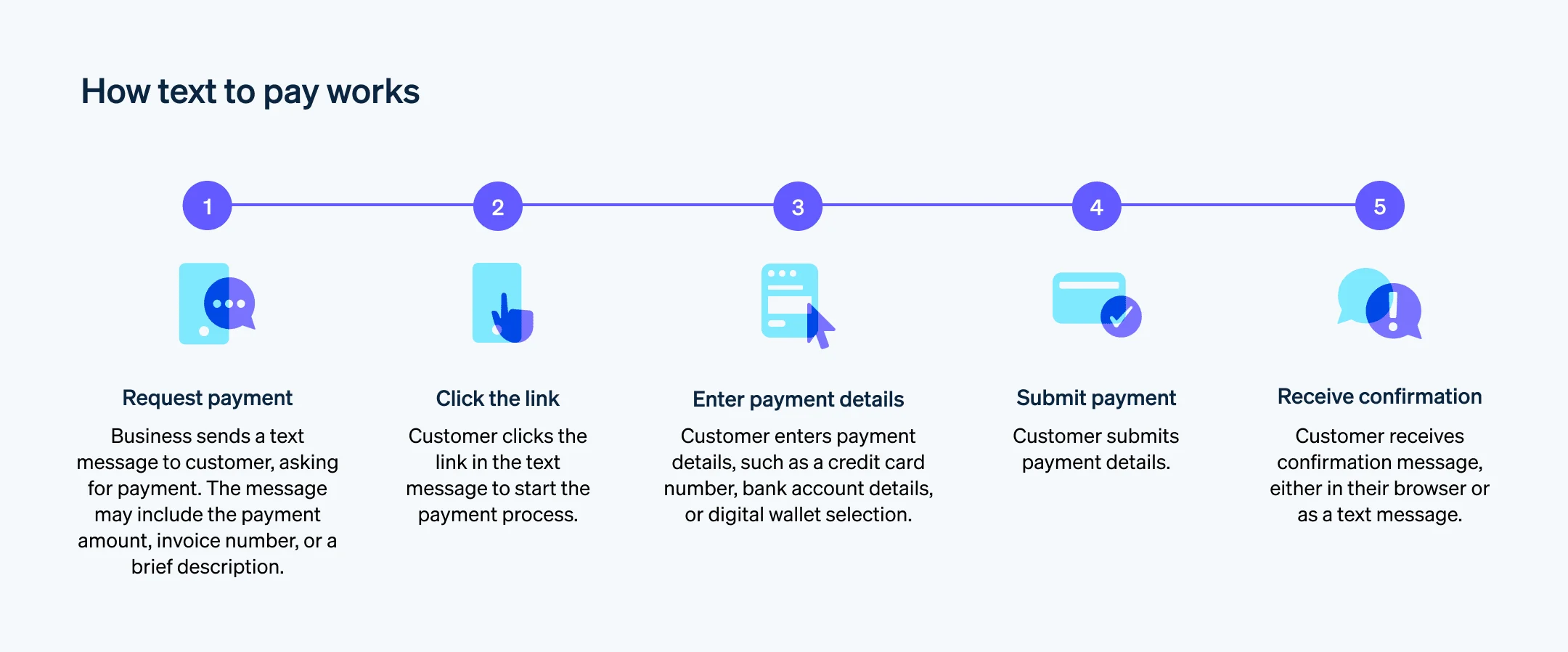
Text to Pay simplifies transactions by integrating the billing and payment process into a single, mobile-friendly platform. Here's how Text to Pay works:
Request payment via text: A business initiates the process by sending a text message to a customer’s mobile phone, which informs the customer that a payment is due. This concise message usually includes the payment amount and may also provide a brief description or invoice number for reference. The goal of the message is to provide enough detail about the purchase without overwhelming the customer with information. Businesses can also automate payment reminders via SMS to be delivered before the payment is due.
Direct customers to a secure payment link: The text message contains a link that the customer can click to start the payment process. This link directs the customer to a secure payment portal, which is often mobile-optimised for convenience. The link uses encryption and other security measures to protect the customer’s personal and financial information.
Collect payment information quickly and safely: The payment page prompts the customer to enter their payment details, such as credit card information, bank account details, or a digital wallet selection. The interface where the customer enters this information is designed to be simple and intuitive. Security protocols encrypt the data and safeguard against unauthorised access.
Confirm payment and send receipt: After the customer submits payment details, the transaction is processed immediately. The customer receives a confirmation message, both on the same payment page and also as a follow-up text message. This second text serves as a digital receipt, confirming the amount paid and to whom. The business gets a notification that the customer made a payment, which allows the business to update its records.
This process represents a shift towards more direct and instantaneous billing methods, and services that allow payment by SMS also reflect the mobile-centric habits of customers. Text to Pay makes it easier for customers to settle bills promptly, helping businesses improve their receivables and overall service.
What types of businesses use Text to Pay?
A range of businesses use Text to Pay. These include:
Utilities and service providers: Businesses that provide essential services such as water, electricity, and telecommunications often use Text to Pay for monthly billing. This method ensures the timely collection of payments and reduces the need for paper billing.
Healthcare facilities: Medical practices, clinics, and hospitals use Text to Pay to collect payments for services rendered. It’s a convenient way for healthcare patients to pay their bills without needing to call a provider or use paper mail.
Retail businesses: Retailers, especially those with online storefronts, sometimes use Text to Pay as an option for their customers to make quick and easy payments. These purchases are often linked with order confirmation texts.
Restaurants and food services: Some restaurants and food delivery services use Text to Pay to enable convenient contactless payment.
Transportation services: Taxi companies and rideshare services use Text to Pay to allow customers to pay for their rides with their mobile phones. Often, these businesses integrate this feature within their mobile application systems.
Insurance companies: Insurers use Text to Pay to collect premiums, allowing customers to maintain their policies without the traditional methods of making payments by phone or mail.
Property management firms: Residents can pay rent and other property-related fees through text, simplifying the process for both landlords and tenants and providing a digital trail of payments.
Government entities: Some government agencies have adopted Text to Pay for collecting fees and fines, providing a more modern payment solution.
These businesses and organisations benefit from Text to Pay through reduced administrative costs, faster payment cycles and a decrease in late or missed payments. The convenience of Text to Pay can also lead to higher customer satisfaction for customers with a mobile-focused lifestyle.
Pros and cons of accepting Text to Pay for businesses
When a business adopts Text to Pay, it places an emphasis on fast and simple transactions. SimpleTexting’s 2026 survey revealed that 74% of US consumers check their text notifications within five minutes of receiving a message. Offering customers Text to Pay acknowledges the importance customers place on instant, mobile-based transactions.
Using Text to Pay comes with many advantages and some challenges. Here’s a rundown of both:
|
Advantages of Text to Pay |
Disadvantages of Text to Pay |
|---|---|
|
Faster transactions: The immediacy of text messages can reduce the time between billing and payment to just moments. |
Reliance on technology: Text to Pay assumes customers have access to and are comfortable using mobile technology. |
|
Improved customer experience: Customers benefit from a one-tap, mobile-friendly payment option that fits seamlessly into their daily routines. |
Security requirements: Businesses must implement robust cybersecurity measures to protect sensitive financial data. Customer data privacy in SMS payment systems is a concern for many users. |
|
More prompt payments: Text notifications cut through digital noise, encouraging quicker responses and timely payments. |
Up-front infrastructure costs: Implementing and maintaining a reliable Text to Pay platform requires initial and ongoing investment. |
|
Operational cost savings: Digital payment collection reduces reliance on paper billing, postage, and manual processing. |
Risk of billing inaccuracies: Automated billing systems must be carefully configured to prevent errors that can damage trust. |
|
Simplified auditing: A digital transaction trail makes it easier to track, review, and audit payments in a centralised ledger. |
Regulatory complexity: Businesses must stay compliant with evolving financial and payment regulations. |
|
Greater accessibility: Text to Pay expands reach by engaging customers through a widely used communication channel. |
Customer adoption challenges: Some customers may prefer traditional payment methods or be hesitant to adopt digital payments. |
Incorporating Text to Pay is not just a functional upgrade—it’s a strategic choice that a business makes to engage with customers. However, businesses must implement this new payment method thoughtfully, and take into account the security and sophistication such a system demands.
How to create a Text to Pay strategy that fits your business needs
Creating a Text to Pay strategy that fits your business objectives involves a series of steps tailored to your operations and customer interactions. Here's a step-by-step guide:
Assess customer habits and define objectives: To determine how appropriate Text to Pay is for your business, examine the ways your customers currently pay and how open they are to new technology. Then, clearly determine what you want to achieve with Text to Pay, which could include faster payments, improved customer experience, or reduced administrative work.
Choose the right provider: Select a payment platform that provides Text to Pay and is a good fit for your business—both in size and volume of transactions. Scrutinise the payment provider’s security measures, reliability, and support services. Stripe, for example, makes it easy to send payment links via text.
Integrate with existing systems: Your Text to Pay solution should work with your current billing software, helping you manage payments and maintain records without the need for manual entry.
Set up infrastructure: Invest in the technology infrastructure that supports Text to Pay, such as secure internet connections and compliance with payment card industry standards.
Develop clear messaging: Craft messages that are direct and concise for your payment requests. They should include the amount due and simple instructions on how to pay.
Prep your team and system: Make sure your staff understands how Text to Pay works and that they can assist customers with enquiries. Before rolling the offering out widely, conduct a pilot test to work out any issues.
Launch and educate: Introduce Text to Pay to your customers, highlighting the ease and safety of the service. Provide guides or FAQs to educate customers on how to use the new payment method.
Monitor data and feedback: After implementation, monitor transaction volumes and collect customer feedback to see how the service is being received. Be prepared to tweak your strategy and make adjustments as you learn more about what works for your customers.
A well-thought-out Text to Pay strategy requires careful planning and a willingness to adjust when necessary. Successful implementation can lead to more timely payments and a better payment experience for customers.
What does Text to Pay cost to implement and use?
The costs to implement and operate a Text to Pay system can vary widely depending on several factors, including the size of your business, the volume of transactions and the specific service provider you choose.
Implementation costs
- Setup fees: Some providers charge an initial fee to set up the Text to Pay service, which can include integrating it with your existing billing systems.
- Technology investments: If your current systems aren’t capable of supporting Text to Pay, you may need to invest in upgrading your hardware or software.
- Compliance costs: To safely handle payment information, you might incur costs related to adhering to payment industry security standards.
Operational costs
- Transaction fees: Providers typically charge a fee per transaction. This can be a percentage of the transaction amount, a flat fee, or a combination of both.
- Monthly fees: There may be a recurring monthly fee for access to the Text to Pay platform, which can vary based on the level of service and features you choose.
- Maintenance fees: Ongoing maintenance and technical support to make the system run effectively can also add to the operating costs.
Additional costs
- Payment processing fees: These are fees charged by banks or credit card companies for processing the payments, which are separate from the transaction fees that your Text to Pay provider charges.
- Marketing costs: You may need to spend money on marketing campaigns to inform your customers about the new payment option.
Businesses that are deciding whether to implement Text to Pay need to consider these costs against expected benefits, such as faster payments and improved customer satisfaction. It's a good idea to compare prices and services from different providers to find a solution that offers the best value for your specific needs.
Choosing between QR code payments and Text to Pay
There are a few important distinctions to keep in mind when choosing between QR code payments and Text to Pay.
Here's what to consider:
|
QR code payments |
Text to Pay |
|---|---|
|
Requires customers to scan a QR code with their phone |
Sends a payment link directly to the customer via text |
|
Typically used in person or on printed materials |
Can be used remotely or in person |
|
Customer must open a camera or QR app |
Customer taps a link from their text messages |
|
Depends on physical placement or visibility of the QR code |
Does not require physical signage |
|
Best for point-of-sale or on-site transactions |
Best for invoices, follow-ups, and remote payments |
How Stripe Payments can help
Stripe Payments provides a unified, global payments solution that helps any business – from scaling startups to global enterprises – accept payments online, in person and around the world.
Stripe Payments can help you:
- Optimise your checkout experience: Create a frictionless customer experience and save thousands of engineering hours with prebuilt payment UIs, access to 125+ payment methods and Link, a wallet built by Stripe.
- Expand to new markets faster: Reach customers worldwide and reduce the complexity and cost of multicurrency management with cross-border payment options, available in 195 countries across 135+ currencies.
- Unify payments in person and online: Build a unified commerce experience across online and in-person channels to personalise interactions, reward loyalty and grow revenue.
- Improve payments performance: Increase revenue with a range of customisable, easy-to-configure payment tools, including no-code fraud protection and advanced capabilities to improve authorisation rates.
- Move faster with a flexible, reliable platform for growth: Build on a platform designed to scale with you, with 99.999% historical uptime and industry-leading reliability.
Learn more about how Stripe Payments can power your online and in-person payments or get started today.
The content in this article is for general information and education purposes only and should not be construed as legal or tax advice. Stripe does not warrant or guarantee the accuracy, completeness, adequacy, or currency of the information in the article. You should seek the advice of a competent lawyer or accountant licensed to practise in your jurisdiction for advice on your particular situation.