Preparing for agent-to-agent commerce
Charting the future of payments
Längd
Fyll i formulär för att titta på hela videon
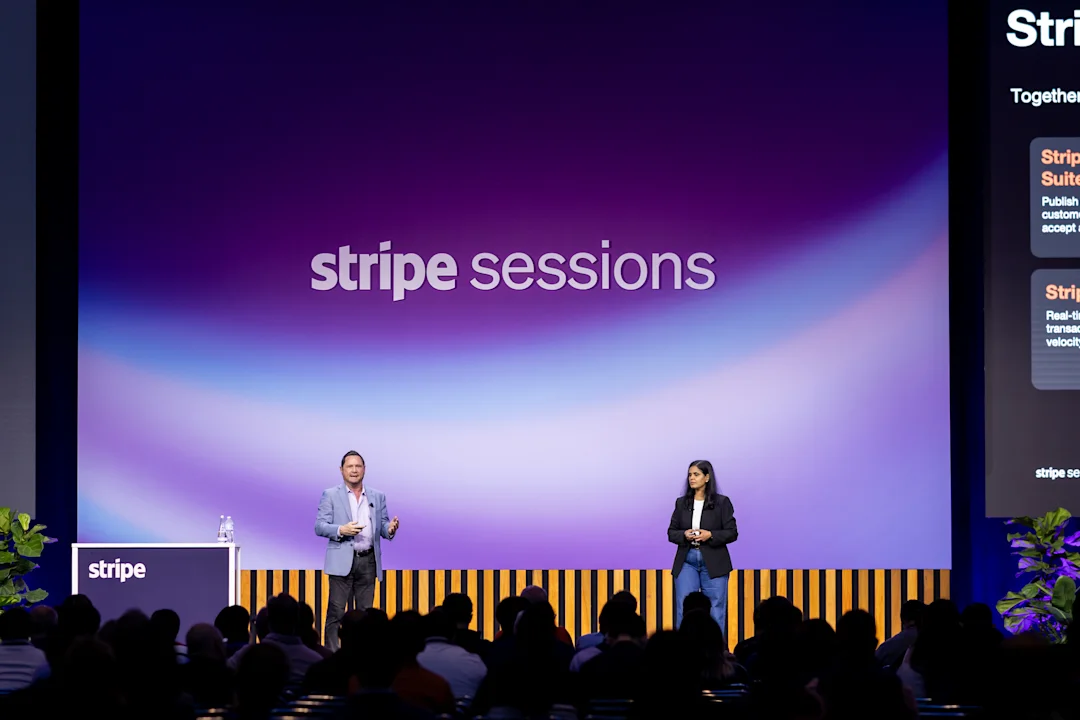
Today, agents help people shop. Soon, they’ll buy from other agents, negotiating, comparing, and completing purchases autonomously. See use cases emerging across industries and learn how to ready your business for agent-driven commerce.
Speakers
Kalyani Koppisetti, Principal Partner Solution Architect, AWS
Danny Smith, Solutions Architect Global Lead, Agentic Commerce, Stripe
KALYANI KOPPISETTI: How is everybody doing?
DANNY SMITH: All right.
KALYANI KOPPISETTI: Really? That’s not good. Let’s ask that question again. How is everybody doing? Yeah. It’s a thousand-people room. We need to make it look like thousand-people room, so let’s get the energy out. I’m Kalyani and this is Danny. We’ll get to us a little bit in a minute, but it’s all about you guys. How many of you have used an AI agent to do anything in the last one week? Please raise your hands. And those of you who haven’t raised your hands, I know you have used it.
So how about, have you thought of anything in the last one week or last one month or one year—is there a task that you said, “I wish something, somebody can automate it end to end, that I don’t have to do this anymore?” Please raise your hands if you have at least one or two tasks that you want end to end. Okay. That’s fair, good enough. Now let me ask you one more question. I promise this is the last question. Maybe I’m lying. But what if that agent needed to pay to complete your task? Would you let that agent do that? Okay.
DANNY SMITH: Please say yes.
KALYANI KOPPISETTI: Yeah. No, but I think that’s what we are here to talk about, right? How do you go from using the agent to do productivity tasks to using and pushing the boundaries on it? We have all the tools and everything else. We’ve been hearing about it in the last couple of days, but how do we go from using the agent to write your emails to actually buying something for you? And last question: how many of you work for a company or know of a company which will accept a buyer agent? Is there anybody who’s working at—oh, wow. You guys are full friend. Awesome. So, we are here to talk about that.
And just to give where we are in the agentic commerce space, payment industry has been building for agents because technology has advanced to that stage where agents can have wallets. 12 months ago, this space had nothing. They were just starting to talk about standards. Now we have more than 10 standards. We have agents who can have wallets, and agents can now complete purchases without a human click. What I mean by that is not that human is not involved, or we are not involved—humans sounds very distant—we are not involved. It’s just that we tell the agent the policy, we set the governing rules, and then we don’t have to put in our credit card information and everything else into a checkout form. The agent can take care of that for ourselves. And that’s where we are now. 12 months ago, every transaction had to go through a checkout flow. And this is, again, 12 months ago, there were a lot of prototypes, but now we have actually production. I know there’s 100 million agent transactions reported according to the sources. And yesterday, if you heard the keynote, there were so many features that Stripe launched that help agents have a wallet, have a rules, and you as a businesses have bot protection as well. So to be able to recognize when there’s a bot abuse. So there’s a lot of things that are happening today. So we’re going to talk about it.
So, I’m Kalyani Koppisetti. I’m a partner solutions architect at AWS. I’ve been in the financial services industry for 25-plus years, and my recent focus has been payments and agentic commerce, and I’m here with Danny. So, Danny, take it away and get us started.
DANNY SMITH: Everybody, my name is Danny Smith. I am the agentic commerce solution architect lead at Stripe. I apologize in advance for my voice. It’s just due to all the many exciting conversations I’ve had all week with users, partners, people in training. So I’m going to push through, but very happy to get us rolling. So there is an ecommerce paradox. You probably heard this a few times this week. Most websites are built and optimized for humans. And if you look at the story of this bot right here, actually, I feel like this bot is, he’s hit a brick wall like my voice has hit a brick wall. What is that brick wall? There’s a file called robots.txt. Show of hands. And I couldn’t let you use all the questions. So, show of hands, who’s heard of robots.txt? Looks like about half. Okay. So basically, there’s this paradigm in agentic commerce where your high-intent, agentic buyer and agent may actually be blocked at the front door or hit a brick wall due to how you have your tech stack configured, how you have your website configured.
So this is the paradox. We don’t want to turn away these high-intent buyers, but we also want to make a safe and secure experience. So this bot and this example is going to get turned away, and it’s going to go on to the next website. It doesn’t call customer support. It doesn’t fill out forms. It just moves on to the next. So this is a high-intent buyer that we actually care about in agentic commerce, and we want to basically facilitate that buyer as we move forward.
So what we’re going to do is show you a prototype. Okay? This is not a production. This is showing the flow. This is an accurate flow of where we’re moving in the industry. So I have a buyer’s agent. I’m giving it a task. And this task is basically, “Generate an image for a sneaker marketing launch campaign,” and I’m going to give it the astronomical budget of $2 to accomplish this task. Now, that’s a lot of money in microtransactions. This is living large, two whole dollars. We’re going to go forward, and we’re going to contact three websites, and we’re going to move forward and basically say, “Go build this image for me as part of this campaign.” So seller one rejected. Actually, the seller had no visibility to this transaction even happening. It doesn’t even know that a buyer was at the front door. It was immediately rejected. And we’re going to talk about why in a second. Seller two, a little bit better. It read the manifest. It got to the product catalog. It got to a point where it was trying to complete an actual transaction. The payment rails were not in place. And seller two came back to this buyer agent and said, “Hey, sign up for an account.” When an agent tells another agent to sign up for an account, it’s not going to happen. So it’s going to move on.
Seller three, the entire experience was automated by a seller’s agent. So step one, it found the website. It got through the brick wall. Step two, it found a manifest, and we’re going to walk through exactly how this happens. A manifest is telling this agent, “Here’s how you transact.” Step three, the payment rails were in place. So this was actually a good experience and end-to-end experience. The transaction actually happened, and we got it done in three seconds for 12¢. So way under budget, everyone’s happy. So again, it’s one product that we’re trying to find, three different sellers. Two sellers had no visibility to this even being an enabled buyer. The third seller was able to get that visibility, actually transact, paying customer, everyone’s happy. So we’re going to walk through, kind of in detail, how we can get to that third seller modality to make sure that agent-to-agent commerce becomes a reality as we move forward.
So we want to focus first on the buyer’s agent. So Kalyani, give us more background on the buyer’s agent.
KALYANI KOPPISETTI: Yeah. So as most of you didn’t raise your hands because you didn’t want to give a buyer agent your credit card, I assure you, there’s agent wallets that you can give them with $2 budget. And here’s what happened behind. Again, here we are showing the logs, because this is important piece that we all need to understand is, when we give an agent a task to do, we need to know what the agent did with that task. We need to make sure that the agent understood the intent. As you can see here, everything that the buyer agent did is logged into logs. That is where you can have observability on it. You can evaluate it and make sure the buyer agent is doing exactly what they are doing. When I talk about a buyer agent, this buyer agent doesn’t necessarily have to be created by your consumers. It can be an agent that you expose on your merchant website, too.
So, don’t think of the buyer agent as something that the consumers have to worry about. This is something that you can expose as well. So in this particular case, it is logging all of the things that Danny said about discovering those three providers in parallel. And then when robots.txt didn’t allow it to go further in for seller one, it didn’t. For seller two, it got it. Then it looked at the manifestation file, it looked at the capabilities, the capabilities matched the task, tried to execute the API, and it got rejected because of the 403 that we talked about. But the seller three was able to capture that. So if I want to visualize this in a more picturesque way, I mean, again, this is the main components that any buyer agent should have. It should understand what the consumer intent was. It should discover what services that it can use to fulfill the task that we have given it.
And it does that using the manifest file that I talked about. And I just gave you a high… The manifest file talks about, who is this, who’s the seller, and where to send the request, how much it costs. Basically, it gives all of the information for the seller agent to able to act on it. And then it enforces the policy. So when the seller agent says, “Hey, it could cost me 12¢ or $2.” It knows how much we told it that it can spend. If it is 12¢, it’s under the budget. So it can actually go ahead and do it. If it is about $2 that Danny said, it would come back to Danny and say, “Hey, Danny, I’m not able to fulfill your task, but I can do it for $2.5 cents. Are you okay with it?” And as soon as Danny says, “Approved,” it’ll go and execute on that.
So that’s the enforcement button over there. And then eventually, being able to pay with the wallet and then finally confirming the order back, confirming that the task is completed. So these are the main things I know: autonomously act on your user’s behalf, raise it to consumers if there is an escalation that is needed, and audit. Have everything that the buyer agent does in auditable file. So this is how a buyer agent works, but we need to look at it from a seller perspective as well, because if the buyer agent is coming to merchants, if the merchants are still using APIs or your products is not ready to be accessed by a agent, then you still are not going to capture the sale. So, Danny, can you walk us through the seller agents?
DANNY SMITH: Yeah. Let’s kind of recap what happened during that prototypical demo. So seller one, what do the seller server logs look like? They’re blank, because I got blocked at the front door. So again, no visibility at all to this being a buyer. Seller two, a little bit better, right? We’re visible. We got API access to the product catalog. We found a manifest. The payment rails just aren’t configured. So you can see in detail in the logs that, hey, sign up for an account. As I said earlier, agent to agent, an agent’s not going to sign up to your account. It’s going to go on to seller three. So seller three, sale actually captured. Website discovered, manifest found, API catalog access granted. We’re well within our policy to make this transaction. The seller agent is actually doing some things that are pretty new. It’s a new paradigm that we’re talking about.
We’re checking things like, is this an approved transaction? Is this an approved catalog item? Photography is an approved method that we’re going to implement via this API. Do we have inventory? Are we protecting our margin? There’s a lot of things that we’re going to talk about, but basically in this scenario, the seller agent met all the criteria, especially having the payment rail in place, and that was a successful transaction. So, what does a seller agent actually look like? How does it work? It’s got a lot of responsibility. And this is, again, a new paradigm. There were some people that raised their hands earlier that I think have started to implement this as a concept. And we’ve talked a lot this week about agent to agent with machine payments that Stripe has released, and that’s a protocol that allows this to happen. But you do have to have some logic in place as you’re going to scale this to the enterprise.
As you start moving away from microtransactions to real physical goods that have real value and a lot of monies exchanging hands here, but even between agents. So this is a concept where you’ve got to, first of all, authenticate the agent that’s coming through the front door, make sure that published manifest exists. So that’s how website two and three, or seller two and three, were discovered in the demo that I showed. That manifest is crucial to that. You’ve got to be able to quote a dynamic price. Pricing can change on the fly, especially based on things like available inventory or how much volume you’re trying to purchase. That kind of goes into step four, which is negotiation. We have to enforce, basically, policies. So this was mentioned in the keynote earlier this week, but agentic commerce is powering a transaction that’s becoming less of a moment and more of a policy.
So as policies are in place, Kalyani talked about buyer’s agent policies. It’s important as a consumer that you’re protected. It’s important as a seller that you’ve got the same level of policy engine in place to protect things like your margin, your inventory. Make sure that all of these guardrails are in place as you move forward. So these are just eight different categories. The very key category is “collect.” So, collect, think of it as this: agents reason, but code actually pays. So the protocols are very, they’re very solid. We’ve talked about them a lot this week from Machine Payments Protocol. AI powers a lot of the reasoning, is powering most of the boxes that you see there. But when we move into a payment rail, this is something that AI steps out, and it just executes a call, and that code is actually making the payment.
So it’s a very key concept. And then we’re also worried about things like fraud, fraud prevention that we’re going to talk a little bit about how that’s powered by the combination of AWS and Stripe and our tech stack. But just to give you an overall concept of a seller’s agent, again, you’re protecting the seller the same way the policy engine is protecting the buyer. And these are the key steps that you have to take and the key parts of logic that you have to implement that have a truly successful seller agent that’s going to allow you to scale these microtransactions up to enterprise level.
KALYANI KOPPISETTI: So, I know Danny and I talked about the buyer agent, seller agent architecture. Again, those are sample architectures. Your agents could be a little bit more complex. We touched on negotiation, pricing. Let’s say you have an item for $12, and that’s a reasonable price for single item. But if I wanted to buy in bulk, if I’m going to buy 1,000 pieces of it, if I came to the store, or if I had a representative that I talked to, you will negotiate that price and give it to me for $8. But if that agent is sitting on your website and is able to do that with the buyer agent, then you can make sure that your margin is protected, but at the same time, quote a price that the buyer agent can actually take an action and buy it. So you are actually capturing that sale. So, talking about these things, the building blocks are ready, right?
You have AWS. AWS has several key functionalities, features, and products that can help you build and scale agents in however your business needs require. And Stripe is here to power the agentic payments. And then we also have our partners who can accelerate your journey. Again, there’s a lot of news coming out, and it’s overwhelming amount of information out there, and you’re always… The most question that we get is, how do we even get started? There’s so much noise or there’s so much information, we can’t keep up with it. So that is our job, our partner’s job. We keep ourselves informed on what’s happening in the industry and how to go about implementing some of these things, protecting you as a merchant, but also your consumers. So if you want to go from concept to production faster, we have partners for that. Again, we are just touching on three important things. We have… Come find us afterwards if you want to talk about any specific use cases.
So as Danny said, a new type of consumer is emerging, and for the first time in our history, we actually have agents surpass the traffic on websites than us, humans. And 51% number may not look like a big number, but the number next to it, if you look at it, that is 7,851% year-over-year growth in agentic AI traffic. So depending upon how your website or ecommerce site is set up, or how your infrastructure is set up, you may or may not be seeing this traffic. Just because your logs are not showing you agentic traffic, doesn’t mean the agent hasn’t tried to come to your website. It did; you were just not aware of it. So I won’t dwell more into the thing. So this is the reason why we are talking about it. We are still in the stage of innovation. It’s not like everything, all the tech stack is completely built and ready to jump on, but we need to go on this journey together because this is happening.
So this is my favorite slide in all of the slides that we have, because it’s all some of my problems. So, where we see traction. So Danny and I have been having a lot of conversations with customers, and where we are seeing a lot of adoption of agent-to-agent commerce is in the SaaS. I know you must have heard about all of these pay-as-you-go models coming up, API monetization, talk about API monetization, monetizing your data. Some of those things used to be Herculean tasks before, but now it’s much more easier. So you can capture the cash and carry type of a thing by automating, accepting payments using the protocols that Danny was talking about. Automated vendor evaluation, I don’t know, everybody needs a vendor software, a piece of software that you want to use within your infrastructure, but sometimes that evaluations take six months.
But if you have an agent that can evaluate two or three services at the same time in parallel and come back to a recommendation, then your time to market increases, right? So the sooner you can get to your consumers, the sooner you can capture that revenue. So we are seeing a lot of that. And then I also talked about dynamic pricing. So a lot of ecommerce websites have pricing that is available, but that pricing is sometimes based on the inventory and everything else. You have some discounts that you offer, some coupons that you offer, but there is no mechanism where you can adapt that pricing to the needs of the customer. If customer is trying to buy in bulk, as I said, you’re not able to do that. And now with agentic transformation that’s happening, you have all the tools to be able to do some of the dynamic pricing thing.
In the travel and hospitality field, I may or may not use—personally, I may or may not use a bot to book my travel, but I definitely could use a bot if it has any rebooking of flights necessary or hotels in seconds. Is there anybody in the audience whose travel was disrupted because of a snowstorm, a flight canceled?
I’m sure everybody. So in fact, I’ll tell you a story. A couple of months back, I was hosting a co-innovation work stream, and I was preparing for it. I live in New York, and it’s February, huge snowstorm, flight got canceled. So I had to go. As I’m preparing for my important session with my customer, I had to stop what I was doing, context switch to my travel agency, cancel my hotel because my flight was rebooked to a four days later, which I can’t go because that’s not useful for me anymore. So I had to go cancel my flight—cancel my flight, cancel my hotel, everything, come back and start working. But a part of me wanted to be there in person because this was an important innovation work stream that I was running. I wanted to be in person. Everybody else was going to be in person.
So like anybody else, me and my colleague, what we did, we kept looking at our travel site every few minutes to see if by any chance there is a seat that will open up. And it did. We were able to book, then we booked the hotel, and then we travel, and that session was successful. But I couldn’t have imagined making that session happen remotely. And that’s my personal experience. But throughout that journey, I was thinking, how I wish there was an agent that the travel agency could give us where it knows my policies, company’s policies, it knows where I’m traveling, it knows my constraints as to when I need to reach there. It would just book it, so that I don’t have to do context switching. As it is, we are distracted with so many things that are happening. This is one more thing that was added to my list. So I wish… So that’s why travel and hospitality disruption recovery, I would love for anybody to please build that agent. I would use it.
And sometimes it’s a multiparty trip planning, right? And if I have a large number of family members traveling from one location to another location, I wish I don’t have to call an agent and talk to them and negotiate the price. I wish there was an easier way to do some of those things. So we see some of this. So we see some use cases in that travel and hospitality industry, that where we can see it. Retail and ecommerce, and all industries have some B2B use cases or not. Again, I won’t go into each of these use cases. These are just representatives. There’s many, many, many more use cases where this could be useful. So moving along, if you want to build any of those use cases, AWS AI portfolio, I just wanted to show it over here, the entire tech stack of point in time, because AWS is constantly releasing new features, new capabilities based on your feedback.
So this is what we currently have. I may, again, things may have changed from the time I’ve prepared this slide to presenting this slide, too. So AWS has all the AI portfolio that you need to build and run the agents at scale, but then, Danny, can you walk us through what Stripe has?
DANNY SMITH: Yeah, absolutely. So kind of to recap exactly what Kalyani just said, AWS has the power to build the agents on both sides of that equation. Stripe is that layer of payments and that layer of trust that helps make this agent-to-agent transaction an actual reality. So, what have we launched together with AWS? So Stripe’s powered by AWS. We have a strong partnership with AWS, and our go-to-market strategy in agentic commerce has been, “Let’s provide as many turnkey value-added solutions to our customers as possible.” So one you’ve probably heard a lot about is Agentic Commerce Suite, which is our turnkey solution that allows you to sell your products in a one-to-many integration shape to many different AI companies and AI agents. So you’ve heard exciting news about the Meta launch, Gemini, many others are coming. So basically, you definitely want to start to participate as we move into the enterprise scale of integrating with Agentic Commerce Suite.
Stripe machine payments that powered a lot of the x402 money movement that we saw in the prototype? This is a live protocol today. There’s about 90 companies that have already launched. This is the ability to monetize your API layers and different things on the seller side with a Machine Payment Protocol to make that a very safe and secure experience. Shared Payment Tokens, this was an early mover in the agentic token space for Stripe. And think of it as context wrapping around a tokenized payment method, things like budgeted amount, fraud signals, built-in exploration. So this is what makes it a very safe experience for the consumer to make sure that when you’re checking out on like a ChatGPT or a Gemini, when you give it your credit card, and you’re going to buy a $5 item, the AI doesn’t hallucinate and try to buy a $5,000 item.
Even if it does try, it will fail because a Shared Payment Token is in place. Stripe Radar is that fraud protection layer that’s built into the Shared Payment Token functionality. This is powered by something called the Payments Foundation Model, which we co-developed and launched with AWS. So we’re very proud of that Payments Foundation Model. So Stripe Radar is powering the fraud prevention layer in agentic commerce today. Link’s wallet for agents is something that we launched this week as part of Sessions. If you’ve built your own general purpose agent using something like OpenClaw or anything else like that, you can actually install a skill called Link CLI that will allow your agent to go make purchases on the internet with those guardrails in place. So the guardrails are very important. And if it somehow goes outside of the guardrails, it will prompt you, so there’s human in the loop.
There’s a lot of really cool demos. I built a demo on Link wallet for agents at the Stripe agentic booth, so please come by. And finally, let’s not forget about MCP, the protocol from the past. Stripe can definitely allow you to monetize your MCP apps by using our MCP server and our MCP toolkit. So quickly quick, the roadmap, get visibility. Do not put that brick wall in front of your website so the agents get blocked at the front door. Second, monetize your… I’m sorry, modernize. See, Stripe, monetize, right? Modernize—
KALYANI KOPPISETTI: You should monetize, too.
DANNY SMITH: Your tech stack. Okay. Make sure that you’ve got things like an agent manifest. Make sure that you’ve got a programmable API-accessible catalog. You have to basically modernize. Leverage turnkey solutions like Agentic Commerce Suite and some of the other solutions we’ve discussed. Build focused agents. So you basically want to start small, build an agent that has smaller tasks, and then move in time into other use cases. Design for fraud and trust. Again, implementing things like Stripe Radar, Shared Payment Tokens, make it a very trustworthy experience. And finally, shape the standards. We want to hear from you as customers. These are your buyers. These are your customers at the end of the day. We’re all in between trying to make this a good experience, but we want you to help us shape the standards as we move forward.
KALYANI KOPPISETTI: Thank you all for joining us today.