Building trust in agent‑driven commerce
Charting the future of payments
Tiempo de ejecución
Completa el formulario para ver el vídeo
As agents move from discovery to decision‑making and execution, trust becomes the foundation of agent‑driven commerce. In this fireside conversation, Mastercard explores how financial ecosystems can enable secure, scalable agent payments without sacrificing choice, transparency, or control.
See how trust is established when a consumer delegates purchasing authority to an agent and get a clearer understanding of the trust infrastructure required for agentic commerce.
Speakers
Pablo Fourez, Chief Digital Officer, Mastercard
Sherri Haymond, EVP, Global Head of Digital Commercialization, Mastercard
Devang Kothari, CTO, Wizard
Jennifer Lee, Product, Agentic Commerce, Stripe
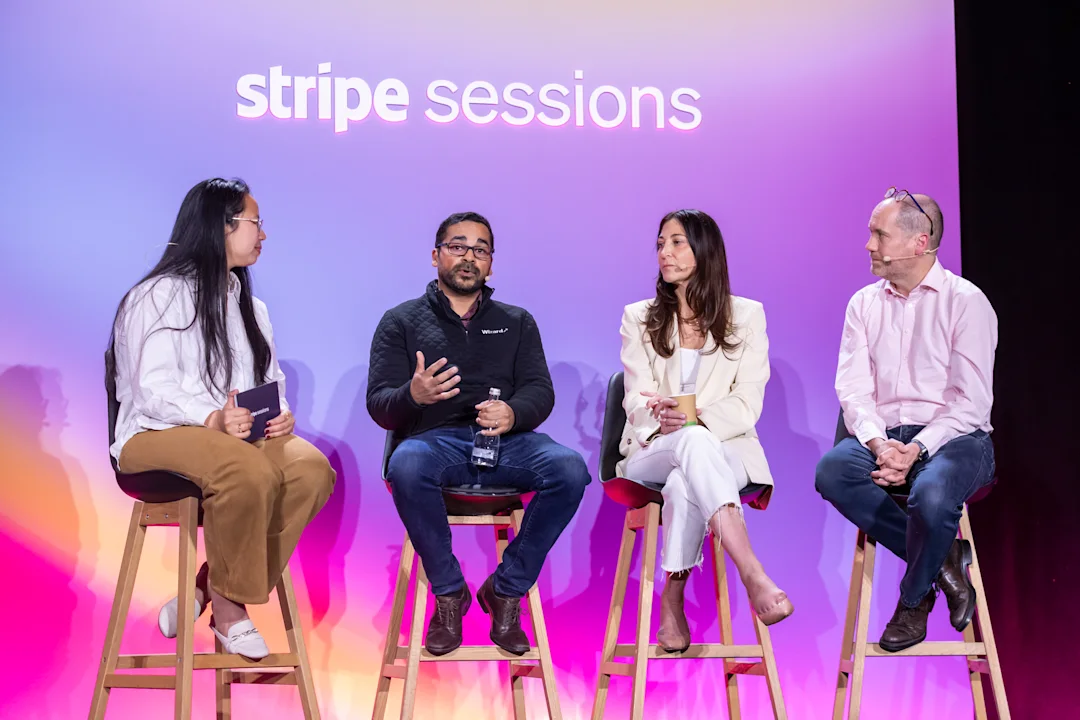
JENNIFER LEE: Hi, everyone. I feel like this is the hardest part, is getting on the stools. But yeah, please no accidents. We’re far from the ground. Hi, everyone. How’s everyone’s Sessions going? Good. Okay. Amazing. Wow. Packed room over here. Thank you for spending your time with us today. I know it is lunchtime, and we really appreciate you all for coming out. And we have a really, really great panel in store. But hi, everyone. My name is Jen Lee. I’m one of the product leads for our agentic commerce team here at Stripe. And today we have a great group of leaders here to chat with you all about agentic commerce. We have Pablo Fourez, who is the chief digital officer at Mastercard. And also from Mastercard, let’s welcome Sherri Haymond, who is the executive vice president of global digital commercialization. And finally, we have Devang Kothari, who is the chief technical officer at Wizard AI.
All right. So a little preamble for me before we get into the frameworks and trust infrastructure that we’re going to be talking about today. I actually want to ground this conversation in something new and concrete because earlier today, Mastercard, Stripe, and Wizard announced new work focused on enabling trusted agent-initiated payment flows. These payments are enabled by Shared Payment Tokens, which work natively with Mastercard’s Agent Pay tokens. And this is what makes today’s conversation actually quite timely.
So to kick things off, I want to start with a quick pulse check from each of you. When you look at the rise of agentic AI in commerce, particularly as agents begin to act with delegated authority in real payment flows, like moving real money around, what’s one shift you’re particularly focused on? And what do you think has changed in the past year that made this feel a little bit more real rather than something that’s purely theoretical?
PABLO FOUREZ: Start?
JENNIFER LEE: Yeah, Pablo, go for it.
PABLO FOUREZ: I mean, what we’ve been listening through the days here is it’s real because it’s out there, people are using it. And so it’s actually not just PowerPoint; is actually things that are happening. And so I think that’s a big, well, a change over the last year. I think another change, I think over the last year, is we had a lot of protocols over the last year. And I really see now this thing converging and some of the things that we heard over the last two days, last two weeks, I think very encouraging seeing, for example, adoption of UCP. Earlier this week, we actually, with Google, we contributed, they contributed AP2 to FIDO. We contributed verifiable credential—Verifiable Intent—to FIDO to create standards. So I think, as an industry, we are starting to converge on how to get things done in a practical way that can scale. And so I think that’s a change. Yeah. So what was the other question? What made it real? I don’t know what—
JENNIFER LEE: Yeah. And what do you think has changed… You mentioned protocols changing the past year. Sherri, it sounds like you want to chime in there as well.
SHERRI HAYMOND: Yeah. No, just building on what Pablo said. I mean, it’s actually happening. And at Mastercard, we went ahead and kind of early on, we, and we’re going to get into this a little bit later with trust, et cetera, that we had for many years been working on building a very scaled, ubiquitous world of tokens, tokenization. And we actually worked very closely with Stripe for many years to get this off the ground, from mobile commerce to ecommerce, cloud-based commerce, et cetera. It was obvious to us that we should then do this, agentic commerce with tokens, like build on that transparent, trusted, secure infrastructure. So this was obvious to us. We weren’t sure that it was going to be obvious to everybody else. So we went ahead, though, and we took the step and we enabled all of our issuers, and we didn’t know what was going to happen.
So initially, we went ahead and we were engaging with partners like you, you implemented the tokens. Obviously we’re live with a bunch of large LLMs that we talked about, that was talked about on stage yesterday, and now, with other shopping agents like Wizard, which is super exciting. But in addition, what’s also so cool is that issuers around the world at Mastercard are so excited to get testing and get going that there was like demand from my team to come up with like, “Oh, go find us. If I’m in the Philippines and I want to start going ahead and testing, what are we going to do?” So we actually set up, we went out and, for them, we sourced partners to go ahead and create little miniecosystems to get it started because there was so much demand for this, to participate in this kind of trusted way of implementing the technology. So for me, it was just really exciting. And the big shift was to see that it was just as obvious to the rest of the universe that it was to us.
JENNIFER LEE: Yeah, definitely. And Devang, from the agent side, what have you been seeing?
DEVANG KOTHARI: Yeah. So at Wizard, we’ve been building the first AI-native agent purpose-built for ecommerce. And so we’ve been thinking about this problem, trying to solve it for years. Only now, with the help of the ecosystem, Mastercard and Stripe, have we been able to deliver that query to checkout experience, which we think is essential for agentic commerce.
JENNIFER LEE: That’s awesome. I would say in the query to checkout experience—and this is where I want to get into the meat of what this panel is about. So AI agents like yours and many, many more, are starting to act on the behalf of users in actual real commerce flows. So why does trust become so critical at this moment? And isn’t just making maybe AI smarter the best way to solve it or, probably not, but let’s hear what you all think.
PABLO FOUREZ: Yeah. I mean, obviously the trust is so important, I would say. It’s important because now you have a new actor that is helping consumers, it’s helping merchants conduct commerce in a different way, but it poses a lot of questions. Particularly consumers will say, “Can I trust this? Are things going to go well? And if they don’t go well, what’s going to happen?” Right? And so that’s an element of bringing trust to consumers. And on the merchant side, likewise, you’re saying, “Okay, I’m shopping through this channel. How do I know that I can trust this new party? And how do I know that it has actually the authority to make the purchase on behalf of the shopper, of the consumer, of the cardholder? How do I know it’s not fraudulent? And then if something goes wrong, like for some reason, or is it a dispute or whatnot, like, how is it going to work, and who will have my back so that I can resolve whatever issues arise in a fair way and in a quick way?”
And so I think it’s less about—obviously the AI is super smart, but is the ecosystem that needs to adapt, to be able to support these new flows in an efficient way. And so that’s what we’re working to do is to get… It’s a big change, I think, for the payment systems to adapt to this new thing so that it does work very seamlessly and flawlessly. And a lot of the work that we have been doing over this year is concentrated on that, getting the base of how it works, that you can trust it basically, because it’s working fine and it can address not only when it goes well, but also the edge cases if it doesn’t go well, right?
JENNIFER LEE: Yeah. I think that makes sense. Actually, I think when I’ve been talking to merchants at Stripe, it’s been one of the top questions that I get. I feel like, I don’t know if folks here who are selling things and thinking about how agents would be purchasing them, I feel like one of the key things they want to figure out is, “Is it a good bot or a bad bot coming through?” Sherri or Devang, did you have a take on this as well?
SHERRI HAYMOND: Yeah. So well, on the good bot, bad bot thing, we’re actually, not planned, but we think that’s actually a huge… It’s a huge issue, and it’s a huge opportunity. And, of course, we are working with our merchant partners to provide those signals, as I know you are too. And you talked about that yesterday. So more of that to come, I think it’s actually a really big, important issue. So Pablo talked a bit about how the ecosystem is building trust and why it’s important for consumers and et cetera. I mean, another aspect of it is that consumers have to trust that the agent that they’re working with knows them, understands them, and is going to bring them value. And then, once they bring them that value, can facilitate a seamless, trusted experience, when it actually comes time to buy. So part of our partnership with Wizard is that we’ve introduced a capability called Insight Tokens.
So initially, it’s just the base case that we’re doing initially with Wizard. And these are geo-based insights, so ZIP+4 insights, similar insights that we’ve been using actually for ad targeting for many, many years, like out of our data and services business unit at Mastercard.
And these GeoInsights, what they do is they’re—in an aggregated and anonymized, privacy-safe way—they can help Wizard know that I live in Westport, Connecticut, in a certain part of Westport, Connecticut. And, in that part of Westport, Connecticut, it means that I’m more likely to want to shop at, let’s say, a boutique to buy the… Let’s say I’m looking for a T-shirt, a white T-shirt. The kind of white T-shirt that might be surfaced to me from the local boutiques that are near me might be quite different from what Wizard would surface for you, Jen, because you live here, and maybe you just like different kinds of T-shirts.
JENNIFER LEE: Yeah. And definitely different for Pablo.
SHERRI HAYMOND: And definitely different for Pablo. That’s right. And so because we’re working together with Wizard to enable relevant things that a user would then be like, “Oh, shopping with Wizard makes… Wizard understands me. And shopping with Wizard, even though I haven’t necessarily, through a chatbot interface, given Wizard every single detail about the things I’m worried about in the every day, or whatever anybody uses chatbots for…” We’re still able to… Together, we’re able to then deliver this really… An experience that doesn’t feel creepy, but at the same time is beneficial and delightful, and that also builds trust.
DEVANG KOTHARI: Yeah. I like to think of it as “frictionless personalization.” We can get a lot of signals about you even before you query to provide that level of trust that this agent knows what you’re looking for. And at Wizard, we’re really thinking about trust across the customer journey. How do we win consumers over to trust our agent to ultimately, one day, place a purchase on their behalf, right? So I think it starts with smart discovery, where we really understand the user’s complex queries, it’s no longer keyword search. Then it goes to the native checkout layer. We’re big believers that not only is discovery important, but you have to be able to place that order. And at Wizard, we’re working closely with Stripe. We’re going to be the first agent that supports the Universal Cart. So you can add multiple products across retailers. And then, finally, with personalization, if you trust that the agent knows you, only then are you going to trust them to make that purchasing decision with or without you. So that leads to that final stage of automation.
JENNIFER LEE: Yeah. Actually, that makes me think about how there’s a difference between delegating and automating, because we’ve automated checkout and commerce for years. What do you think is different when consumers delegate authority to an agent instead of just having them automate a task?
DEVANG KOTHARI: Sure. So I think it’s an interesting time because usually you’d be the human-in-the-loop, and you’d say, “Okay, I approve this transaction.” I think the future’s going to be very much policy-driven: this is the wiggle room, this is around the budget, but here are the exceptions. And I think that itself will grow over time. These are things that we’re starting to think about, but mainly I think agents are going to make commerce a lot more efficient. We’re big believers of that, of helping you find that product that meets your needs. And so, originally it’ll start with assistance, but ultimately it’ll start with more and more automation, and it’ll bring you into the loop for large purchase items and things that make sense. But long-term, it’s going to be saving all of us the six to eight hours a week that we waste doing the same thing. So I think that’s—really excited for that future.
SHERRI HAYMOND: I mean, we agree, and in order to make that possible, like what we did was take a step back, and Pablo’s going to explain a little bit more about this in detail, but we took a step back and we said, “We have billions of transactions in our network all the time, and people trust us a lot.” And so, there’s a real market shift when you’re delegating authority basically to a piece of software to act on your behalf. It’s very different than when you are going yourself to a website or an app reading all of the product description, reading the terms of sale, reading, for example, that maybe you’re buying something that’s final sale. You’re making that decision, you’re seeing it with your own eyes. So, there has to be some way to fill the gap that exists when you’re delegating that authority to a piece of software, which is where Pablo comes in.
PABLO FOUREZ: So I think, indeed, it’s different, because one thing is if it’s automation, it’s just very clear what it’s doing, right? And if I’m delegating, I’m giving some autonomy to the agent, and at the core, the question is, “Okay, but so the autonomy within what boundary?” What’s the… No, because I’m not going to just say, “Whatever.” I’m going to put a boundary around, some constraints around it. And then there needs to be a way to ensure that actually the agent stays within those boundaries on those constraints. And so that’s basically what it’s going to take for this promise of more autonomous AI shopping, I think, or commerce, to unfold is that we can effectively capture both the instruction that I’m giving the agent, the boundaries that I put around the autonomy that it has, and that can be verified. And so we put a lot of… This, everybody agrees, I think. It’s kind of obvious in a sense. And so the work that we have spent a lot of time on is to, okay, so how do you actually implement that in a way that is workable?
And so we developed this specification basically, ways of doing it and implementation for doing exactly that, which we call “Verifiable Intent.” And it capture actually, firstly, it captures it’s me that is actually authorizing the agent to do something. And so if it’s a fraudster that is doing it, you can make a difference, right? And then it captures what is it that I’m asking the agent to do and what boundaries, what constraints, I put in. And so for example, I would be able to say whether this final sale, whether I provided this or not, or whether at which merchant I want it to be shopped, or like it can be defined depending on the use case, and then it can be verified. And so I think that creates the basis for basically then innovating and coming up with what are the use cases that make sense for consumers.
And I do believe it’s a continuum, right? And starting with me being in the loop already provides me tremendous value to be able to discover things immediately and not have to go to the website, that’s super convenient, super valuable. But if I can actually do more than that, I think we’re… Yeah.
SHERRI HAYMOND: And at the end of the day, if something goes wrong, like a consumer wants to know or a small business wants to know that they can exercise their same rights and get the same consumer protections as they would if they were going to the website and reading those terms themselves. It’s this technology that Pablo just spoke about that then feeds into… It closes the loop. It closes that gap I mentioned before between you being there and you not being there. It feeds this data object into basically our chargeback system so that if something does go wrong—and only when, by the way, something goes wrong—the issuer would have access to this information to be able to see what happened and understand what authority you did. So that did give the merchants that we’re not enabling also a giant ecosystem of friendly fraud, which I actually call theft. Because that would obviously be the last thing that we want to enable.
And so, yes, for us, it seemed kind of obvious, but to actually put it together was, it’s not a simple task because it involves many parties and all of that stuff, and then it has to be implemented by the ecosystem. But that is kind of the glue that we think is going to really bring it all together.
JENNIFER LEE: Yeah, that makes sense. Actually, I have a follow-up question for you, Sherri, but first actually maybe a question for the audience and raise of hands. I’m curious, after hearing about all of this, or maybe before, let’s say you’re in the market for a white T-shirt, a raise of hands of who wants to be the one where you still have to click the button? And then who wants to just delegate that away? Let the agent click the button. Okay, interesting. That’s cool.
SHERRI HAYMOND: And who still wants to go to the store?
JENNIFER LEE: A little bit of both. Maybe I’ll have the agent checkout from the store.
SHERRI HAYMOND: Exactly. Well, no, but with Wizard, you can actually see examples of the store and then…
JENNIFER LEE: Exactly.
SHERRI HAYMOND: Yeah.
JENNIFER LEE: Well, I have to go there.
DEVANG KOTHARI: Yeah. I think it’s going to be a hybrid. I think, personally, I think every now and then I like to go to the store and feel the object that I might be buying or see what size it is. And so, I think it really depends on the use case, that white T-shirt, maybe I’m really into a style, and there’s some subjectivity to it, and maybe my agent over time will learn my style, but I think making everything more efficient, humans can then make those quick decisions. And so it’s fine if we’re still in the loop.
JENNIFER LEE: For sure. Especially when you’re talking earlier, saving that time, we’re so busy.
DEVANG KOTHARI: Yeah. That’s the unfun part of shopping. I think making the purchasing decision could be fun.
JENNIFER LEE: Yes. Keep the fun parts fun. Going back to the responsibility part, I think something that, when I hear merchants thinking about this space, they hear about the chargebacks, they hear about the friendly fraud, and they just want to be reassured and basically have an answer to: who is responsible for the trust in the agent-driven world? Obviously there’s platforms, there’s networks, there’s someone else, and there’s also your role that you were talking about earlier as well. How do you think about this space when no single company can, or maybe should, actually control the agent?
SHERRI HAYMOND: And I think that’s actually a lot part of the answer, that it’s everyone’s responsibility. In order for this whole thing to work, we all have to come together. I mean, this is a good example of some parties coming together, but there’s also issuers, there’s PSPs, there’s acquirers, there’s ecommerce platform providers. There’s so many different entities. There’s merchants that all come together and have to do their part. And we’re helping to do a lot of the work for these ecosystem participants, and so are you. So that, also, we talked about it earlier, Devang, that entities like Wizard can more easily take advantage of this kind of technology, but it really is everyone being aware that although we’re trying to make it easy and seamless, it definitely is a shift and a change that does involve people coming to the table and doing the work. So we do encourage anybody who’s a merchant in the room. You guys should be doing the work.
PABLO FOUREZ: Yeah. One thing I would say on this is, for this to work well, especially on the edge cases, this idea of how you share data related to the transaction is quite important. You gave the example of if the issuer needs to help the consumer resolve something, well, how do they do it if they don’t have access to this data? Same thing on the merchant side. If it’s interacting with an agent, it needs to be able to verify some data. And so sharing of the data across the ecosystem is one key element of this, but there’s a tension there because you want to do it in a way that is private, that the data is shared for a purpose, basically. And the purpose is to make sure that there is no mistakes or the merchant can validate the transaction. And so part of what we’ve done is to build privacy within the protocols to share this data.
And so there is this concept that we leverage that is called “selective disclosure.” And so basically all of this data is hashed, and so it’s meaningless, except for the parties that choose to selectively disclose it to each other so that, for example, a merchant can validate, “Oh yeah, this is an agent that has, a consumer authorized that agent to make that purchase. And I can validate that because I am the counterparty.” And if you have your multimerchant basket, well, it’s not going to share the data of one merchant with the other merchant because it’s built in a way that you don’t have to do that. And likewise, if there is a dispute that happens, hopefully very infrequently, but it’s only when it happens that then you can then leverage this data to resolve it. And so this idea of having privacy built in, I think it’s a very important aspect for all of us to bring scale and to scale this.
JENNIFER LEE: Yeah. I think that makes sense. And also, I like how you talk about the actual underlying infrastructure. So I’m curious, you mentioned some parts of the infrastructure that’s already in place, but where do you think concepts like Verifiable Intent fit? And then also, I think the spicy part of this is, where do you think they stop being enough?
PABLO FOUREZ: Where do they fit? I mean, I think what, as Sherri was saying, securing the transactions on our network, from our perspective, it’s a key obligation, I guess, that we have. It’s really something that I care personally about, making sure that every cardholder that’s using our cards can have trust and that things will work out, and then we’ll be able to support them if it doesn’t. And same thing on the merchant side, I think it’s our job to make sure that the merchant can trust this new way of interacting with users and this new channel and that they will get paid. And then, if there is an issue, that it will be resolved fairly and in a good way. And so the technologies that we bring is verifying the identity of the user. “Is it me?”
Making sure that the transaction is linked to my identity and we do that with tokens, and making transactions basically unique and they cannot be replayed, very difficult to do fraudulent transactions. And within that Verifiable Intent place, this role of providing, allowing the agent to prove to the merchant that they have this authority from the shopper—which is in our case, would be the cardholder, but this is an open standard that will support any different types of payment methods—and be able then to prove that they have this authority and that the merchant can trust this interaction and can start moving from a human-in-the-loop to a more autonomous type of purchase. And so I think it’s very core, and it’s very core also to the life cycle of what might happen in the… When all goes well, it’s fantastic, but I know I have experience, I guess, in my family, what happens when things don’t go very well, and then you have a real fraud that happens, and it is very unpleasant experience, and sometimes you don’t recover the money, and it can be devastating for people and for families. And what we’re trying to do is to protect against that. And these technologies, the consumers won’t have to know about it, but the fact that we are doing the work together so that that is something that we don’t need to think about. Yeah.
JENNIFER LEE: Yeah. I think that makes a lot of sense. And then we’re coming up on time here. So I have one final question for all of you. What do you think is the responsibility of leaders and builders in this room as agentic commerce evolves? And would love to maybe start with Devang and go through the row.
DEVANG KOTHARI: Yeah. I think you’ve heard trust is basically throughout. And I think what agentic commerce allows us to do is rethink the things that we learned from traditional ecommerce. It gives us that opportunity to bring it not only on the ecosystem level, which Stripe and Mastercard are really helping establish, but also the customer journey. How do we rethink trust to win the consumer’s trust to start basically solving shopping, which really excites me.
SHERRI HAYMOND: I think everyone also just needs to lean in and not wait. I mean, I gave the example earlier of, and actually I think it was either Will or, it was Will, I think, that mentioned it yesterday on stage: it’s okay that it’s not scaling wildfire yet on the big LLMs. We’re seeing so many examples of, well, number one, they’re all participating, but we’re seeing so many examples of shopping agents, merchant agents. There’s other things going on, and just don’t wait because these things tend to go like that. And if I’m an issuer, I’m also finding out what my consumers want. If I’m anyone in the ecosystem, I’m finding out what my customers and what end users want, and I’m going ahead and getting involved.
PABLO FOUREZ: Yeah. I would say the builder piece, I couldn’t agree more. So going doing the things, and if you have ideas or feedback or things that you want to see changed because you have a use case or you have something that you want to happen and somehow it’s not there, I think you can always engage. And we put, for example, this spec and et cetera on GitHub, we have contributed to FIDO. Anybody, it’s open there, you can go in there, and you can submit, you can actually build on it, you can develop, you can make contributions and enable those use cases that you want to do for your business. And we are there to support, basically, to support it from our perspective, but we can do it like it’s really done by the builders. Yes.
JENNIFER LEE: Yeah. That’s awesome. All right. Perfect timing. Thank you all for the time. And it sounds like we all just have to just get started. So hopefully you all enjoyed the session with us today, and thank you all for coming to our panel.
PABLO FOUREZ: Thank you.