The agentic front office: From funnel to growth engine
Charting the future of payments
ระยะเวลา
กรอกแบบฟอร์มเพื่อดูวิดีโอเวอร์ชันเต็ม
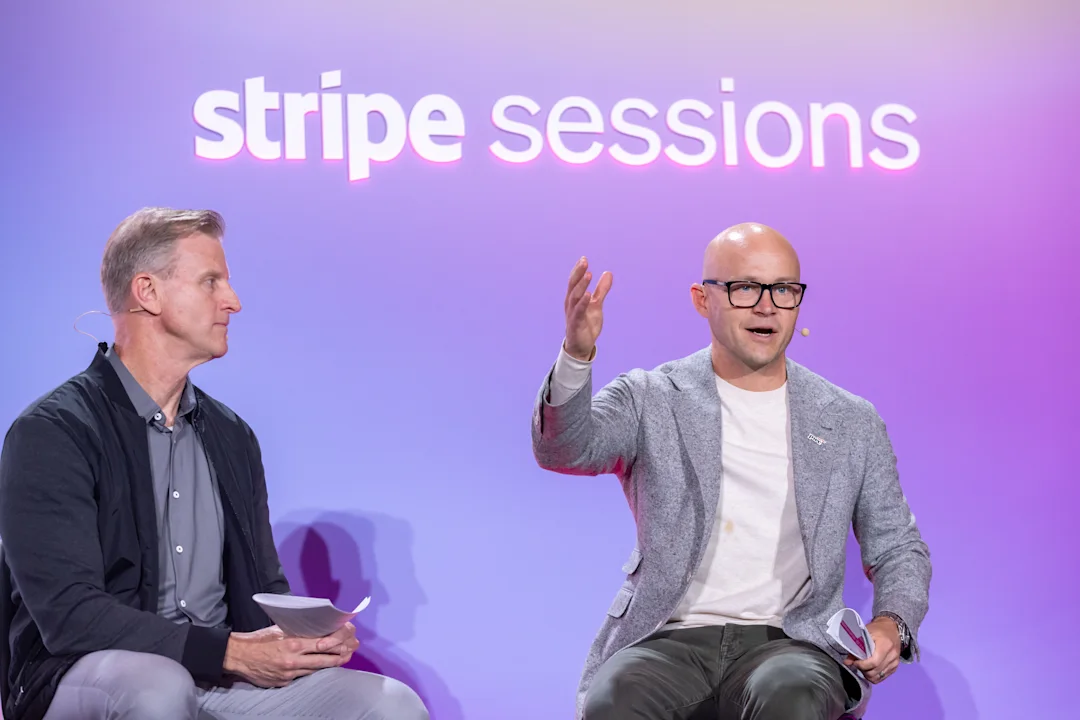
Marketing generates and converts demand. Sales closes it. Service helps customers. Those boundaries made sense when humans ran every step—but the division of labor is shifting. As front-office work becomes agent-driven, the handoffs leak revenue and the customer relationship gets harder to manage holistically. Join Ian Kahn, principal at PwC, and Tyler Bryson, CRO of the Americas at Stripe, to see what a unified, agent-powered front office looks like in practice. Agents handle repetitive work. Humans focus on judgment and relationships. Every interaction feeds a shared system that gets smarter over time. Get a framework for what needs to change in your go-to-market operations, and where to start.
Speakers
Ian Kahn, Partner, Commercial and Service Excellence Platform Leader, PwC
Tyler Bryson, Chief Revenue Officer, Americas, Stripe
TYLER BRYSON: Hello, hello. How is everybody? Good. Sessions Day 2, heading into post-lunch session or pre-lunch session. Hey everybody, my name is Tyler Bryson, and I lead revenue for Stripe here in the Americas. I’m also the leader for all of our product sales globally. And it’s just an honor to have you all here because hopefully we’re all going to have a chance to talk about this phenomenon that we’re all dealing with of the agentic front office, this way of rethinking the way we need to engage our users, our customers, to grow. And it’s something, of course, that’s a huge part of Stripe’s conversation internally every day. We support over five million businesses with many different needs. We’re seeing about $2 trillion of volume as you’ve heard throughout the economy, and we’re seeing incredible patterns. And we’re thinking every day, “How is our experience from that first time startup to the largest enterprise in the world?”
Ian, we were just talking about this. “And how do we use agentic technologies to improve the experiences of our users?” And that’s what we want to explore today. So to help me do that, I’m glad to, excited to, introduce you to Ian Kahn, a partner at PwC. He leads their commercial and service excellence practice, which is right at the forefront of the things that we’re talking about, making it real. So let’s welcome up Ian.
IAN KAHN: Thanks, Tyler. Great to be here.
TYLER BRYSON: So a great thing about PwC and working with Ian is not only are we working to tackle these problems together, we’re doing it in a partnership. And as you know, Stripe has many capabilities about enabling growth for our users, but we need help from partners like PwC to help take that from products and solutions to real transformation. And so that’s why we’re so glad to have you here, Ian.
IAN KAHN: It’s great to be here. We’re a bit of an odd couple though. We were talking about this. So Stripe is 15 years young, is that right?
TYLER BRYSON: 15. Yep.
IAN KAHN: And PwC is a 175-year-old partnership.
TYLER BRYSON: And changing fast every day.
IAN KAHN: I know. But I think we’ll get into this conversation. I was reflecting a little bit, just to go off script.
TYLER BRYSON: Yeah.
IAN KAHN: And it’s like a collision of multiple forces. You have innovators colliding with scale players, and there’s so much happening right now. And I think this whole conversation about the agentic front office is, going forward, like what wins? How do we need to adapt? What do we need to do to win in this new world?
TYLER BRYSON: In Stripe’s annual letter, you may have, if you’ve read it, there’s a section about what we call the “sorting machine.” And it’s this idea that this capitalist system is constantly sorting and choosing winners and losers. And one of the things, Ian, that we call out or we’re seeing as a pattern right now is that the sorting machine is working faster and faster, and there’s becoming this real bifurcation of winners and losers right now, where there are organizations that are winning, taking share, and others that are dormant and really struggling. So with that as a foundation, Ian, what’s happening? Why are we having this kind of shift, and who’s winning with profits and who isn’t?
IAN KAHN: Yeah. I mean, the shift has been unbelievable and been kind of talked about extensively in all of the sessions this week. And I think that the debate about the relevance and the strategic priority around the AI agenda has sort of been, to a large degree, it’s been settled for most organizations, but at the same time, the question is still outstanding around value capture, right? So today, our research suggests that while the vast majority of companies are prioritizing AI-powered transformation as a top three agenda, still, only 75% of the companies that we study are really not capturing any sort of meaningful ROI. And that’s sort of this value gap, that’s the disparity that jumps out from the Stripe research, the bifurcation, as you say. And I think there are a number of reasons for that. I might just sort of paint a quick concept for a second.
The title of the session is talking about agentic front office. I was at another session yesterday with your chief revenue officer for AI, Maia, and the CEO of Vercel, and they were kind of talking about the same thing. They were talking about this massive shift that’s happening in the market, traditional commercial models, sort of product-led growth to sales-led growth to agentic-led growth, and this shift is happening. And when we talk about agentic front office, one question I get sometimes is, “Well, what do you mean by ‘front office?’” And so this is not a universal term, but for us, “front office,” it’s the collection of functions that are designed to enable that end-to-end customer journey. And a lot of organizations today, it’s just very fragmented. And the “agentic front office” is what happens when you reimagine those customer facing functions, that customer journey, when you understand that your customers are now engaging with you in very different ways, using their own agents, and you have to evolve your model in order to meet them where they are and in order to unlock the growth opportunities.
I think the bifurcation reflects the fact that some companies are doing that very well right now, and they’re growing at a much higher pace. We see that in the Stripe data, the AI leaders are outgrowing everybody else. The other companies that haven’t gotten there yet, I think they’ve got a short window to catch up.
TYLER BRYSON: Great. Yeah. And if you were in John’s session on the economy and economic models, it’s clear that this diffusion is not going to take as long as the diffusion of electricity. It’s diffusing fast. We’ve got to be ready. And in most cases, you’ve tried to talk about this idea that it’s the operating model that deserves the AI, not take what we have and throw AI on top.
IAN KAHN: That’s a huge mistake to do that. Yeah. So most front office sort of functions—step back—I’m talking about marketing and sales and service, maybe pricing functions. At a lot of the organizations that we study, reality is these are functional silos. They’re designed to perform specific tasks. They often perform those tasks with high degrees of proficiency. And what we find is that the deployment of AI within those silos, it speeds things up in those silos, but it doesn’t address the friction points or the gaps that have existed between those silos for a long time. The inability for a company to properly transition that qualified lead from marketing into sales with a very sort of tailored approach that meets the customer where they are, the handoff between sales and service that lacks context and leaves the customer feeling frustrated. We think that value leaks from these fragmented processes slowly, quietly, but actually it’s pretty significant.
And that sort of leaky, that problem of value leakage is really significant. And so what the agentic front office really represents to us is it represents a pretty significant shift of looking end to end at the customer journey and redesigning that commercial model in a very, very integrated way. The functional silos need to disappear. At least your customer can’t know that they’re there.
TYLER BRYSON: Yeah. And you said that there were some three different moves companies should take. Do you want to outline those or…
IAN KAHN: Yeah. Yeah. So I mean, as we partner with organizations and think about unlocking the growth potential that exists, first of all, I think you got to step back and look at the way you’re approaching the customer. Very few companies actually have an executive that is responsible for end-to-end customer experience. And so starting there and identifying the critical customer journeys and starting to understand that in the context of your business model, maybe in your industry, these customer journeys, they’re different now. The customer is starting with some sort of AI-powered discovery process that’s often—
TYLER BRYSON: They know your content better than you do sometimes.
IAN KAHN: 100%, 100%.
TYLER BRYSON: We’ve experienced where our users, our customers, are so well prepped before we even have our first sales conversation that I’ve had to challenge my sales: “Uplevel, people. Like, uplevel. They’ve come to our site, they’ve read, they’ve understood it’s about something more.”
IAN KAHN: Back to the sales—and you run a high performing sales organization—it’s the What Got You Here Won’t Get You There kind of conversation because for a lot of high-performing sellers that have had very successful careers, it’s sometimes a difficult conversation to say, “Actually, the way I’ve been approaching my job as a sales executive, that’s not going to work going forward because the customer has changed their behavior. They don’t want to engage with us in the same way.” And so I think the three moves, just in summary, are: one, we have to reorient away from these sort of functionally focused approaches to this end-to-end customer experience design-led approach, one. Two, it has to be intelligence- and data-powered, right? So I think your customer data is one of your most valuable assets. You’ve got to get the house in order, you have to layer intelligence on top of that—agents that have the ability to sense and properly interpret customer intent, agents that have the ability to initiate and execute actions increasingly in autonomous fashion, and also agents that have the ability to read all of the signals in a way that humans struggle to do and learn, right?
The power of what we think of the concept of a commercial brain in your organization, do you have a data and intelligence layer that gives you the ability to continuously learn and serve your customer in a very tailored way using what we think of as “privileged insights?” And then, look, the last point is you have to redesign and reorchestrate the way work happens. Your jobs are changing. And this is the change management story, but looking at all of your roles and thinking, “Look, the job has changed. How do your sellers and your marketers and your service representatives, how are they leveraging AI to do their jobs differently and to serve the customer at a higher level?” And that’s the opportunity. So the three things, again, it’s: end-to-end customer experience design-led. You’ve got to pick that up, building out what we think of as the “commercial brain”—your data and your intelligence layer. And then kind of redesigning your jobs and optimizing your workforce. Those are probably the three pillars that we need to focus on.
TYLER BRYSON: And I would just say in each of those, Stripe’s on our own journey to do that. I would say if you came to Stripe now and looked at my team, you’d see our AI strategy for SDR function, our AI strategy for customer support, our AI strategy for customer success. And what I’m realizing is like each of those people who are touching that user actually needs context of everything that’s going on.
IAN KAHN: 100%.
TYLER BRYSON: And that means, like you said, getting our data in order to a place where all of these systems can be interrogated quickly. And we’ve been building systems for a lot of years, but this universal dashboard is really just this intelligence now that’s making it happen. So great insights, Ian. I appreciate it. So, Ian, where’s it actually working? You’re in boardrooms, you’re making pitches right along with CROs, pitching transformation. Where is it working right now?
IAN KAHN: Yeah. I mean, look, we’re seeing early success stories. One I go back to—I’m going to reference Maia’s presentation yesterday for anybody that was in the room. I mean, you see AI leaders emerging right now, growing at incredible rates.That’s a pretty good signal that something is working incredibly well. And as a 175-year-old global network of firms with a half a million employees, I’m jealous of some of the smaller companies that are, they’re incredibly nimble. They lack the legacy baggage. They can get things done very quickly. And so that speed is an advantage in a lot of ways. But also you see big organizations making the change and making moves as well. I think one thing that we’re seeing in the companies that we’ve studied, and, again, you kind of have this group of leaders that are emerging. It’s like 20% of the companies we study are actually, they’re seeing massive value capture from their AI deployment.
And where it’s working is where you have an organization that has a focused strategy. They’ve picked key areas of the business where they see opportunities, and they focus on that customer and they really implement in a thoughtful way, kind of using those three pillars that I outlined before. And I think when you do that well, you have the ability to create value very, very quickly.
TYLER BRYSON: I think I read in the notes that you had some success with the global consumer goods company that was using Stripe at one layer, but the data wasn’t being connected to an intelligence.
IAN KAHN: So I know the story you’re talking about, and it’s a pretty good one because we initially picked it up in completely the wrong way. And so, this is a consumer brand that you all interact with on a daily basis, very large global organization. They came to us with a pretty common pain point. The pain point was they had operational costs that were growing, especially around their customer service function. Not only were the costs growing, but they were getting a high rate of customer complaints, and they felt like their service function was broken and needed to be fixed. One of the key metrics they looked at was average handle time. And so, the kind of going-in hypothesis was, “Can we leverage AI to optimize the service function, take cost out, reduce handle time, and maybe deliver a better customer experience?” That was a decent thesis, but it was missing a bunch of critical points.
TYLER BRYSON: Back to the kind of like silo solved.
IAN KAHN: The short version of the long story is the customers were really frustrated with the ordering process, and the ordering process was highly time-consuming and it was very manual. And we thought there was an opportunity to leverage sort of AI ordering to optimize that, and to, also, when you do that well, you’ll drive higher ticket size and ultimately growth. But that was actually an incomplete thought as well because the customers were actually increasingly coming through what we think of as and commonly described now as an “agentic commerce” sort of engagement model. And so, in the past, we were thinking, “Well, customers are coming through traditional channels, and they want to engage with us a certain way.” And we built our front office and our service function in order to like serve them in that traditional pattern. But the pattern broke because the customer is now coming in through agentic channels.
They want to deal with us in a very different way. They don’t just want to talk to a customer service representative. They actually want the ability to make smart decisions about ordering details, and then they want to transact. And so, by the way, that changes the job of the salesperson. So notice we started talking about customer service, but actually what we end up looking at is, well, now how do sales and service work together? And if the salesperson used to spend all this time on the ordering process, but now that’s being done by AI, it really changes my end-to-end thinking around the whole front office, not to mention there’s a marketing story. So when you pull these threads, you may start with, “I’ve got a particular pain point in my service organization: handle time is too high.” What you get to is—
TYLER BRYSON: Connected to something else.
IAN KAHN: And by the way, we’re unlocking growth and taking out costs at the same time. And Stripe is a key partner because agentic commerce is, it’s one of the tools in our toolkit here as we reimagine the end-to-end agentic front office, but we think that agent commerce capability and obviously ability to convert at the point of transaction is essential and no one does it better and with more confidence than Stripe.
TYLER BRYSON: And one of the things that we hypothesize for you is this idea that payment flows and their—people’s interaction with their money is an actually, a critical experience that we’ve got to get right together. And when that gets wrong, trust is lost, and we’re down the wrong path. Okay. But, Ian, I want to get your thoughts though. So, some amazing companies in this room, running fast, do you suggest, “Hey, get started, do something.” Or, “Oh no, I’ve got to pitch a two year transformation.” What’s the balance of like getting the right visibility as CROs in the room maybe and getting back to the board? How do you pitch this? You got to have some early wins. What are your thoughts?
IAN KAHN: Yeah. I mean, we get the sort of the two-year, three-year transformation push a lot. And I wake up every morning feeling like we’re not moving fast enough, and I’m sure many of you feel the same way. We don’t have two years or a year to accomplish our objectives. We’ve got to break things down into smaller chunks. And so what I believe is that, with the right focus, you have the ability to move the needle at a much faster pace, right? So I think my advice is, when you look at your business model, if you think about the customer or the user that you’re serving, and if you take the time to look end to end at that journey, what you might find and probably will find, is that there are gaps or seams in the way you’re serving the customer from kind of the start of the journey or like what we think of as kind of what our marketing function is kind of focused on doing through the sales process, through the post-sales service.
And so, when you take that end to end, and you look at those journeys, you’ll find the friction points, you’ll find the opportunities for improvement. I think you pick one or more of those high-value opportunities, you go at it hard, you ought to be able to move the needle in 12 weeks or less. We think getting started with focus and moving fast, that’s your wedge, is the way you build momentum and the way you start to drive the transformation that we think of as the shift to the agentic front office. So the clock speed has to be much faster than multiple years.
TYLER BRYSON: Yeah. When you hear—I don’t know if some of you were here yesterday for the Sam Altman discussion, but it’s like, “What is your planning horizon?” He said, “Well, I’m planning 10 years for energy and data centers, but we’ve got to move so quickly now.” I think he said that they’re planning at most like two years ahead. So, I think most of our ideas now, to make agentic a growth engine, not just the old sales funnel, into something different, we’ve got to have 12-week kind of turnarounds.
IAN KAHN: You do.
TYLER BRYSON: The world is just like expecting that from us.
IAN KAHN: Yeah.
TYLER BRYSON: And I think we’re seeing that. I mean, I’ll just share a few examples at Stripe. We, for the first time, are launching our first agent-led, entirely agent-led campaigns and outreaches out to you. I don’t know if any of you’ve experienced that yet, but our early results are really promising, which just means that we’ve opened a dialogue with the user in a sustained agentic conversation, where we’re able to assess interest, share insights, and basically prequalify a lot of the work before it even got to our SDR function. And again, we think we’re actually improving the experience because these agents are really accurate. I mean, there’s a lot of concern about hallucination. Believe me, real people hallucinate in some ways, as you know. So we’re seeing accuracy, we’re seeing interest, and that was a 12-week sprint to get that moving. And I’ve got to run, with the breadth of Stripe’s product offerings, I’m trying to run 12 different motions or campaigns every quarter—hopefully not all to you at the same time, so don’t throw eggs at me yet.
But we want that to be a very natural experience. “Oh, it’s Stripe. Yeah, I trust Stripe. What do we want to… Great, I didn’t know that was available. Oh, you think that I could have an improvement in my operations? Yes, I’d like to learn more.” What do you think?
IAN KAHN: I think we all need to be… First of all, I think you’re leading the way. That sounds leading edge to me, Tyler, and I think we’d all love to hear more about that story and the results, and learn together, but it’s exactly the direction that we all need to be going in. Even for our business, again, 175-year-old partnership, 50% of that is consulting, but we have big tax and advisory M&A and audit businesses. We’re thinking hard about what does the future look like when our clients… They’re engaging with us through purchasing agents, right? Majority of B2B buyers are now already using agents in their purchasing journey, and they want to be able to engage a firm like PwC and consume our services in a completely self-service, agent-driven model that is very different from what we’ve done traditionally. So we’re on the same journey, and I think it goes back to that, the signals that you mentioned and the learning, the importance of that.
We call it the “commercial brain,” but this, getting your data organized with the intelligence layer and making sure that as you deploy these agents, you do it with guardrails. We talk a lot about trust, but also the instrumentation, so you are reading the signals and learning so you can optimize over time. Because, for sure, we’re going to deploy agents… We’ll do lots of great work on design and testing and whatnot, but we’re not going to get it right 100% of the time. I think one of the key disciplines that you have to have is governance and continuous improvement. Your customer is not going to give you a long leash or have much tolerance for poor execution or bad experiences.
TYLER BRYSON: Yeah. Okay. So let me recap what we’ve covered before we wrap up. So, there is a bifurcation happening, for sure. There are winners and losers, and they’re emerging faster than ever. AI is one of the elements that’s differentiating those organizations already. Some of them are AI companies that are growing really fast, but obviously that technology, those capabilities, are coming. Second thing we talked about, hey, it isn’t just about throw AI out there; get back to the customer journey. And I think we’ve talked about customer journeys, at least I have, for many, many years, but now there’s a new variable in the equation of like, okay, you thought you knew what the customer wanted, they want something different now. And turns out they don’t want what you used to offer or the way that you engage them. Third step, find a process, find an area of that customer journey, get moving fast. How can they work with a PwC and a Stripe to make that happen?
IAN KAHN: Look, I think we all learn from each other. Conversations like this are good, but every business needs to figure out what are the core capabilities that they have that create value for their customers. And then I think you look at everything else and you say, “Okay, how do I find partners that can do this thing for me maybe better than I can or can help me to go faster?” This agentic front office conversation, it’s a huge transformation for most organizations. That’s probably not the way you create value for your customers. And I think whether it’s driving the change management or thinking about the architecture of the commercial brain or redesigning some of the jobs or leveraging a platform like Stripe to help you with the end-to-end monetization platforms that are required to grow your business, I think we all need to engage with partners to scale faster, to transform in more inspired ways. And I think those are the types of partnerships and relationships that we’re all looking for.
TYLER BRYSON: We’re grateful for that. And I’ll just throw in our point is we’re not ripping and replacing anything right now. We are using the data that we have and exposing it in the commercial brain concept.
IAN KAHN: Yeah.
TYLER BRYSON: And it’s just unlocking so much. So I mentioned agents earlier, it’s actually just changing the way Stripe shows up better every single day, whatever the interaction point is. And we hope that you start to feel that, and we have long ways to go in that journey, but it’s a bright opportunity ahead. And I’ll just wrap by thanking you all for being on this journey with Stripe as we figure out this way. One of the concepts that we’re working on, and you heard about it yesterday, is we know you need more of our data so that you can embed that into the intelligence of your processes. It’s just got to get easier so that when your customer support teams or your CRO or your CFO needs insights and information, it’s part of the intelligence of your agentic front office. Sound good?
IAN KAHN: Perfect.
TYLER BRYSON: All right, Ian. Well, thank you so much for joining me. Everyone, let’s give Ian a round of applause. And I look forward to coming back and doing this again next year with even more stories of what’s happening. Okay. Thanks, everybody.