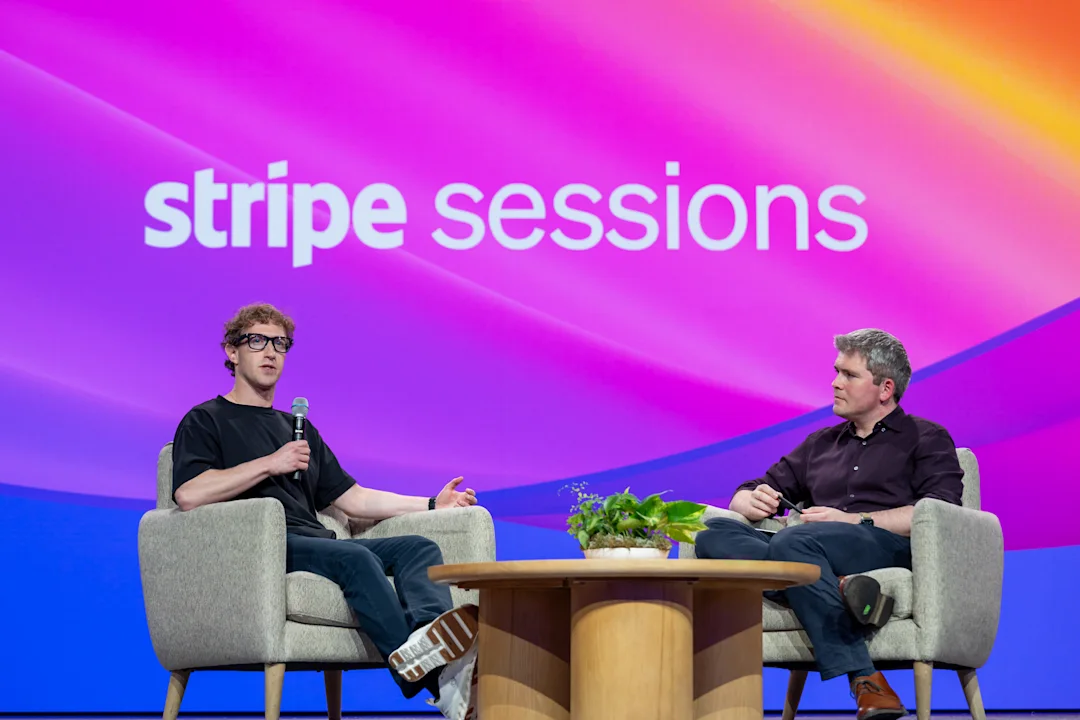
Opening keynote: The future of commerce
Discorso di apertura
Esecuzione
Compila il modulo per guardare il video completo

The future of commerce is being written by businesses growing 7x faster than S&P 500 companies. In this keynote, Patrick and John Collison discuss the state of the internet economy, how breakout businesses on Stripe are growing at record speeds, and the two tailwinds shaping the next decade of commerce and global trade: AI and stablecoins.
Speakers
Dwarkesh Patel, Host, Dwarkesh Podcast
John Collison, Cofounder and President, Stripe
Patrick Collison, Cofounder and CEO, Stripe
PATRICK COLLISON: Where is John? He’s—[unintelligible] the intro to his talk, and… John, what are you doing?
JOHN COLLISON: Patrick, you’re so TradFi. I’m obviously vibe coding. I want to write code that feels good to me, not just CI.
PATRICK COLLISON: OK, we got to go to Sessions. There’s a lot of people waiting there.
JOHN COLLISON: Patrick, chill. You said you wanted more hands-on keyboard help with Sessions. People are looking real nice out there at Moscone. It’s a pretty good vibe.
PATRICK COLLISON: All right, John. I know you love your vibe coding. With Andrej’s tweet, he wasn’t talking about the particulars of your sensory experience here. He was talking about the tool chain.
JOHN COLLISON: Hang on, we’re done. Accept all and deploy. What are you waiting around for? We’ve got to go to Sessions. We can’t be lollygagging around here.
ANNOUNCER: Please welcome Stripe cofounder and CEO, Patrick Collison.
PATRICK COLLISON: Good afternoon and welcome to Stripe Sessions. Sessions is the Internet Economy Conference, and this is by far our biggest one yet—32% bigger than last year. We have around 8,000 of you joining us this week, and that’s not even counting the agents that I know some of you smuggled in. It’s really awesome to have you join us here this week, it’s fantastic to have so many people back this year, and it’s wonderful to have so many new faces joining us for the first time.
Now, when we say the “internet economy,” we mean every business that’s taking advantage of the internet to do something fundamentally new. And our goal with Sessions is to become a kind of convening spot for everyone who’s working out how to adapt to the extraordinary new capabilities and possibilities that abound. We’re joined this week by some of the world’s fastest-growing startups, including Cursor, Vercel, and Lovable; some of the world’s most ambitious and rapidly adapting enterprises, like URBN, Nestlé, NVIDIA; and some the most influential software platforms, like Shopify, Atlassian, and Salesforce; and, of course, many, many more besides.
We have a ton of good stuff lined up for you on the stage, but I hope you also get to spend a lot of time interacting directly with each other. I think this is one of the most valuable parts and maybe the most valuable part, of Sessions.
And to this point, I want to start out by taking a moment to express my gratitude and admiration—gratitude to you, our customers and partners, because your trust and your feedback is what makes our work possible. We could not build Stripe without your advice and your guidance. And admiration because it’s not nice ideas cooked up in the science lab that changed the world; it’s good ideas that are painstakingly and steadily deployed and distributed and scaled. And this process of entrepreneurship, it’s the greatest force for welfare improvement in human history, and you all are making it happen. We’re just so proud to work with you, and it’s why we do what we do.
So we have a ton to pack into this session this evening, and so I’m going to try to move quickly through the rest of it, at a 1.5x podcast speed. So, first, I want to look across the Stripe ecosystem. So last year, in 2024, you all had an extraordinary year. Revenues of businesses built on Stripe grew 7 times faster than those of the S&P 500 in aggregate. And so Stripe is empirically the home to the world’s fastest-growing companies.
This growth amounted to about $400 billion of new payment volume, so incremental new payment volume. And so you can kind of think of this as the GDP of Stripe growing by about $400 billion last year. Now, it’s always a bit tricky to kind of reason about these numbers. Like how do you put that in context? Well, one way to think about it, that I think is kind of extraordinary, is the EU economy grew by around $600 billion last year. So the growth of the Stripe ecosystem is almost as large as the growth of Europe as a whole. So, congratulations.
And in total, businesses built on Stripe processed just over $1.4 trillion in 2024. And this figure works out to around 1.3% of global GDP. It’s a lot, but it’s also small. And GDP isn’t capped. So, in that 1.3%, I think the point is that there’s a ton of headroom for growth.
Now, here in the US, there are over 2 million businesses actively building on Stripe, and this works out to around 6% of all US businesses. And in that, in those 2 million, it includes 50% of the Fortune 100, 80% of the Forbes Cloud 100, and 78% of the Forbes AI 50, but that 78% should actually kind of be 100%, because it’s all of the Forbes AI 50 that are accepting payments for something. You know, not all of them have shipped yet, so we’re really glad to work with them.
For all of these businesses, and for every one of you here in this room, we want Stripe to be both the fastest-improving infrastructure that you build on, but also the most reliable platform that you work with. And a cool stat—or at least one that I think is cool—from last year is that we deployed 1,145 pull requests, on average, every day across Stripe. These are fully shipped into production. And this average includes weekends and everything. It’s not just business days.
And so our teams are shipping improvements constantly. A lot of companies, they do monthly, or quarterly, or weekly—whatever—deploys. We’re shipping improvements to Stripe almost literally every single minute. And while doing this, we maintained 99.99986% availability across our critical APIs.
We know how important reliability is to all of you. And so, this 99.99986%—it works out to around 44 seconds of unavailability through the year. So, including all the Black Friday, Cyber—you know, all that stuff. So it’s less than a minute of unavailability through the year in 2024. Teams at Stripe take this really seriously. So that’s a very quick snapshot. And you can read more about the Stripe ecosystem and what’s going on in our annual letter. And we left a copy on all of your chairs, so feel free to take that with you.
Now we’re gathered, of course, at a funny moment. It’s been many years of unprecedented times. We’ve all heard that line a lot. At this point, maybe they’re just precedented. Maybe this is the new normal. But this juncture right now is clearly somewhat unusual. We’ve two countervailing forces. On the one hand, we’re at a time of significant dislocation and uncertainty in global trade. Maybe a fulcrum moment for the global economy. But we’re also gathering at a moment of profound technological change because there’s not one, but two gale-force tailwinds—well off the Beaufort Scale—that are dramatically reshaping the landscape around us. I’m talking, of course, about AI and stablecoins.
These are major new breakthroughs that are emerging in a turbulent economy. And we’ve seen the pattern of innovation during troubled macro times on many prior occasions. I think there’s an important lesson in this. When new technologies collide with a turbulent economy, the technology tends to win. The technology tends to win.
And so let’s talk about those technologies for a moment. On AI, I first advise you—you know, I’m biased—but I first advise you to preorder your copy of <em>The Scaling Era</em>, published by Stripe Press. And I think it’s the best single work that’s yet been assembled on this revolution. And because the field is so fast-moving, it’s not out in hardcover yet, but you can obtain your copy—you can download your copy immediately today on Kindle via Amazon.
And besides all of the technology miracles that are ensuing, I’ll say the most striking thing that we observe from a commercial point of view is how rapidly businesses across Stripe that are employing AI in some novel way—how rapidly they’re able to monetize their breakthroughs. Like it’s really remarkable.
And so you all might have seen this chart before. So this is showing the kind of accelerating diffusion of new technologies across the economy. And in the early 20th century, it took decades for technologies to reach 50% adoption. In the late 20th century, we got there in maybe 10 or 20 years thereabouts. With AI, it’s basically a square wave. It’s happening overnight.
On stablecoins, we’ve called them room-temperature superconductors. And that’s a bit tongue-in-cheek, and I don’t know if everyone exactly knows what a superconductor is for, but we think the analogy has some merit. Just like actual superconductors, stablecoins massively reduce the friction and energy loss that are associated with storage and movement.
And with a lot of crypto, the use cases can feel very sort of crypto-native. And that doesn’t mean that they’re bad, but it can be unclear how they connect to the real economy and to the rest of the world. But with stablecoins, it’s about real-world utility in regular businesses. And there will be some really cool announcements lined up on this front tomorrow.
And so this is all to say that, despite the challenges, we see a powerful case for optimism. And that brings us to this event. So money, in its everyday form, exists across thousands of distinct systems that don’t always talk to each other very well, which in turn means that any part of business that touches money can be surprisingly recalcitrant and resistant to change. You’ve all experienced and dealt with this. And this recalcitrance is particularly costly when the world is undergoing a period of dramatic transformation.
And so we are building programmable financial services in order to fix this. We want to make money as easily manipulable and manageable as any other form of data, so that it’s easy to launch new markets, to test and deploy completely new revenue models—and most importantly—to ensure that you can actually implement the customer experience that you can now sense is newly possible maybe as of just last week. And we think that there is going to be a lot of global economic reworking and rewiring in the coming years, and we want to build a platform that helps you guys do it. And so that’s what this week is about.
So we’re changing the format a bit this year. Tomorrow morning, we’re going to unveil over 60 major enhancements of Stripe that we’ve been busy with for the past couple of months, and in a couple of cases, for the last couple of years. The major problem we had with the keynote tomorrow is trying to figure out what to cut. Folks at Stripe have been working extremely hard to deliver the improvements that we’re going to unveil, and I’m very proud of what we’ve put together. So I really hope you like it.
This evening, we wanted to zoom out a bit and to share some of the higher level observations around what we’re seeing across the internet economy as a whole. We’re in San Francisco at the very edge of the frontier, and new phenomena and new patterns that eventually impact every business at every scale, every sector—they often first materialize as patterns among startups. And so to give an overview of some of what we’re encountering, and what we think might burgeon and come to matter in the years to come, I want to hand it over to Stripe’s president, and my cofounder and my younger brother, John.
JOHN COLLISON: Thank you, Patrick. So our focus now is on the future of commerce. Tomorrow morning, we’re going to talk about the product and the roadmap. But I’d like to talk about what we see happening at the frontier. And we’ll start by taking a tour through the rapidly evolving landscape of the internet economy. It’s going to be kind of like a safari, but with fewer lions and more line charts. And then we’ll look over the horizon to see what’s coming next. So let’s pop on our explorer hats and get going.
As Patrick mentioned, your revenues are growing 7 times faster than those of companies in the S&P 500. You all are developing the next era of commerce. And so I want to look at one particular slice, the breakout companies building on Stripe. These are businesses that have grown their revenue from $1 million to $10 million in less than 2 years. And obviously many of you run businesses even larger than that, but what you tell us every year is you want to see what’s going on at the frontier. And we find looking at the fastest-growing emerging companies gives us important situational awareness no matter what size company you’re running. So here goes.
There’s the chart of breakout businesses on Stripe. And you can see that the rate at which companies are hitting this breakout velocity is at a record high. It’s even higher than what we saw during the pandemic surge. And you might wonder, “What kinds of businesses are these? What shape do the fastest-growing businesses take?” As you can imagine, there’s quite a few AI companies. In fact, nearly all the new AI labs and products are running on Stripe. So we thought we’d look at the 100 fastest-growing AI startups and compare them to their equivalent peers in SaaS. And the growth dynamics are literally like nothing we’ve ever seen before. AI companies are compressing scaling timelines dramatically.
And if you narrow the set further, and if you just look at AI startups founded in the last three years, you can see some of that square wave dynamic that Patrick mentioned. They’re reaching $5 million in ARR in just 9 months, on average. And right at the vanguard, it gets even wilder. Lovable, based in Stockholm, hit $50 million in ARR in 4 months. They’re now the fastest-growing startup in Europe. Cursor, launched only 2 years ago, and they announced that they’re at over $300 million in ARR. It’s really quite something.
Now, when you bring up this AI revenue, one question that people tend to ask is, “Is the revenue actually sticky, or are people dabbling, trialing, and then canceling?” And so we compared AI retention rates to SaaS retention rates, and the picture is quite interesting. So individual AI companies see a lower retention rate than their SaaS counterparts, but customers are typically turning to other AI tools. At the industry level, the lines flip. AI overall has higher retention than SaaS. So, from where we stand, we’re seeing an industry that’s rapidly developing. It’s got a ton of dynamism. People are eagerly switching between AI tools, but nobody’s going back to thinking by themselves. Clearly, AI is generating a huge number of breakout companies that are seeing faster monetization than we’ve ever seen before.
Another category which actually contributes the largest number of breakout businesses in our dataset is SaaS platforms. Fully 60% of small businesses in America use 1 SaaS platform or another to start and manage their business. Think Toast for restaurants, Jobber for plumbers, Mindbody for gyms. From 2005 to 2015, the number of new small business applications across the US each year—it hovered here at around 2.6 million. And as you can see, then in 2016, some kind of inflection happened, and we’ve seen more and more businesses getting going. And this happened at the same time that we saw the number of SaaS platforms start to inflect—you see there—at a similar stage.
So the growth in small business creation has happened contemporaneously with the growth of SaaS platforms serving them. And these platforms act as conduits, injecting technology, automation, and AI into businesses that have historically been slow to adopt them.
It’s pretty unlikely that an individual church would deploy LLMs to handle event logistics, or that an individual retailer would build AI to predict stock requirements, but that’s exactly what platforms like Pushpay and Transformity are doing for them. We’re seeing this over and over again: SaaS platforms putting AI to work across the small business economy. And so these SaaS platforms are breaking out as a result of the technology-powered productivity they’re delivering for the small business sector.
The final set of breakout companies I want to talk about is the creator economy. They’re reshaping not just commerce, but culture more broadly. The number of creators monetizing content via Stripe has more than doubled in the past two years alone. And I find this chart very interesting, because again, maybe you associate the creator economy as kind of a COVID phenomenon when we were all taking online cooking classes rather than going to restaurants. But you can see here, I mean, the COVID period is small by comparison. Years later, it’s still on a tear.
And official economic indicators are still catching up. You know, the Census Bureau doesn’t give us stats on influencers. But Goldman Sachs estimates the number of people earning more than $100,000 a year through online content to be 2 million. So if they create our economy or company, it will be the largest private employer in the world after Walmart.
You’ve probably noticed this if you’ve just interacted with the youth recently. Fifty-seven percent of Gen Z say it’s their aspiration to be an influencer. And look, maybe they’re right. Maybe it’s the only AGI-proof career that’s going to be left. And you’re probably familiar with the big names YouTube, TikTok, and Instagram. But we’ve seen the growth of an incredibly vibrant ecosystem where industries from journalism with Substack, to education with Coursera, are being reshaped through the creator economy.
And just last week following a court ruling, Apple changed its policies to allow developers to take payments outside of the App Store without incurring fees. This means developers have much more design and commercial flexibility to create payment flows for app experiences. For the first time, if you’re making an app, you can economically use your own payment stack for digital goods.
So AI, vertical SaaS platforms, and the creator economy. Those are just a few of the top categories we’re seeing in the businesses growing the fastest on Stripe. And so you might wonder, “How do they do it? Is there anything we should be taking away from these businesses?”
Well, there’s a few traits that we see again and again in the fastest-growing companies on Stripe. First off, many of them are going global faster and earlier than their predecessors. So, my favorite example of this is that last year, at the age of 3 years old, Midjourney—the AI image-generation service—they sold to customers in over 200 countries and territories, at only 3 years old. At this point, the only way they could grow that number is if they could convince the penguins on Heard and McDonald Islands that they need image-generating AI.
Secondly, today’s vast internet markets enable and reward specialization. And this makes sense. The markets today are so much bigger than they were even a decade ago. We see this in the AI space, with companies like Harvey and Nabla emerging to serve the legal and healthcare industries with specialized AI tools. And SaaS platforms serve nearly every lane of the economy. There’s Traxero for tow trucks, Danceplace for dance instructors, JetInsight for small aviation companies.
Thirdly, there’s new pricing dynamics at play. Selling software used to be about building it once and then selling it, usually by the seat, over and over again at high margins. But now, as products get more AI-centric, inference costs actually become meaningful, and companies are needing fewer seats. So companies are switching to usage-based billing to align pricing with their costs.
And businesses are experimenting with new models, like outcome-based pricing. Take Intercom as an example. They are moving from their support product being per seat, which is how most SaaS is built, to per resolved case. In a world where AI increases productivity, you don’t want a pricing model that depends on hiring ever more people. New pricing models like this are a better way to grow revenues aligned with your customers and set up for the future.
And then, speaking of people getting more productive, these breakout companies for sure have impressive leverage per employee. So I mentioned Cursor. They hit $300 million in ARR. They actually just announced a $9 billion valuation. But I didn’t mention that they did it with 60 employees. That’s $5 million of revenue per employee, which is way higher than any of the big tech companies that tend to be seen as the gold standard on that metric. SaaS platforms—they similarly deliver incredible leverage by amortizing the technology development across a huge number of businesses. GlossGenius, as an example, supports 90,000 salons and spas with just 300 employees.
So global reach, specialization, new pricing dynamics, and high leverage per employee. That’s what we’re seeing among the breakout companies. And it’s important to note that these characteristics—you probably associate them with startups, but they’re not the sole purview of startups. Larger and more established businesses can and do adopt this mindset, as well. And that’s what we’re seeing happen at Stripe.
Take Fender, for example. So they’re almost 100 years old, but they’ve expanded beyond selling guitars to build a rapidly growing platform connecting guitar teachers and students. And this isn’t just a fun side project for them or a cool demo. They have a quarter-million paying customers who’ve taken more than 55 million lessons. So that’s a spin through the fastest-growing parts of the internet economy today, where breakout businesses are at an all-time high.
And if we look a little further ahead—I mean, predictions are hard, especially the future—but I would expect us to be describing a way higher rate of breakout company creation when we talk to you at Stripe Sessions in five years’ time. And that’s because of the two big tailwinds that you just heard about from Patrick: stablecoins and AI. And you already know that these are a big deal, but I want to spend the next few minutes describing how they’re going to create so much growth for the internet economy.
So let’s start with stablecoins. Overall, stablecoin supply—you know, the total dollars in the system—is up to 39% since Sessions last year. And the 2 leading stablecoin issuers together make for the 17th largest holder of US treasuries. And obviously, they’re well on their way to becoming one of the top holders. So how do stablecoins fit into the future of commerce?
Well, if you look at the core flows in payments, there is payment acceptance, there’s treasury and storage, there’s FX, and then there’s payouts. And payment acceptance has been reasonably well addressed on a global basis. Take that Midjourney example that we just talked about. They sold into 200 countries, largely on the back of accepting cards and other payment methods on Stripe.
But then, as soon as you want to do something more complex—say you want to manage balances for customers globally, or you want to pay out money to users in dozens of countries—suddenly things get really hard. And as a result, vanishingly few companies operate any kind of financial applications across borders. And those that do, like Uber and Airbnb, have hundreds of people on their payments teams working a way to build and maintain this functionality.
So what stablecoins are actually enabling is borderless financial services. Last year, we announced an acquisition. We acquired Bridge. Bridge is building the infrastructure to let businesses do and build what they need with stablecoins. And we’re already seeing the demand for borderless financial services go through the roof. And I can actually place it for you.
So I’m going to embarrass myself now. This is Stripe’s payment volume in our first two years of existence. We think it’s pretty nice. We’re quite proud of it. You see this smooth exponential. You see the little bump for the holidays. Do you want me to add the Bridge payment volume at the—you know, [cohorted], the same first two years? So if we add that up there…
So, now, Stripe is this little embarrassing flat line right next to the zero point on the y-axis. And you see Bridge similarly starting its own much higher exponential growth. People have been waiting since 2010 to see if crypto is for real. And what you’re seeing in stablecoins is real utility for real businesses at a growth rate which eclipses anything we’ve seen before at Stripe, including Stripe itself.
Most of this usage is people looking to build borderless financial services. So we have companies like X, Remote.com, and Scale AI; they’re paying out to users globally. We have people like DolarApp and Chipper Cash, allowing users across LatAm and Africa to hold dollar balances. We’re even seeing companies like SpaceX use stablecoins for borderless financial services within their own businesses.
Every large company has hundreds of bank accounts, trapped liquidity in every country, and labor- and time-intensive intercompany settlement. And anyone building financial services has tended to expand internationally very, very methodically. Nubank and Cash App, two of the world’s most successful fintechs, are in no more than a few countries a decade after launching. But with stablecoins providing the building blocks of borderless financial services, we predict launching financial services in a vast number of countries all at once will become much more normal.
The use cases are nearly endless. So anyone doing business globally needs to be thinking about stablecoins. On the AI front, we’ve already talked about how AI companies are growing at rates that we’ve never seen before. But what about applying AI to all of your businesses?
Well, no topic is being more hotly debated around here than AI coding, and how software engineering is going to intersect with it. And I found it’s a little difficult at times to separate the hype from the reality. So we figured we’d put it to the test.
Patrick and I are doing a Q&A here on Thursday morning. I hope we’ll see you all there. And you have to submit your questions. So we thought, “Can we build an app to take your questions, and vote on them and everything, without writing any actual code?” So do you want to see how it went?
All right. So here is my prompt. And this is Cursor that we’re using. And we dropped in this prompt. We can go ahead and submit that. And what you’ll see that’s interesting to me about it is it’s a pretty detailed prompt. We found that if we didn’t specify the stack that we wanted to use, we got worse results. It’s kind of like a detailed PRD that you would give to someone.
But we’re not writing any code. No code had to be written for this to work. And so it was off doing its thing. It got a few errors. Let’s see what it actually does—this was not a one-shot prompt. There was a little bit of nipping and tucking, but we didn’t have to write any code. And so we can show what it actually built if we bring up my screen. All righty. So here we have the working app, and we can ask a question. OK. And we have a working app here.
But to get a sense for what it’s like to build this stuff, maybe we want to modify it somehow. Maybe we decide that you all need some encouragement to ask questions, and we want to gamify it a little bit. And so I can go back into Cursor and say, “Add confetti animation whenever.” Maybe I’ll just say, “Please;” a little Pascal’s Wager. And that is the experience. You see, it’s doing what any engineer would do, which is googling the problem and finding a node package to install. But that’s it. That is the experience of tweaking our app and using it, where we gave a high-level natural language experience, and it’s come back. I’m not going to read all that. I’m just going to accept it. And now we can try.
And so again, we can come up with another question that’s on everyone’s minds, like, “How did Patrick get to be CEO?” And then, in theory—this is a live demo, by the way, so hopefully it works. OK. “We need more pizzazz.” How do you spell pizzazz? “For the confetti, make it more energetic. This is a live demo. I really want it to work.” OK. And again, you’re kind of getting a sense for the vibe coding experience where, OK, we got something back here from Cursor. So it should work. I’m going to again accept that.
OK. Again. Oh, and I will deploy it, obviously. You always want to deploy—like the 5:00 p.m. Friday deploy. OK, so that’ll be in your Sessions app shortly.
So, obviously, this is kind of a fun example. But it does give you a sense of how far along AI coding is. It hasn’t cracked navigating a large code base with a ton of context. And it’s very nondeterministic. Like I’ve never seen that confetti just coming down the right side before. So you’re probably not vibe coding your Lunar Lander just yet. But it is already reducing the time and cost of building production software.
An example of this on the Stripe side of things is adding new payment methods. So this usually takes us weeks, but we gave an LLM a few examples of existing payment method integrations on Stripe, pointed to the API docs; and then, in under 30 minutes, it had a new one where we barely had to touch the output. And so for the right kinds of tasks—modular, well-documented, easily testable—people are already shipping lots of AI code. And these capabilities are already enough to lead to profound industry shifts.
And, of course, it would be a mistake to plan around these capabilities, because the capabilities are only going to get better from here. And AI coding is one example of the general trend in AI, where it can be hard to tell exactly where on the progress curve we are, because it’s such a moving target.
Right now, AI coding isn’t replacing all the software engineers, but at the same time, we have these amazing capabilities that we couldn’t even have shown this time last year. And so, to explore this topic further, I want to bring out a special guest. Patrick already mentioned his book, The Scaling Era. And through his podcast, he’s featured many of the sharpest minds in AI and the people who are actually building the future that we’re all experiencing. Please welcome Dwarkesh Patel.
Thank you for coming.
DWARKESH PATEL: Honored to be here.
JOHN COLLISON: So I think the big thing that’s hard in following AI is, again, separating the progress from the hype and like pointing yourself on the curve. And you’ve thought a lot about this topic. And so I guess I’m curious if you were to predict for everyone here—you know, everyone’s running a business. Everyone here, I think you can assume, is pretty AI-pilled. But just what does it actually look like from here as we start to see all the productivity gains?
DWARKESH PATEL: I think AI today is actually quite limited. Confetti modulo.
JOHN COLLISON: I thought that was pretty good.
DWARKESH PATEL: But it’s an input-output text box. It can answer questions. It can give you instructions for what to do, but it can’t itself perform actions. And it doesn’t have the ability to learn on the job. It’s like living in this Groundhog Day, where in each session, it begins with a new memory, and so it just takes a long time to train a human. These models just come—you’re stuck with the skills they have out of the box; you can’t really train them. And they don’t have an ability to perform actions over—or engage with projects that take days and months, which is like what most work is. Most work is not like writing a Google Doc for 30 minutes. And I think those are the abilities that hopefully will be unlocked over the next few years, and will make them broadly useful, and have huge economic impact.
JOHN COLLISON: So the reason one should be really optimistic on AI is we’re seeing—like again, I think everyone here is pretty excited. But we’re seeing what you can do with this very limited context and kind of limited time to actually go execute tasks. And what you’re saying is, when we actually unlock long-running tasks—you know, the one people talk about—was it your coinage, the “drop-in remote worker?”
DWARKESH PATEL: It was my coinage. Yeah.
JOHN COLLISON: OK, yeah, yeah, yeah. But right now, AI is like someone who started at your company five minutes ago. Imagine how good AI will be when it’s actually the person who’s been around your company for 10 years. Is that basically your case for optimism, that we’re doing amazingly well, even with how limited it is today?
DWARKESH PATEL: Yeah. I mean, even these models today can read every line of code in your code base, and all your Google Docs, and whatever. And just think about how hard it is to onboard a human. No human could do that, that quickly. And if they are actually smart enough to then do useful tasks for you, to engage in long periods of times without your supervision, then—I mean, again, the fact that AIs are so weak right now is kind of a reason to be bullish.
JOHN COLLISON: Yeah, yeah, OK. And you are quite AI-native. How do you use AI in your workflows for the podcast, for your writing, that you suspect people in this room do not?
DWARKESH PATEL: I don’t want to speak for the people in the room, but I kind of treat it like a sort of actual human colleague. And the way you would treat a—if you hire somebody and it’s like—you got to spend hours and weeks giving them feedback, iterating on what they’re working on, changing your instructions. And right now, you try to get something done with an LLM, and it wouldn’t work the first time. And then you just give up. You wouldn’t spend even 15 more minutes iterating on a prompt. You wouldn’t build harnesses and scaffolds and whatever, which we have to build for humans, as well. So I’m more patient with it.
JOHN COLLISON: You’re more impatient with AI?
DWARKESH PATEL: Patient.
JOHN COLLISON: Oh, you’re more patient with AI, I see.
DWARKESH PATEL: Yeah, that’s right.
JOHN COLLISON: And are you saying that you kind of have built out your AI tool kit a little bit?
DWARKESH PATEL: Yeah. One thing that’s been helpful to me—which I think people complain about—is people complain they’re mediocre writers, and I can actually use them to write essays with me. But it requires, through the session, giving them feedback on like, “You wrote this wrong. This is how I’d write it instead.” And the problem, of course, is by the end of the session, all that taste is lost. But through the session, it’s kind of useful.
JOHN COLLISON: Well, but does all that context have to be lost? Like people complain about AI slop writing. Have you an AP style guide that you gradually build out, so that when you go to write something new, you can catch up?
DWARKESH PATEL: I do give them the prompt of, “Write like Gwern,” or “Write like Scott Alexander,” or, “Write like Tyler Cowen.”
JOHN COLLISON: I see.
DWARKESH PATEL: It sometimes helps.
JOHN COLLISON: So prompt that—“Write like Gwern,” or “Scott Alexander” is how you [crosstalk]—
DWARKESH PATEL: Yeah, yeah.
JOHN COLLISON:—slightly [less] [unintelligible].
DWARKESH PATEL: Who is the persona you always like—not for writing, but just anything? You’re like, “I want to have this question answered.” Who’s the persona you give it?
JOHN COLLISON: Well, maybe I should try Dwarkesh given that, you know, I’ll be getting a potpourri of useful writers myself. Jack Clark, cofounder of Anthropic, said he expects AI to boost GDP by 0.5% per year. Does that seem like a reasonable claim to you?
DWARKESH PATEL: I think it would be reasonable if you expect AI to be like the internet. I think that’s the wrong reference class. I think the better way to think about AI is, imagine if you had 10 billion extra people on Earth, and they’re all super smart and conscientious, and are widely educated and trained in every single domain. Would it be reasonable to expect 0.5% economic growth from that? I think not. I think it would be 30%, 100%, or something like that.
JOHN COLLISON: So you think that’s much too pessimistic?
DWARKESH PATEL: Yeah. And also the AIs are helping—the population is increasing, as well, of the AIs.
JOHN COLLISON: One of the critiques you hear is, sure, we’ll see lots of AI productivity growth, but it’s already the case that much of humanity is not bottlenecked on intelligence. We have just lots of silly restrictions in various places. We have lots of places where guilds of particular professions, you know, favor those professions and prevent people from kind of being too productive in those places. You see it across medicine, law, and various places. And so, what do you make of the argument that we’ll regulate our way out of too much AI productivity?
DWARKESH PATEL: I think in law and medicine, I’m especially optimistic because there might be restrictions on who’s allowed to call themselves a doctor or a lawyer. But I don’t know. My business is much simpler than yours, John. But whenever I had to do legal work, very little of it involves actually, like that the lawyer has to be legally involved. You don’t trust ChatGPT yet to write the contracts.
But fundamentally, if you trusted the LLM enough, they could write all the contracts, they could give you the diagnosis. And so, while there might be restrictions on who’s legally designated as a credentialed expert in these fields, if you trust the AI enough, I think you will just defer to them more, even if it’s called a chatbot.
JOHN COLLISON: Yeah, yeah, yeah. So we still get the productivity gains, even if it comes through some different interlocutor.
DWARKESH PATEL: Yeah.
JOHN COLLISON: Yeah. What kinds of businesses do you think will be most boosted by AI? Like, what business gets the biggest benefit?
DWARKESH PATEL: One, where a lot of the cost of production comes from labor. I think in software you’ve seen that it’s grown absurdly fast over the last few decades because the marginal cost of serving an additional user is incredibly low. And I think lots more businesses will become this way given the fact that labor will be supplemented, made more productive, replaced, whatever you want to call it, with AI.
And secondly, businesses which have high elasticity of demand—if you can automate big parts of your workflow and you can make 1,000x the widgets, or 1,000x the services, is there actually demand for your product enough that that would be saturated?
JOHN COLLISON: Yep. OK, I’ll buy that. So if we just, again, go and predict a little bit forward, if we’re all back at Stripe Sessions this time next year, what do you think are the major advances? Like again, the demo, legitimately, we couldn’t have shown this time last year. It just wouldn’t have worked. What do you think the capability is that everyone’s going to be excited about? What are the big unlocks, the unhobblings, between now and next year?
DWARKESH PATEL: I’d be quite excited to see it actually use a computer—not just an ID, but just do whatever you need on a computer, and not just for a few short minutes and you got to give it instructions again, but just—it runs away, and maybe you started something at the beginning of the session, and then you give your keynote, and then you come back and it’s gone and done a whole big task.
JOHN COLLISON: That’s what I did, it’s deploying right now. I think it’s either in the Sessions app for you right now, or it’s about to be. So we’re a little bit there. But I know what you mean. So much longer-lived agentic actions.
DWARKESH PATEL: Yeah, and ones that involve a broader range of tools than just coding. Like you’ve got to call up a vendor to figure out some confusion. You’ve got to like chat with some people on Slack.
JOHN COLLISON: Is there something as well to thinking about how broadly we trust the agents, as well? Because there’s something right now where, when AI goes off and does something, you’re really supervising. It’s not a junior employee. It’s an intern, and it’s not your best intern. You’re really reviewing the work. Will we see something where just the amount of leash you’re willing to give your agents—like there’s the how long they’re spending going and working on the task before and coming back to you, but then there’s how much supervision you’re giving them, which I feel like might be another axis.
DWARKESH PATEL: Yeah. I think it’s not that different from humans, where if you give some humans too much leash, you can run into some trouble. And it is a case that they are, in some sense, more reliable, in a sense. So, if an intern goes and does something for you, and you figure out they messed up, it’s not clear like why they would have done it. They’re not going to be the 2,000 words of chain of thought that’s like, “Here’s what I tried to do, here’s why it didn’t work.”
But yeah. You will have to have the same checks and balances on them that you have on human workers just because—like there’s no person at Stripe who could hopefully break every single important system. You wouldn’t want to put AI in a similar position either.
JOHN COLLISON: Yes, yes. Last question. What are you personally most excited about right now in AI?
DWARKESH PATEL: There’s a lot of like drudge work involved in every job, and I do think like—I’m optimistic about the fact that I can just focus on the thing that I enjoy the most, which for me is just like researching for the podcast or something. And everything else can just be behind this blob of agents that I can interact with once a week, and then I can forget about it.
JOHN COLLISON: Less toil, more fulfilling work.
DWARKESH PATEL: That’s right, yeah.
JOHN COLLISON: On that note, Dwarkesh, thank you.
DWARKESH PATEL: Of course, thanks.
JOHN COLLISON: We are living through a major platform shift with AI, as you all know. But every time there’s a major platform shift, how people buy changes. And I want to give you a concrete example. So let’s go back to Cursor for a moment.
So bear with me on the hypothetical. Let’s assume that you all love the AMA app on Thursday. It’s a huge hit. We’re going to turn it into a startup. We’re deploying it on the public internet. And so we want to build some more functionality. And, in particular, we’re going to build on top of Vercel. And we’ve been seeing a lot of load, so we’re going to build in their bot protection functionality.
And the reason I want this kind of specific hypothetical—because Cursor knows how to do everything in the coding realm—but now we need to go do something in the real world. We’re going to buy a service, and we need this functionality. And so normally from here, yeah, we built it. But we need to go break our flow. We need to go to the Vercel website, go through that whole setup, get our credentials, come back to the IDE here. But this is where we think things are changing.
And so we can actually have—if we call Cursor’s MCP here—we can just describe the functionality that we want. So we’ll ask for that upgrade here. So we’re just describing, again, natural language, what we want to add to Cursor, and we submit that. And it’s going off, and it’s finding out what functionality is, how it works. It’s giving us the link. And so now, if we click this link, you see we’re coming to the completed Stripe checkout page that already with Link has our credentials, so we’ll hit “subscribe” there.
And that’s it. We come back to Cursor, and we can, in fact, just turn on the functionality now, because it’s been enabled. And that’s it. That was the entire transaction. And so what you saw here was we needed some extra functionality in Vercel, and we just did the entire thing in Cursor. This is a totally new modality for commerce. In 30 years, when your grandkids ask where you were when agentic commerce took off, you can tell them you were right here at Stripe Sessions.
The term you’re going to start hearing way more of is MCP. So just remember that. A simple way to allow models to engage in tool use in the wider world, including making complex purchases on your behalf. And there’s tons of applications for this just broadly. But what you’ve just seen here—one tool, directly making a financial transaction with another tool—that’s going to create buying opportunities and patterns for growth for all sorts of companies.
You’ve probably seen that you can now purchase directly within ChatGPT. Soon, every AI tool may become a sales channel for you. Previous internet commerce experiences were all built around the web and the web browser. But as we spend a rapidly growing share of our time in AI tools, it’s likely that commerce gets rewired to natively work with this new modality.
So you can see why it’s a busy time in the internet economy. It’s certainly the busiest that we have felt in quite a few years at Stripe. It’s a really fast-changing environment. And that’s why you’re all here at this moment to discuss the future of commerce over the next few days. And like Patrick mentioned, what better place to do it than San Francisco? From the Gold Rush to Waymos, for almost two centuries now, people have been coming to San Francisco in search of the future. And not every vision for the future pans out. There’s a Clippy for every Copilot. There’s a Juicero for every Tesla. But innovation depends on people being willing to take big swings on bold ideas.
In fact, I have to call out another great Stripe Press book here. This one is called Boom, and it argues that bubbles have very positive long-term effects. The hype and frenzy is actually a prosocial force in gathering people and capital around technologies that then create quite long-lived benefits. And for us, the energy fizzing around AI and stablecoins right now is pretty clearly going to drive rapid progress in both of those. Each individually will bring enormous change to the internet economy, and both together look set to transform commerce. Our intent is to pull that future forward for all of you building on Stripe, and you’ll hear a lot more about this over the coming days.