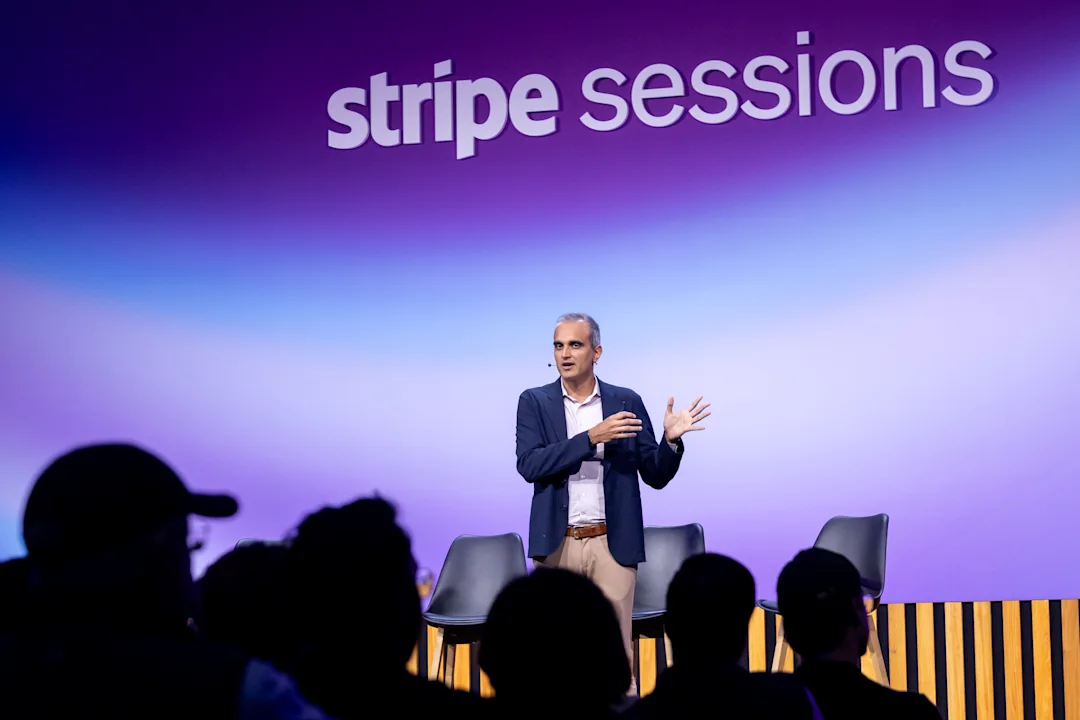
Managing money at scale: Treasury as a feature, not a department
Growing platform economies
运行时间
填写表单,观看完整视频

Managing money across borders, currencies, and providers is complex. And the landscape keeps shifting—from stablecoins and new rails to multicurrency demands. Stripe’s treasurer discusses how to accept, manage, and move money globally across currencies and stablecoins, and what the infrastructure behind this process actually looks like.
Speakers
Adam Ballai, Director, Money, Replit
Derek Shimozawa, Head of Product, Payments, Mercor
Bart Heideman, Head of Product, Payouts and Marketplaces, Stripe
Leland Rodger, Treasurer, Stripe
LELAND RODGER: Good afternoon. Welcome to “Managing money at scale: Treasury as a feature, not a department.” I’m Leland Roger, and I’m the treasurer here at Stripe. And when I joined Stripe’s Treasury team nearly nine years ago, some of the first questions I asked myself on day one were, “Where’s my cash right now? What’s my FX exposure? Which of my entities have money, and which of them need it?” And if you’ve ever asked yourself any of those questions, and I’m guessing many of you have, then this talk is for you. Here’s what we’ll cover today: first, we’ll discuss what going global actually means, and why it’s harder than most people think. Second, we’ll share how we virtualize treasury management at Stripe. Third, how we turn that into a product that you can use. And fourth, how stablecoins fit into the picture. Following that, we’ll hear from two Stripe users, Replit and Mercor.
But first, let’s start with the problem. The first thing to understand is that going global doesn’t mean what it used to. When I joined in 2017, Stripe processed 78 billion in total payments volume for mostly the US and EMEA markets. Last year, that number was 1.9 trillion, or 25 times growth since 2017. Today, we operate across over 45 markets, dozens of currencies, and over 125 payment methods. That growth didn’t happen overnight, but the shift it reflects is real. Digital native companies and AI platforms are now global from Day 1. They don’t just sell in one market. They have complex multidirectional flows from the moment they launch. For most of you, treasury and finance isn’t your core product. And that’s exactly why this matters. To operate a global business, you need three core money management capabilities: to accept funds, to store funds, and to send funds.
Traditional banking systems work well for a domestic hub-and-spoke model, not a global mesh network world. To replicate Stripe’s reach today, you’d face the N-squared problem: needing a separate integration for every country and currency pair. Imagine you operate in 10 countries and eight currencies. That’s not 10 connections. It’s potentially dozens of unique banking relationships, each with its own licensing, safeguarding, bank integrations, liquidity, and risk management needs. The combinations multiply fast. And for most companies, the instinct is to go down this path by adding more relationships, more partners, more integrations, more banks, a.k.a. more complexity. What you actually want is something that looks like this: a single integration point that gives you access to every market. But getting from the N-squared world to this one, well, that’s where our story begins. Now I want to talk about what it actually takes to go global, and why the traditional approach doesn’t work.
Has anyone here opened a bank account in an international market?
Okay. And did anyone find that process slightly painful? Yeah. Yeah. It is quite the process. From apostilles—did not know what that meant before starting this process—to notaries, it’s a bureaucratic obstacle course. I have literally stapled passport-size photos of myself onto documents, wet-signed my signature across my forehead to prove it had not been tampered with. And this isn’t just paperwork. It’s a systemic barrier to entry. This traditional way of establishing a global presence is slow, prohibitively expensive, and does not scale. If you have to spend months of time filling out dozens of forms just to get a local IBAN, you aren’t innovating. You’re just surviving the bureaucracy. And at Stripe, we hit this wall hard. As we grew, the complexity became exponential. For every new market, product, and currency combination we wanted to launch, we needed a specific banking partner to support it.
And each one came with those headaches I talked about earlier—bespoke API or legacy SFTP server. It was completely unmanageable. Our roadmap was being dictated by the speed of bank KYC departments rather than our own engineers. So we paused, gathered around the nearest whiteboard, and we dug deep into the problem and eventually arrived at a scalable solution, which was to establish an internal treasury management system known as an “in- house bank.” The traditional model that we were running—one entity, one bank account, one country—was like the old days of buying physical servers. Every new market meant buying more hardware. We needed to shift to the cloud phase: virtualized infrastructure that would scale without the physical overhead. By building an in-house bank entity, we created a central financial hub that provides global treasury services to participating Stripe entities. Those treasury services include trading FX, settling intercompany flows, and placing and borrowing funds from the in-house bank entity.
Instead of moving money across expensive international borders, we use local accounts, leveraging the receive-on-behalf-of or pay-on-behalf-of frameworks. Then another breakthrough came when we realized that the same in-house bank infrastructure that we built to improve our own internal corporate treasury services could be turned into a product for you. Here’s what this means for you. Real-time, multicurrency support without months of bank onboarding or legal setup. We handled the complexity of physical money storage, the licensing, the safeguarding, the partner integrations, and the liquidity operations so you don’t have to. This means when you need to get paid in the UK, we aren’t sending a slow, expensive SWIFT message from a US account. Instead, we’re utilizing our local UK presence to move funds domestically while our in-house bank handles the ledgering behind the scenes. Because we’re integrated locally in the market, you can get local US or UK account details for your invoices and payments.
Just as AWS virtualized servers so you don’t have to buy a rack of hardware, we’ve virtualized treasury so you can manage your business globally without the infrastructure burden. We’ve replaced the notary and the stapler with a virtualized ledger and turned going global from a multiyear project into a few lines of code. So how did all of this become a product you can actually use? Well, let me show you Treasury. We talked about the complexity of managing money globally, and how we virtualize that infrastructure. But infrastructure alone isn’t the product. The question you’re really asking is, “What does this mean for my business?” Remember those three core capabilities I talked about before, accepting, storing, and sending funds? Treasury is how we deliver all three. Think about how most global businesses manage their money today. You accept a payment from a customer in euros. Your payment provider converts those euros into dollars because that’s your home currency.
Great, money’s in the door. But then you need to pay a supplier in Europe. So now you’re converting dollars back into euros. You’ve paid for foreign exchange twice: once on the way in, once on the way out. We call this the “double FX trap,” and it’s quietly eating into your margins every single day. With Treasury, that cycle breaks. You can receive funds like for like, in whatever currency your customer pays. If they pay you in euros, those euros land in Treasury and stay as euros. You can hold them there indefinitely. When you’re ready to pay that European supplier, you spend those euros directly. No second conversion, no mystery fees, no margin erosion. And it goes beyond avoiding unnecessary FX. From a single global account with Treasury, you can pay balances in US dollars, euros, and British pounds today—without setting up new local accounts, without negotiating new banking contracts, without weeks of paperwork.
When you need to convert between currencies, you can do it instantly right from your Stripe Dashboard, at competitive market rates. You choose the moment, you see the rate, you execute. And because your payments and money management live on the same platform, you can manage the full life cycle in one place. Money comes in through Stripe Payments, sits in Treasury, converts when you need it to, and then you pay out to vendors or other parties without leaving the platform. And this isn’t just a hypothetical. We’re seeing users who earn revenue in multiple currencies—dollars, euros, pounds—using multicurrency settlement to receive and hold those balances in Treasury and then pay their obligations directly in each currency. Then at the end of the month, they convert whatever’s left into their home currency, for example, to meet payroll. One conversion, once a month. Instead of converting everything on the way in and then converting again on the way out.
This isn’t just operational convenience. It’s a P&L benefit. Every unnecessary FX conversion is margin you’re losing. Every hour your team spends reconciling across providers is an hour not spent on your actual business. What used to take months to stand up, opening a new currency for your business, now takes minutes.
Now let’s look ahead because everything I’ve described so far operates on traditional financial rails. And those rails, as good as we’ve made them, still have constraints. Banks close. Weekends happen. Time zones create friction. If you’ve ever had a large payment stuck in limbo over a holiday weekend, you know exactly what I’m talking about. Stablecoins change this. Think of our Global Payments and Treasury Network as a highway system. Stablecoins are a new high speed lane on that same highway. One that runs 24 hours a day, seven days a week, with near-instant settlement. But let me make this concrete because we did this ourselves in Treasury. Stripe needed to settle an intercompany obligation from the US to Mexico. Traditionally, this would mean an international wire, dollars out of a US bank, through correspondent banks, converted to Mexican pesos, and deposited in a Mexican account. That process can take one to two business days, and it involves intermediary fees at every step.
Instead, we use what’s called a “stablecoin sandwich.” We converted US dollars to a dollar-denominated stablecoin using Bridge’s orchestration layer, and that stablecoin moved virtually and instantaneously. On the other end, it was converted into Mexican pesos and deposited into the local Mexican bank account. The result: approximately 256 million Mexican pesos, 14 million US, moved before breakfast. Start to finish. Compare that to the multiday wire it replaced. It wasn’t just faster. It was more transparent, more predictable, and the execution cost was lower. This is why we see stablecoins as more than a niche feature. They fill gaps that traditional rails can’t: weekend settlement, real-time cross-border transfers, and access to stable assets in economies where that stability is hard to come by. We’re building this into the same platform that you already use. You won’t need a separate integration or a new provider.
As these capabilities come online, they’ll be available in Treasury, alongside your payment processing and the rest of your existing Stripe infrastructure. It’s another lane on the highway, and you’ll use it when it makes sense for your business. When I think about where money management is heading, I see a world where the boundaries between traditional finance and new rails become invisible to you. You shouldn’t have to think about whether a payment moves over ACH or Faster Payments or a stablecoin rail. You should tell us where the money needs to go, how fast, at what cost limit, and the infrastructure figures out the best path. That’s the system we’re building. We’re building it so that treasury is no longer a department you have to staff up. It’s infrastructure that works for you and a feature that you can turn on. Dashboard, balances, activate Treasury. That’s it. And the best way to understand what this means in practice is to hear from companies who are living it.
Bart Heideman leads product for payouts and marketplaces at Stripe. He works with companies like these every day on exactly these problems. He’s going to sit down with Adam Ballai and Derek Shimozawa from Replit and Mercor—two companies that went global fast and had to figure out treasury along the way. They’ll share what worked, what didn’t, and what they wished they had known earlier. Over to you, Bart.
BART HEIDEMAN: Thank you, Leland. So you just heard how Stripe thinks about global money movement, but now I want to flip the lens. What does this actually feel like when you’re on the other side, building a company, growing fast, and trying not to light your hair on fire, trying to figure out payments? It didn’t cost me my hair, but I definitely get a bit gray sometimes when figuring out payments. What I’m going to do, I’m going to quickly introduce our guests, and then we’re going to dive straight in. So I’m joined here by Adam, director of money at Replit. Replit is the cloud-based, AI-powered platform where developers can code, run, and deploy applications straight in the browser. And Replit has been global from day one. They’re thinking hard about how to localize pricing, adapt to different markets, and keep their internal operations simple as they scale.
And I’m joined further on my left by Derek, head of payments product at Mercor, the AI-powered talent marketplace. They went from processing payouts that were in total of $200,000 a month. In a matter of weeks, they scaled to $2 million a day—virtually all of that on Stripe Connect. And Derek has seen what happens when your payments volume outpaces your infrastructure and how getting it right matters. So let’s get started.
Leland described the N-squared problem. Every new country and currency pair, creating exponential complexity. When you were getting started, did you appreciate how hard the money side was going to be or did it blindside you? Maybe we start with Derek, and then we’ll go to Adam.
DEREK SHIMOZAWA: Sure. So as Bart said, Mercor is an AI talent marketplace. We work directly with experts that are working on the next generation of AI models with frontier labs, with enterprises. And that type of talent lives anywhere, which means we were global from Day One. We had to meet our experts where they were, and that means being able to pay out almost everywhere. I think the finer point is, for us, working in AI now means there really is no opportunity anymore to gradually outgrow your manual processes. And for myself, I was at Airbnb about six years ago, pre-IPO. We were moving super fast by any normal measure. And as we’re growing, you can start to see some of the cracks form. But my experience at Mercor now, especially working so closely with AI, is by the time you see the cracks now, the water’s already coming through the walls.
And I think that’s the additional framing that it would just add onto the N-squared problem. It’s not so much that the complexity compounds—which I completely agree with. It’s also that the rate at which that compounds is faster than most human processes can keep up with now.
BART HEIDEMAN: And Adam?
ADAM BALLAI: Yeah. So Replit is powering the first billion in developers out there to build anything they want. And so at Day One, we also need to be global and thinking about developers come from anywhere in the world. They can be from a small village to a city, and we want to make sure that they have access. And so when we think about how we want to be global, it kind of goes back to the open question that we had, I had, many years ago, when thinking about my former opportunity, where I was put in this exact same situation before Stripe existed. And we had to build all of these rails that you saw up on stage. They required us to start hiring experts because I didn’t know how to solve this problem. And so it became an interesting challenge for us to think about all the different networks, all the different partners. And we actually needed to figure out, also, prioritization because could we be building our product more in a specific region over these different challenges? But it’s great to have a partner with Replit and Stripe.
BART HEIDEMAN: Of course, with Stripe.
ADAM BALLAI: Yeah.
BART HEIDEMAN: And Derek, follow-up question. You mentioned you went, I think you started paying out from a handful of markets to basically going global. And what’s like the first thing that broke for you?
DEREK SHIMOZAWA: Yeah, that’s easy: ClickOps.
BART HEIDEMAN: Okay.
DEREK SHIMOZAWA: So when I say “ClickOps,” what I mean is those kind of daily processes or weekly processes that your company runs to get things done. And in our case, the most critical ClickOps that we had, especially at the beginning was wage day, like paying out the wages to these experts that are working on the frontiers. And at the very beginning, when we started—and this is only like maybe a year ago—we were moving maybe $200,000 a month, and now we move over $2 million a day. And from a ClickOps perspective, what that means is it started off as a minor inconvenience, right? Like five to 10 minutes, you have a single engineer in front of the screen literally clicking out and sending out payouts—which sounds ridiculous now. But over time, it quickly compounds, and I hinted at that earlier, that compounds so fast. And before you know it, it’s broken.
And I think that’s the thing is, it requires, recognizing that requires a certain amount of discipline because as you’re moving that fast, every single manual operation that you introduce into your day-to-day operations—especially ones that are so critical to, say, your marketplace, like paying out your experts—is a potential failure vector. And I guess doubling down on my point earlier is the time to replace those vectors, those potential failures is a lot, a lot sooner than you might expect.
BART HEIDEMAN: And I think, Adam, similar question for you, with Replit being global from Day One, how do you think about adding maybe additional operational complexity, like new entities, multiple currency settlement versus staying sort of more like USD-only focused, like keeping it simpler?
ADAM BALLAI: Yeah. When you are, and this goes back to this original point I was making where you want to focus on your product, you want to go to market as fast as you possibly can. You want to keep as many operations as lean as possible. And so when you think in one currency, it makes it easier for all of your reconciliation and all the different combinatorial explosions that occur in your finance operation. And when you’re thinking about who you want to hire for, how do you want to grow your team? Do you want to use your budget to expand in finance, or do you want to think about more intelligent ways to do more automation to enable it? So like localizing your currency, but still settling in USD, is a value. And so I think a lot of what we’re talking about here is, is there ways for you to keep that funds within Stripe, and then transfer it out from a payout use case, seems to be really powerful for companies to really focus on what really matters at the end of the day.
BART HEIDEMAN: And I think like at times we sort of hear from startups, they’re thinking about like, “This payment thing, let’s figure this out later.” And what is maybe an advice you would have? What’s like the thing that you wish somebody would have told you from the start when you were starting out?
DEREK SHIMOZAWA: Should I go first?
BART HEIDEMAN: Yeah, you can go first.
DEREK SHIMOZAWA: I think top of mind, the thing that’s most salient right now for Mercor is hiring. So it’s not so much actually what we would build, it’s who. And that means building teams of experienced builders that have—I alluded to the cracks before—that can almost anticipate what we need to build next before those cracks even come up because, like I said, there is no time anymore. There’s very little runway at this point. And so having people in the room—and I can attest—if you look back at our history, our short history, every architectural accident that we’ve avoided has been because we have an expert in the room that has the battlescars and said, “Well, listen, somewhere else I’ve experienced this. This is what we need to do.” So for me, to answer your question, the first thing I would do from Day One is build a team of builders, intense, urgent builders that have the battle scars and knows what scales looks like from Day One because you really don’t have time to learn on a job, especially things like treasury and payments.
BART HEIDEMAN: Adam? Very ambitious?
ADAM BALLAI: Yeah, very ambitious. And actually the way to go, I 100% agree with you. Get a small crack team to go at the problem as soon as they can with leveraging all the tools and the environment. But for Replit, there’s a big learning actually we had when I first joined the company, and it was an interesting thing that I wish I had known in my previous time, is who you partner with when you think about prioritizing your global expansion efforts. And I’d always partnered with finance or partnered with some other group of people to think about how do we get the paperwork done, but we never thought about how do we actually think about the strategy for executing in thatenvironment with a partnerships team, a sales team, a marketing team. And when you think deeper about that partnership, you act as one full team going towards a deployment in a country, which enables you to have better localized pricing and also save you a bunch of time about all the extra things that you have to do to help put that country online.
BART HEIDEMAN: You were saying it’s hard sometimes to do payments when you’re growing this fast. How do you convince folks internally to maybe take a step back, pause a little bit, and get sort of payments right? How did you go about doing that?
DEREK SHIMOZAWA: Yeah, I’ll try to give an AI bent on that answer.
BART HEIDEMAN: Okay. You have to.
DEREK SHIMOZAWA: Yeah.
BART HEIDEMAN: Exactly.
DEREK SHIMOZAWA: That would make sense. A payments group within an AI company, especially one like Mercor, is in a really unique position because you’re moving with this huge amount of intensity and purpose and speed, but at the same time, in terms of responsibility, you still have the accountability, regulatory oversight of say a fintech.
And organizations like OFAC or FinCEN, they don’t care whether you’re a startup or not, you still have to play by the rules. And so going to your question, I think the argument that I’ve found most effective is this, because at Mercor, we are trying to automate everything. There’s going to be agents around everything we do from issuing contracts, setting prices, providing advice and suggestions to our expert community, and yes, payments. And so, the argument is that as you automate, automation doesn’t reduce risk if the underlying assumptions and data are unreliable. In fact, it just amplifies it. And so, as we move forward, I think there is definitely a need to, like I said, have people in the room that have seen this before. And I think, also, the argument isn’t so much, “Let’s slow down.”
It’s, “Let’s think about this. Have we thought about all the edge cases? What else could go wrong? What are we not thinking about?” Because especially in the age of AI now, when you ask the question of, “Can we do this?” More often than not now, the answer is, “Yes. Yes, we can do this. And we can probably do it tomorrow or even now.” I think the more interesting question that we have to ask on top of that, especially working in payments, treasury accounting functions is, well, what else are we not thinking about? And that requires a diverse team, including young, energetic and people who’ve seen it before.
BART HEIDEMAN: And when I hear you talk, you focus a little bit more on the money out. I hear, Adam, you’re talking more about the money coming in. Maybe the question for the panel, when these worlds collide, what breaks? What happens? Maybe Adam?
ADAM BALLAI: Yeah. So when you’re thinking about how do you move from moving money in to moving money out, what’s the type of systems that you need to build? And so at Replit, we try to think about how to move fast, how to leverage and leap forward with technology. And so we adopt standards like x402 to help us with pass-through billing with our partners. And so those enable us to move much quicker, to be able to onboard more partners and be able to handle payouts without necessarily all this heavy weight that we might need to do on the treasury side.
BART HEIDEMAN: And maybe if we’re going to look a little bit at like the future, Leland was talking about that your future infrastructure should abstract away whether it’s rails—ACH, Faster Payments, stablecoins. How do you think about that? Do you think that vision actually matches what you are seeing in the market? Do you think that that’s where we’re going?
DEREK SHIMOZAWA: Yeah. There’s a lot of what Leland talked about, from the N-squared problem to stablecoin rails to abstracting out that complexity, that makes a lot of sense. We’re seeing that every single day. Really quickly, I think on stablecoin for us, we haven’t embraced it yet, but I think it’s an eventuality. It’s inevitable, especially for any global marketplace that’s operating like in LATAM. One of the things I think us and many other startups are watching is financial regulations, stablecoin regulations, as we start to embrace it and as we start to build it into our platform.
BART HEIDEMAN: And, Adam, how do you think about it?
ADAM BALLAI: The fact that we are only six months old with a lot of this technology and we can adopt it is just amazing. So let’s just keep going. Let’s keep investing.
BART HEIDEMAN: Right. And maybe, I’m going to ask you a little bit of a product management type question. I think we even asked this in our interviews, Adam. So let’s imagine you have this magic wand. I say this word “magic wand,” I think, at least three times a week. What’s something that you would love to have in your platform at Replit from a payments perspective that you don’t have today?
ADAM BALLAI: Yeah. So we have to prioritize how we think about international expansion from a payments perspective all the time. Having signals about those markets is really powerful. What’s the adoption like? What’s the willingness to pay? That would be a magic wand to have—just if any startups out there are listening.
BART HEIDEMAN: Thank you so much for your time. Maybe a last question before we break. If you were starting over tomorrow, what’s the one thing you would wire into your money stack, the thing that you would absolutely do? Maybe Derek and then Adam.
DEREK SHIMOZAWA: A ledger. It’s really hard to build transparency into your system after the fact. And my hot take is for any startup, especially a marketplace, a ledger becomes an inevitable eventuality. All good outcomes arise from it, whether it’s getting acquired, going public, IPO. Yeah.
ADAM BALLAI: Mine is very related, which is how you think about the currency for what you’re doing with credits when you’re selling credits. So I’ve actually dealt with this problem twice where we’ve sold credits in USD and centering on USD. Center it on your own currency and build that into your ledger.
BART HEIDEMAN: Great. Adam, Derek, thank you so much for your time. I love this conversation. And maybe before we break everything you saw today—multicurrency storage, instant FX conversion, stablecoin rails—this is live today. So maybe one final plug: go into your Dashboard, go to the balance page, and activate our Treasury product. Thank you, all.
Sessions > 2026 > PLT04 > Transcript