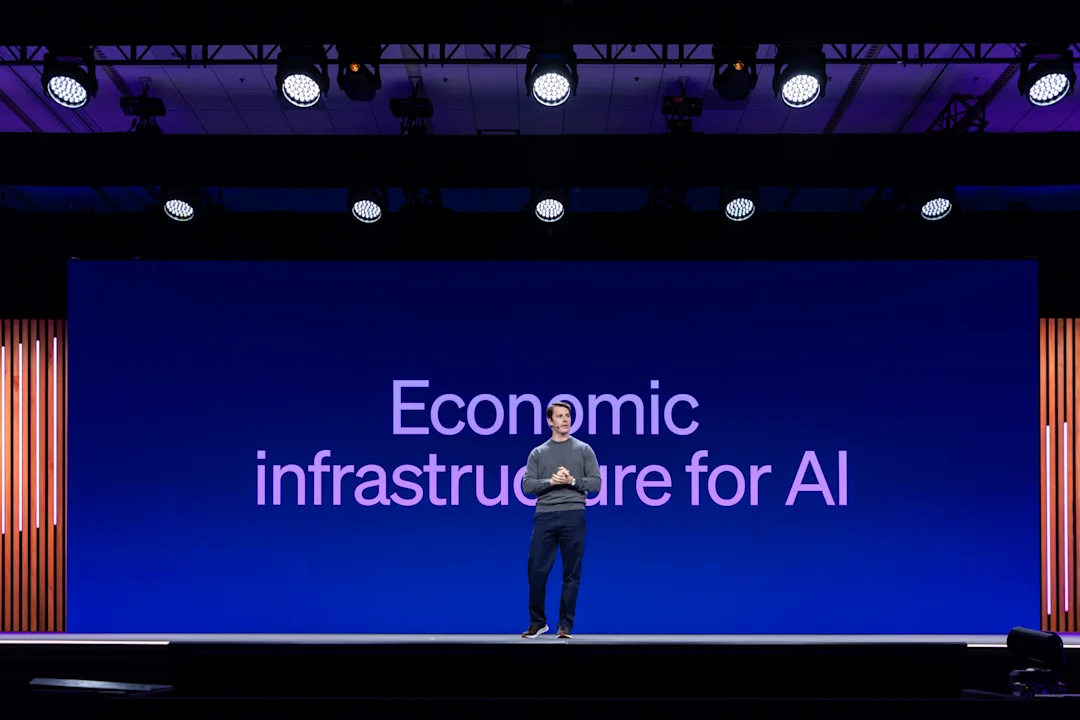
Economists on AI: Labor markets and structural shifts
Charting the future of payments
Tiempo de ejecución
Completa el formulario para ver el vídeo

AI is already reshaping how companies operate, but the bigger shifts are macroeconomic—changes to labor markets, financial systems, and how entire industries are structured. Stripe’s Ernie Tedeschi hosts a conversation with leading economists on what the transformation looks like and what it means for the businesses building through it.
Speakers
Basil Halperin, Assistant Professor of Economics, University of Virginia
Ara Kharazian, Economist, Ramp
Peter McCrory, Head of Economics, Anthropic
Ernie Tedeschi, Head of Economic Insights and Research, Stripe
ERNIE TEDESCHI: Good morning, everyone. My name is Erie Tedeschi. I’m the head of economic insights and research at Stripe. There has been no shortage of excitement, investment, and claims about artificial intelligence. Artificial intelligence came from research labs to our work and our lives probably faster than any technology in history. But because it’s such a young technology, that also brings with it so much uncertainty about what its actual economic effects are. So what we’ve seen already, what is coming down the pipeline, and what this all means for growth, productivity, the labor market. That’s what we’re going to talk about in our panel today, and I am so excited to welcome this panel.
First of all, Peter McCrory is the head of economics at Anthropic. He sees this from inside a leading artificial intelligence lab, where the capabilities are being built. Ara Kharazian is an economist at Ramp. He sees the impact in real-time spending data, so how companies are allocating the dollars for artificial intelligence. Ara, thank you for joining. And then last but not least, Basil Halperin is an assistant professor of economics at the University of Virginia. So Basil brings the academic lens on growth, labor economics, and what history tells us about technology transitions. Okay. First of all, thank you all for being here. I’m really excited about this panel. Before we get to the macro questions, and we will get to macro questions, let’s start with a personal question. So Peter, I’ll start with you and we’ll go down the line. What’s one thing that you now do with AI that you can’t imagine not doing with AI anymore?
PETER MCCRORY: It’s a great question. I mean, in some sense, what Claude opens up is this ability to do so much more than what I as an economist have training to do. So one concrete example is I can now build interactive dashboards to visualize the data in, almost instantaneously, and not only explore that for myself, but send that dashboard to colleagues and illustrate the insights that my team is finding and showcase it or even cast a vision of what we might want to build together. As an economist, one thing that I feel already is that the technology helps me iterate and explore ideas much faster than I could have before. You can send Claude off on a journey to estimate a regression or do some statistical analysis to find out if the idea is actually worth exploring further.
ERNIE TEDESCHI: Ara?
ARA KHARAZIAN: I completely agree. It’s this incredibly powerful RA that allows you to iterate and try out new ideas extremely quickly, swap out different methodologies to see if, hey, you may have found this one result somewhere, but if you change a couple assumptions, you get something completely different. So I think it makes everyone’s research a little bit stronger.
BASIL HALPERIN: Yeah. So besides coding, which I think everyone’s aware of, I think the effect of AI on the ability to do math is kind of growing and underappreciated. So as an economist, I spend a lot of the day pushing Greek letters around the whiteboard, and I drop a lot of negative signs because I’m not a full-time mathematician, things like that. And AI really helps just do the math for me.
ERNIE TEDESCHI: Wonderful. So now let’s get into the macro questions because I can’t resist. So we keep hearing about how AI is changing work, but we don’t really see that in the productivity data yet. So I looked this up. Productivity between 2024 and 2025, if you look at business sector output per worker grew 2.2%, which is fine, solid, maybe even a little bit more than solid, but not exactly gangbusters. In 1999, in the midst of the dot-com boom, business output per worker grew by 4% that year. If you look at total factor productivity, which is harder to measure, but that’s really what economists think of when we think of technological growth, that’s the efficiency with which we use labor and capital. That grew 0.8% in 2025 versus roughly 2% in 1999. So even more mid, not quite as impressive. So what’s going on here? Is it just too early? Is this the solo paradox in action, or is there something unique about AI where it just takes a long time for it to show up in the productivity data? Basil, why don’t I start with you and we’ll come back this way?
BASIL HALPERIN: Yeah. I think John’s excellent talk this morning, still a lot of our talking points here where there really is just this slow diffusion through the economy where firms need to reorganize their internal processes. So like if you think, for example, 1982 Commodore desktop comes out, five years later, there’s this famous solo clip. We see the computer age everywhere, but in the productivity statistics, took another 10 years for the dot-com boom. And the dotcom boom is really driven by capital investment, will be the analog of building data centers today. And then it wasn’t even until another five years later in the early 2000s that finally TFP was growing at its fastest rate. So even if things are growing five times as fast today as they were during the dot-com era, the computer age, that’s like four years until from the desktop computer until we see things in TFP.
ARA KHARAZIAN: I disagree. I think we are seeing some of the results. I don’t think that you’re going to see it in aggregate statistics that are weighed down by the vast majority of businesses that can’t take advantage of AI effectively, right? A doctor’s office or a dentist’s office is not going to grow dramatically more because it has AI. And you might not even see it in some sector-level data, even for the tech sector or the finance sector, two sectors that we know are pretty far ahead in AI adoption. But within those sectors, there are stories, more than just stories, of firms that are growing their revenues faster without growing their headcount. And then if you talk to the CFOs of those companies, they explicitly say that there has been a decoupling between revenue growth and headcount growth. And that’s only at the companies that are pretty far along ahead in the AI adoption curve. And that’s really hard to identify in a data set when you’re just looking at the aggregate.
PETER MCCRORY: So I tend to kind of agree with both of these perspectives, which is it is undeniable that it’s a general purpose technology that is poised to have very large and transformative effects on almost every sector and every occupation to some extent will be transformed by the technology. But then there’s this question of how does that theoretical capability meet the real world? And so we do this exercise in a report that we put out in early March where we compare theoretical capabilities of large language models versus where Claude is actually used in automated ways for work purposes. And there’s a huge gap for computer and mathematical occupations like software engineers, that theoretical exposure is close to 95%, but we only see about 34% of those tasks showing up in our data. And in general, it is the case that we see signs of adoption moving much faster than previous waves of transformative technologies.
About a year ago when we launched our economic index, we estimated that about 36% of jobs had at least a quarter of the tasks typical of those jobs showing up in our data. That number in just a year has risen to 50%. So one out of every two jobs for the US economy has a nontrivial share of the activity that you do in that job showing up in our data. Across the US, we’re seeing rapid diffusion of Claude across states moving arguably five to 10 times faster than this benchmark of a prominent study that came out last year, documenting how long it typically takes transformative technologies to spread across the US. So I think we’re actually moving quite fast, but it will take some time to show up in the aggregate statistics.
ERNIE TEDESCHI: And if it doesn’t show up in the aggregate statistics, but we do see signs that say in the sectoral statistics, should that bother us or is that just going to be sort of the way that AI works? And I’ll open this up to all three of you, no order.
ARA KHARAZIAN: Well, that’s where you get this situation where there are some companies that are growing significantly faster than other firms, and traditional economic intuition would tell us that more firms are then going to enter those sectors where there are profits to be made and more workers might enter those sectors where there are profits to be made. Traditional economic thinking would also tell us that it’s really hard to do those transitions because people study up for one thing or just making the transition between industries is often very difficult both for workers and for enterprise. That transition is often easier to make for AI. You can study up on it fairly quickly. The technology is designed to allow people to get acquainted with it fairly quickly. And so a lot of our traditional methods of thinking about the constraints of the transitions, I think fall apart here.
PETER MCCRORY: I guess I would be very surprised if over the next decade we do not see clear markers of aggregate lift and productivity. So one of the exercises that we do in the Anthropic Economic Index is we have Claude look at the conversations that people are having in a privacy-preserving way and estimate what task are they doing and how much time did they save doing that task? Compiling information from reports might take people 10 hours to read all the documents and then a few more hours to put together a one-page memo. Claude can do that sort of thing in 15 to 20 minutes. When you add up the efficiency gains at the task level using standard macro-growth accounting, for those that are familiar with this literature, it’s referred to as Hulten’s Theorem, you generate a number of 1.8-percentage-point increase in labor productivity growth each year over the next decade, if that’s how long it takes for the diffusion process to unfold.
That’s just current models and current usage patterns. As businesses figure out how to restructure operations that could amplify the effect, these models are improving very fast, and so that’s another force pushing in the direction of large productivity gains, not from the capital expenditure needed to build out for AI, but from the actual efficiency gain that the technology brings.
BASIL HALPERIN: I’m as bullish, I think, as anyone in this room on the potential effects of AI, but I do want to caution about anecdotes where there is, for example, this famous study from the organization METR where they let a group of software engineers use AI for some coding projects, but not for others. And afterwards, they asked, “How much do you think AI sped you up on those projects?” And compared that to how much did it actually speed them up on average? And of course, everyone predicted that it sped them up 20% or something, but instead it made them marginally slower. It’s hard to estimate your own productivity, estimating the aggregate productivity is even harder.
ERNIE TEDESCHI: So, I’m going to throw out a few topics. We’ll start with Peter. We’ll go on down the line for each one. For each one, I want you to tell me if it’s overrated or underrated. And since we’re all two-handed economists here, totally fine if you need to add some nuance and if you want to talk about things more, totally understand. We did advertise that these are economists talking, so none of you should be surprised by how lengthy some of our answers are. Okay. Let’s start with current AI CapEx sustainability in the near term. Peter, overrated or underrated in our discussions.
PETER MCCRORY: I think the demand for intelligence is maybe insatiable, at least for the foreseeable future. And so it’s unclear if we’re... Yeah, there’s going to be a lot of demand and we’re maybe even running into supply constraints already. So I don’t know which direction that puts overrated or underrated, but I’ll let—
ERNIE TEDESCHI: It’s important.
PETER MCCRORY: Yes.
ERNIE TEDESCHI: Ara?
ARA KHARAZIAN: Properly rated. I think that there’s a reasonable concern that some companies are spending too much. At the same time, these companies are making a lot of money selling this technology. As long as that continues, I think it’s generally going to be fine.
BASIL HALPERIN: So I think bubble concerns wildly overrated or somewhat overrated, but sustainability of CapEx, we have to appreciate how fast CapEx has been growing. It’s like over 3X per year, that’s like 10X every two years. We basically start to run out of GDP, 2030, 2032. AI CapEx, if you kept growing at that rate is 10%, 30% of the economy. You just literally run out of GDP unless GDP starts 10x’ing every two years, which would be of course crazy.
ERNIE TEDESCHI: That’d be great. Agents going mainstream in the Fortune 500 in the short term. Peter.
PETER MCCRORY: I guess maybe I would say underrated in the sense that these models are increasingly capable of handling complex tasks and as they become more reliable, delegating is the very clear future.
ARA KHARAZIAN: Underrated.
BASIL HALPERIN: Slightly overrated. I don’t find agents that useful, but I’m a pointy-headed economist.
ERNIE TEDESCHI: AI-driven large-scale white-collar employment crisis. Peter, overrated or underrated.
PETER MCCRORY: I would say it’s not yet in the data. I have huge error bars over the future. Typically, new technologies automate some things, but create new tasks. Can we create new tasks fast enough to provide meaningful opportunity for displaced workers?
ARA KHARAZIAN: Overrated for most jobs, properly rated for tech jobs.
BASIL HALPERIN: Maybe overrated for all. So I think of the case of translators perhaps in the last few years or call center workers where you might have really imagined that AI would already be showing up. If AI had the capability at translation as it did at software engineering, naively, I might kind of feel like software engineers should be all going unemployed or something, and I don’t think AI’s quite there yet. And so if we’re not seeing it with call center workers, that makes me feel like there’s just other stuff going on.
ERNIE TEDESCHI: And then last one, energy as the main bottleneck of AI, R&D, and deployment. Peter.
PETER MCCRORY: I think it’s underrated as an aspect of how AI is already reshaping the economy, the impact on factor markets as being both a bottleneck to deployment, but also the impact of this rapid CapEx on interest rates and investment elsewhere in the economy is a material effect.
ARA KHARAZIAN: Underrated to the extent that the policy environment is not prioritizing bringing new energy online.
BASIL HALPERIN: While agreeing with everything that was just said, I’ll say overrated in the sense that supply is elastic in a lot more ways than people expect. We’ll find ways to get energy even if people need to become electricians and we need to pay them lots of money to do so.
ERNIE TEDESCHI: So I want to go back to John’s talk this morning. He talked about the Coasean reading of AI and firm structure. And so I wanted to explore that a little bit more with you three. Ara, I’ll start with you. Sorry. Ara, I’ll start with you. We’ll go Peter and then we’ll go Basil. Is AI just mostly an efficiency enhancer? Is it just going to be same organization, same structure, just everybody works faster? Or do you think it’s going to fundamentally change how we structure organizations and build businesses?
ARA KHARAZIAN: I think if you look at the organizations that have done a really good job implementing AI, it’s not fundamentally changing structures. There are, I think actually somewhat intentionally, the labs are explicitly calling people’s job titles like member of technical staff or member of finance staff, and firms are suggesting that everyone should be a builder. So there’s a little bit of that happening. At the same time, I think that for most firms, as their competitors start to adopt AI and then also move further along the AI adoption curve, they’re all going to have to compete to be just as productive as each other. And AI just becomes this additional tool that makes everyone more productive, makes better products, makes better software, makes people a little bit more organized, but everyone has it. And in that kind of model, there will be shifts in the kinds of jobs that grow and fall, but the main outputs of an organization don’t end up changing all that much.
They just become higher quality.
PETER MCCRORY: So I guess I would say two things here. One, which is more qualitative, we did this large-scale survey of Claude users, about 81,000 people around the world. And in general, people said that Claude helped them become more productive. But one of the main things that they emphasized was not how fast you do something, but the scope of what you’re able to do. So product managers, for example, being able to do some type of software engineering and vice versa, this blurring of the boundary between traditional job functions, I think is in some sense underway as you have broader scope. But at an organizational level, I think we should not downplay the importance of complimentary investments that businesses need to make in order to, at scale, generate the productivity benefits. So when we look at enterprise API deployment of Claude where Claude is embedded in existing or new workflows, the most complex tasks, something like automated biological research, typically generates a bunch of tokens, but relies on disproportionately more input tokens or context information.
And that pattern holds quite strongly. What that reveals is that it might not just be capabilities alone, but access to the relevant information at the right time. And I think about what tasks might Claude be good at today, but where it’s very hard to get the right information. If you’re developing a sales strategy and the information that Claude needs is in your coworker’s mind, you need to think about organizational processes to elicit that information or data modernization to connect all the data pieces together. I think that points in the direction of sort of economies of scope. Maybe in equilibrium, firms will have a huge incentive to broaden out the range of things that they do so that they can codify and centralize that information. On the other hand, creative destruction is an incredible force for productivity growth and economic growth. And so the barriers to entry as a startup are now much lower. You can use Claude to broaden the scope of what you do. And I think how this all shakes out, a little unclear.
BASIL HALPERIN: Just to, I think, echo the points that were made. So one way to think about one of the main economic effects of the web was sending the cost of communication nearly to zero, and that had clear effects on making remote work possible, making email maybe the main form of communication within firms. And so what cost will AI change? I think it is something about idea generation, the cost of that getting sent down to zero, and how that changes the scope of activities of any individual worker or the firm as a whole.
ERNIE TEDESCHI: So I want to make sure we get in questions about the labor market, because there’s a lot of anxiety about how AI is affecting that. So in particular, I think that there is an anxiety around younger workers and new hires. So Basil, I’ll start with you and we’ll come down the line. To what extent do we see actual displacement of any worker, but in particular young workers from AI? And if you want to opine on this, if we do see displacement effects for young workers, how does that affect things like apprenticeships, learning, new skills? How do we upskill young workers in an environment where AI is displacing them?
BASIL HALPERIN: This is the $30 trillion question and a very difficult one, and there’s research with evidence all over the place. So I’ll just focus on one point, which is that ChatGPT came out November 2022. This is the same time the Federal Reserve in the United States or really began hiking interest rates to fight inflation. Higher interest rates change the economic calculus of a firm. If I’m a firm, if I’m a company, I’m trying to decide whether or not to invest in something for the long term, higher interest rates make it less likely that I’ll want to invest. Hiring a young worker is like making a long-term investment. You’re making a long-term investment in an individual. So you might imagine that the rise in interest rates has caused a tighter labor market for younger workers, and it’s really hard to disentangle that effect from the effect of AI on workers. How it nets out, my read is that it’s unclear maybe there’s some effect, but mostly it’s these other macro conditions.
ARA KHARAZIAN: I think that the labor market effects are going to start with the most marginally attached workers. We saw that in Ramp data where we ran a study on firms that had previously spent a sizable amount of revenue on labor marketplaces, so Upwork and Fiverr, tasks that are generally very well scoped, tasks that are very specific, and tasks that are very short term. That can include design tasks, but it can also include finance tasks and software engineering tasks. So firms that used to spend a lot of money on these freelance labor marketplaces have since cut their spending and shifted it over to AI models, such that we’re seeing something between savings of 60% to 97% amongst the firms that used to spend a lot of money on those labor marketplaces. And the firms that made that shift fastest were those that were most economically incentivized to do so, the ones that spent the highest share of their revenue on labor marketplaces in the first place.
And so not only is there this economic incentive for firms and now this opportunity to move work back in house and maybe make your own logo or design or quick marketing copy if you need to instead of outsourcing it. But the workers that are most exposed to that are not captured by the research that’s currently happening on the economic impact of AI. When we see these papers that are written about AI exposure, they’re talking about jobs that are very clearly defined, but they’re not talking about freelance workers. Freelance workers are not often well captured in government data sets anyway. And also they’re exactly the kind of worker for whom our current unemployment system is not designed to serve in the event of some large-scale unemployment issue. And so that’s one of the places where we are going to see one of the early impacts of AI, where we are already seeing that amongst the firms that are most incentivized to make that change and where we don’t have policies in place to absorb that negative effect.
PETER MCCRORY: I’ll kind of return to this point that Basil made, which is, we had the largest nonrecessionary labor market slowdown in US history. Who typically struggles when the economy slows down? It is those who are just entering the labor force. I think you have to have an additional piece of the puzzle to argue that it’s that. It has to be that young workers are more cyclically sensitive in occupations that have higher AI exposure. That’s like my instinct. We had some... I mean, unfortunately, in some sense, we had the arrival of this incredibly consequential technology in a very volatile macroeconomic environment, which makes it incredibly challenging to tease out its effect from other effects. That was the motivation for this report that we put out in early March where we asked the question, “If displacement effects materialize, where might we expect them to show up at the very least?” So it’s a very weak test, and that generated this, where’s Claude being used for tasks and automated ways for work purposes.
By that measure, there’s no systematic movement of unemployment for workers in the most observed exposure relative to those in jobs that have no AI exposure. But when we look at younger workers, it does seem like job-finding rates are a little bit lower in the last year or so for those most exposed. In the survey that we ran, we also document that the people who are most concerned about the threat to their job from AI are exactly those workers in occupations that have this high-AI exposure as we measure it. So at the very least, people are worried about displacement in exactly the places that we might expect it to materialize. And then young workers in particular are most worried among the people that we surveyed.
ERNIE TEDESCHI: Yeah. I often say in macroeconomics, you don’t have the chance to run a lot of experiments. You can’t put a country in recession and compare it to another country, so you have to accept natural experiments. And as exciting as AI is, one of the most unfortunate things about the timing of AI, going back to Basil’s point, is that it happened... We got ChatGPT the same year that we got a hike in interest rates, that we got the great resignation, living in the shadow of the pandemic. And more recently, there have been all these other shocks affecting the economy, tariffs, immigration policies. It just makes it really hard to disentangle. I really wish there were a cleaner way to identify what AI is doing.
We only have three minutes left. So let me end on this question. What is one thing that most people currently believe about AI and the economy that you think will look obviously wrong in two years? And Peter, I’ll start with you.
PETER MCCRORY: Obviously wrong. I’ll focus on something that I think people need to be paying more attention to, which is in the long run, the big thing that matters is, does AI automate the process of innovation itself? You write down your favorite growth model of the economy. Productivity growth is the engine of long-run prosperity, and AI has this possibility of automating innovation, overcoming the burden of knowledge, helping us, and innovation and the method of innovation. That’s a very urgent thing for us to understand. Labs sometimes talk about this in the context of does AI help accelerate AI innovation itself, but it’s actually a broader consideration for the economy.
ERNIE TEDESCHI: Ara?
ARA KHARAZIAN: I’m going to do something no one ever does. I’m going to say something bad about Anthropic and...
ERNIE TEDESCHI: Love it.
ARA KHARAZIAN: The labs are not incentivized to produce products that are effective and priced effectively. You are incentivized to spend as much tokens as possible on these kinds of products and tools. And I do think that’s going to start to make its way into business decision-making, where companies may opt for software and tools that are not explicitly built by the labs because a competitor is better incentivized to build something that is effective and priced effectively and uses tokens in a moderated way. And the second point being that that would also have employment effects, that if the labs are not able to control the rising cost of tokens, because we’re seeing all these stories about large companies like Uber blowing through their token budgets, then the cost-benefit analysis of adding labor versus adding AI tokens completely falls apart.
BASIL HALPERIN: I’ll give a take that won’t be resolved on a two-year time horizon, but I think speaks to something that you hear a lot about, which is the idea of escaping the permanent underclass. Bad news, I don’t think it’s possible, you’re not going to escape the permanent underclass. What I mean specifically is that either AI is like a normal technology, it’s the web on steroids, happens five times faster, and everything’s hunky-dory. We have normal political system for thinking about redistribution, et cetera, despite all its problems, or the world becomes totally sci-fi. We’re all in the permanent underclass. Saving now is not doing you any good. It’s like being the Incas before Columbus comes to Americas and trying to save your way out of the effects of colonization. Either that happens or the political system figures it out. We need the political system to figure it out.
ERNIE TEDESCHI: That was a fantastic conversation. So please join me in a round of applause for our panelists.