How Lovable turned pricing into a growth strategy
Designing adaptive revenue models
Runtime
Vul het formulier in om de hele video te kijken
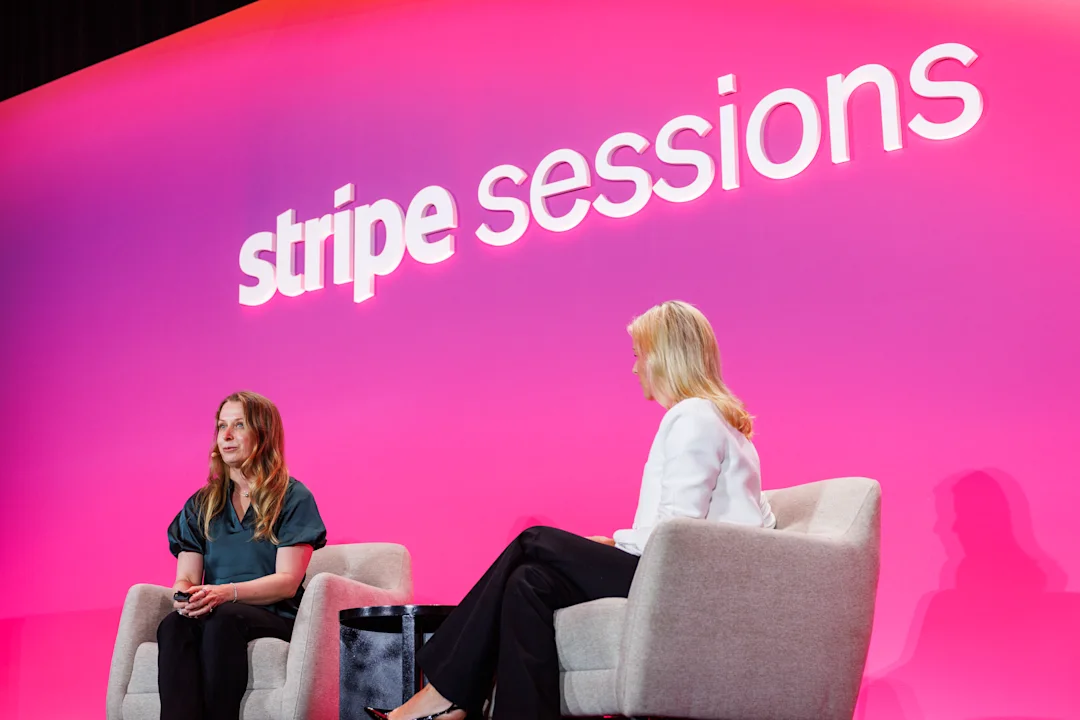
Lovable, one of the fastest-growing AI companies, adjusted their pricing ten times in one year. Elena Verna, Head of Growth, explains why—and how. From adopting usage-based billing to building and testing entirely new pricing models with live customers, Lovable treats pricing as a core part of their growth strategy, not something to set and forget. Learn how they align pricing to customer value, run experiments without eroding trust, and build the flexible billing infrastructure to move at the speed their market demands.
Speakers
Elena Verna, Growth, Lovable
Eileen O’Mara, Chief Revenue Officer, Stripe
EILEEN O’MARA: Hello, hello. Hello and welcome to what is going to be a really exciting session. I am so delighted to have an incredible leader, Elena Verna, join us, who is the head of growth at Lovable. Now, Elena has been in the industry for some time and is trailblazing how AI companies price and we’re all super curious to learn how they’re thinking about it and how you’re leading the way. But before we get into that, Elena, can you share with us maybe a little bit around your story and your journey, how you got here? Not here to San Francisco, but here to this position at Lovable.
ELENA VERNA: That was a trip too. I’ve been at Lovable for almost a year. I’m hitting my one-year anniversary in two weeks. It feels like 10 years at Lovable every month is equivalent to a year to any other company that I worked at. But previously I was operating in companies like SurveyMonkey, Miro, Amplitude, Dropbox was my last gig before I joined Lovable, but I also advised a lot of companies. I think probably over 40 to 50 startups, all focused in B2B SaaS, product-led growth space. That is really my superpower. And course creation, my newsletter, all of the things. I pride myself on being solopreneur as well as being operator at the same time.
EILEEN O’MARA: Gosh, that’s pretty impressive. Specific to Lovable, I think a lot of people here all know the stats. Just so I quote them correctly, $400 million ARR in 14 months. It’s pretty phenomenal when you think about the success you guys have had. But the motion is slightly different than your prior background. You’re a growth leader. A lot of domain expertise in PLG, product-led growth. But of course, Lovable is PLG, product-led, it’s sales-led, it’s B2B, it’s B2C.
ELENA VERNA: It’s everything.
EILEEN O’MARA: It’s everything. So you go into this role and you grow this company like crazy, but now you have to be master of multiple different monetization strategies. Can you share with us how you approach that?
ELENA VERNA: Yeah. So when I joined a year ago, Lovable was at $40 million in annual recurring revenue where it just crossed $400 million not so long ago on the tear to hit next milestone. So it’s 10x. At the same time, our company itself, 10x, we had almost only 20 employees a year ago when we joined, believe it or not. Now we’re 185 employees.
EILEEN O’MARA: It still sounds kind of small for $400 million ARR.
ELENA VERNA: But it’s really big for us. I mean, the change in terms of just how many people we have in the company is quite large. So we’re going through the company cycles and company evolution at unprecedented speed. So reorgs every three to four weeks, a lot of changes to our strategy, so many tactics that we have to do. And really the only way that we’re able to execute it with so few people is by being as AI native as possible. We’re constantly trying to figure out what is the best way to do a certain task without necessarily creating cross-functional dependencies or alignment meetings or up-and-down decision making. So high agency, high autonomy, everybody has to have a founder hat on and just hiring the best people that it’s the global maximum for them to work at Lovable and see how far we can push the boundary of what is truly possible in such a short period amount of time.
EILEEN O’MARA: Yeah. I mean, I think for non-AI native companies, I think everybody is curious to know how you can go and build a company and serve largest enterprises in the world, as well as obviously somebody who’s starting to build a company today. And so my question is, how are those different kind of categories or archetypes using AI tools or are they using them differently?
ELENA VERNA: Yes. We started as almost consumer business. A lot of people would come in and build their personal projects, their portfolio sites, maybe some websites. We very quickly found a B2B use case. We even found it in data, I believe it or not. Some people would start doing prototyping, but we now have a lot of internal tooling and even companies being created on our platform, which is so incredible to see. But we’ve always been bottoms up. So we’re really focused on the builder. We’re still, to this day, heavily focused on the builder. And those builders bring us into their place of employment. So we do have enterprise contracts with Uber, with HubSpot, with Microsoft, with many others, with multithousand people deploying it across the companies and using it for a variety of use cases. But we still stay strong on self-serve and product-led growth, and that builder is our core competency.
We focused on nontechnical user. A lot of engineers use us, but we really want to make things easy and seamless for that nontechnical persona. And they pull us in, into their personal life, into their work life, into just using their personal tools. And it’s really beautiful thing to see. It’s really hard because a lot of companies struggle of, do you do enterprise or do you do prosumer and how do you combine the both? We are staying really focused on prosumer is our core competency. And then we graduate and expand people to enterprise. We’re not focusing on enterprise as the reason of why we will absolutely succeed in this space. We want to succeed with builders and enterprise just comes along with it. And we’re very grateful for that expansion and we love working with companies, but builder is really at the heart of everything that we do.
EILEEN O’MARA: That’s kind of interesting because what we are seeing, I guess, is like enterprise behavior and builder behavior are kind of converging.
ELENA VERNA: They are.
EILEEN O’MARA: Which for any SaaS company that has built a SaaS business, you had to be very intentional. It’s like you were serving the builder and to serve a traditional enterprise, it was very different motion. But in your case, actually, they seem to be coming together.
ELENA VERNA: There’s still product functionality that you need to develop for enterprises in order for them to be able to adopt you and to deploy you across the company. So we’re definitely working on all of the compliance, security, and permissioning issues in order for admins to be able to have control of what they’re actually seeing and happening across the company with Lovable. But at the same time, user is a user is a user, whether they’re using you as a prosumer, whether they’re using you inside the company. So we want to just make sure that that experience is absolutely Lovable. So people come to us because as you know, there’s so much competition out there and everybody and their mother is coming into the vibe coding space. So focusing on that seamless experience is our top priority.
EILEEN O’MARA: Brilliant. Love it. Everybody and their mother, literally. Talent and hiring must be an area that you spend a lot of time thinking about in your talent strategy. You’re a small, agile company and everybody counts. Can you share what is your talent strategy? What type of people are you hiring, and what makes them great?
ELENA VERNA: Yes. We are very ruthless with our hiring because we want to hire people that are not coming to us because they want a certain title. In fact, we don’t have titles internally. Everybody’s just doing their work. There’s some leads and heads of the departments, but that’s about it. You won’t find directors or VPs at Lovable. We are also very focused on having different personas and a team that really round what we’re capable of doing. So we have two archetypes. For example, we call them cowboy and farmer. Cowboy are the people that are going and trying to capture new pastures. They really thrive on innovation and like pushing the boundaries. And farmers are people that are scaling. They really, really take that land and with whatever was captured and they maximize what’s output available on it. We love to hire both of those personas who people that are superpowers in it.
Or on the other hand, we also love to hire people that are, I would say, veterans. I’m considered a veteran in the space, where I’ve been here for 15 years. I’m like very anchored in how corporate works. And then we pair people like me with new grads, with truly AI-native people that have no ceiling of what’s possible. Everything is possible for them. And we have all of those four personas, you can imagine two by two. Every math person loves a good two by two. But you can fill the team with all of those four, and that makes the really powerful team. But we love hiring founders. We love hiring people that are not necessarily come from traditional pedigree of what you’d consider from the FANG companies and just can really get in there and figure out what is possible because we’re in a such high innovation velocity space, we cannot just copy what has been done before. We have to reinvent what the future is going to look like.
EILEEN O’MARA: That sounds great. I’m just kind of curious as you’re interviewing people and you start describing to them as like, “Hey, you’re going to be a cowboy or a farmer here.” Are they kind of going, “Hmm.” Does it take them a while to get their head around how you’re building the company?
ELENA VERNA: Absolutely. So we do a lot of trial work with people because they need to see how we work too. It’s a decision for them. It’s not just our decision, but people that have the best self-realization of who they are are the best people to also hire because I know that I’m a cowboy, for example, but I’m a veteran cowboy. I’m not an AI native. I need to learn how to be AI native because that’s not what I grew up with or how I learned to do what I’m doing. So we’re looking for humility. We’re looking for that drive, and we’re looking for understanding what my superpowers are and then anchoring people against the superpowers and creating jobs around them and just giving them a lot of trust and agency and autonomy so then go. Because otherwise we would not be able to sustain the $400 million business with under 200 employees if we had everybody in the box for whatever they defined it and stretched people beyond their superpowers and what they’re capable of doing.
EILEEN O’MARA: That’s great. Thanks for sharing such great insights. Let’s talk about pricing. So can you maybe just describe to folks how you priced today?
ELENA VERNA: Yes. So I work on monetization at Lovable. So one thing that we’re constantly evolving is how is it that we’re going to monetize our customers? Because we’re an AI company, we sit on top of LLM. LLM is not cheap. It’s not the traditional SaaS with 80 to 90% cush margin. So we have to be very careful of how we monetize in order to create sustainable and predictable business. We’re not here to just succeed in the next 12 months. We want to build a generational company. So we’ve been very heavily focused on our monetization. Now, this is our pricing page that you see on the screen. It can go into just lovable.dev/pricing. We are not happy with it. So please don’t copy it as something that is optimized and ready to go because this is very much work in progress. And even in a year that I’ve been with a company, and company itself is only like a year and a half old, we have evolved this so much.
This is a living, breathing thing. And we have so many plans of where we want to take this, where we’re not able to do sometimes because of the cost structure, sometimes where the market is and what they’re ready for. But the amount of iteration that this thing has gone through, not just from the visual UI perspective, but an actual model changes in the last 10 months has been really incredible and really amazing to see and something that I highly, highly recommend everybody who has any AI features or AI product here that pricing that we have for AI is not where it needs to be. It’s too focused on the cost of LLM and not enough on the customer output. And the faster we can move it towards the output, the better it’s going to be, but there needs to be a maturity curve that your business and the market reaches in order for it to happen.
And whoever gets there first will be a winner in your category, in your vertical, in your space. So make sure that you set up the right infrastructure and the right plate triggers and the right team to start iterating on your pricing as much as possible.
EILEEN O’MARA: Super interesting. But I think a lot of folks looking at this like, okay, I get it. You have a freemium model, you have an enterprise model, and two models in between. I think what’s really interesting with your business and how you’ve approached freemium as really an acquisition channel because a lot of people are like, “Oh, freemium.” You got all these people that sign up and you actually can never convert them or retain them, but that’s not the case for you guys. Share with everyone how you approach freemium as like a strategic category.
ELENA VERNA: Yeah. So just an overview of our pricing, we have a Free plan. Yes, great. We have two self-serve plans and then we have an Enterprise plan that is only sold through our sales team. Our Free, Pro, and Business plans have unlimited users. We monetize on credits that they use on the workspace, not on the user. We did a very specific change right after I started. This is based on my learnings that I had in the previous companies where you don’t get the input, which is a user you charge on the output that that user produces, which is credit consumption. And once we changed that, yes, it created a dip in our revenue because we had a Teams plan and we had to sunset it and we had to move everybody to the Pro plan. But then afterwards we saw an explosion in workspaces in terms of number of users that were in the workspaces and most importantly, retention because now we didn’t have a single point of failure in the workspace.
Now we had multiple people in the workspace that are working together and collaborating and creating many network effects on the workspace level. But freemium, back to your question, sorry. Freemium is extremely strategic at Lovable. One of the biggest mistakes that I see a lot of companies do with respect to AI features or functionality is that they shove it into the highest paid plan because of the cost structure that AI has. And they say, “Well, now we have a reason to differentiate our paid plan that otherwise didn’t have differentiation.” And they gate it because our finance is sitting on our back and breathing and saying, “How much did this cost? What are you doing to my margins?” But at the same time, when you’re doing AI pricing and when you’re trying to introduce AI into somebody else’s workflow, you’re trying to change their habits. You’re trying to reinvent what they’ve actually been doing before the alternative methods.
And you cannot do that reinvention without giving it away to them for free first so they can try it, they can hit that aha moment and then you can monetize it afterwards after they see the value that it can bring. So freemium for us, we spend most of our costs at Lovable are going into freemium, but we don’t use it as a cost center. In fact, we spent over hundreds of millions of dollars in the last 12 months on freemium, but to us, it’s not a cost center. It’s our marketing budget, and we’re very specific about that. So we’re trying to give more and more things away for free and then monetize when the propensity to pay is increasing as opposed to trying to squeeze for conversion rate. And as a result, our conversion rate is in double digits. And for freemium model to have a double-digit conversion is really, really strong.
But then on top of it, we do even more. This is just freemium that you have in the product, but we also do so much free giveaways to hackathons. Anybody who wants to host a hackathon on Lovable, participants get Lovable for free. We do internal hackathons. We do partnerships. We did it with Revolut, with Mercury, with so many companies where we give all of their users access to Lovable. And conversion rates there are in 40, 50% to paid after the offer expires. And we spend tens of millions of dollars in product giveaway that way. So you should really think about AI costs and the AI monetization, not as how much you can monetize it and how quickly, but you should think about it of how can I strategically give it away for people to see the better way that output can be produced with my product and then just believe if your product is good enough that monetization comes. And this way it helps you focus on the product as your main area of conversion and what’s doing the selling, as opposed to developing really large GTM marketing and sales teams in order to do that storytelling for you.
EILEEN O’MARA: Okay. So that’s a lot for people to understand. That is pretty amazing. Yeah. No, it’s pretty good. I really want to double click on that because it’s like that is your marketing budget. This is your customer acquisition. And I think a lot of people are like, “Well, if I do that, I also have to do all of these other things.” And you’re like, “Don’t do it. Try this.” You’ll get the results if you really, really stay focused on it. They will convert higher and you will get sticky customers.
ELENA VERNA: Well, you have to focus on your product. Your product has to work. It’s not something that you put in a shiny marketing message and then on the—
EILEEN O’MARA: The experience is poor.
ELENA VERNA: And then experience is poor. Product has to work. Product has to be lovable. Product has to be effective, efficient, all of those things. So it really, it pushes your focus a lot more on product and engineering, which I think is great. So then you can develop a lot more core functionality, but it’s important to not over-rely on marketing and sales and oversell what your product is capable of doing and then under deliver in the product because that really creates a really negative connotation that just lasts forever long. And all of us are living in AI performance theater right now. Nobody knows what AI is actually capable of doing for us. So make sure that what your promises and what your users discover use cases in the product are actually solid and actually useful for them.
EILEEN O’MARA: Amazing.
ELENA VERNA: But also, can I talk about top-ups or you’re going to ask me questions?
EILEEN O’MARA: Well, you can talk about whatever you want.
ELENA VERNA: All right. But also—
EILEEN O’MARA: As long as it’s pricing.
ELENA VERNA: But also don’t limit yourself to a traditional subscription models too. So one of the things that we as a space got really obsessed about is subscription revenue. That’s also good ARR. That gets us really big multiple on our revenue that investors drool on, that your finance team says, “More ARR, more ARR.” But then at the same time, that is not also the most optimal way to monetize your customers in most of the cases. Most of the products are not so habitual in nature that recurring revenue is the only way for you to actually monetize them. So I’ve always worked for subscription-based businesses and I’ve always had this thought of this is not the optimal way, but I’ve never been given an opportunity to actually test any mixed models that offer ad hoc purchases as well as subscriptions because companies always just over-optimize on ARR.
So at Lovable, we were getting so much feedback from our customers. Our customers were yelling at us that subscription is not the right way for them to build.
EILEEN O’MARA: And did they tell you what they wanted you to offer?
ELENA VERNA: Just ad hoc way of purchasing credits, basically saying, “I don’t build every single day in a continuous way. I have building streaks. I have a muse that strikes me and I need to just go and do it. And if you ask me to upgrade my subscription that feels terminal, like now I’m on the higher level forever. Yes, I can downgrade any time. Sure, but I still have to upgrade and mentally commit to it,” that it prevented a lot of people from building. They would just wait for the next cycle and often lose their idea. And most importantly, churning. Now we only had qualitative feedback on it, but we finally tested top-ups as part of our subscription offering as well, which I was very excited about because something I wanted to do my entire life. And the offer is pretty easy. You still subscribe and save if you pay on the subscription, but then you also can buy top-up credits, which is the one-time purchase of credits to really feed into that machine of what you’re building.
The fascinating part about this is that not only it did not reduce our ARR, which is what often most of the companies would forecast would happen. First of all, most of our best users took advantage of top-ups. It wasn’t just like second-level-class citizens that wouldn’t otherwise commit to paid upgrades. This was our best users that started using top-ops. Number two, top-ups started acting like recurring revenue. Repurchase rate of top-ops was just as high, if not higher than subscription renewal rates. And most importantly, from our revenue perspective, I have this chart of the revenue growth of Lovable of month by month. With the blue line here is our top-up revenue versus the subscription revenue. And you can see, yes, there’s some cannibalization of subscription revenue for sure. But you can look at the overall revenue collected. It is just going up and up and up whenever you give flexibility to user to transact the way that they want to transact with you.
And I think in AI world, this is very important. Don’t corner them into a model that is purely optimized for retention and that recurring revenue. You really need to give customers the flexibility to buy how they want to buy.
EILEEN O’MARA: The exchange of value that it is.
ELENA VERNA: An exchange of value. Exactly. And for that, you need to have a good system also that you can enable this on. We proudly run on Stripe. We’ve been very great partners with Stripe and this test was couple of two weeks for one developer to set up. It was about six weeks, eight weeks of testing, and off we released it into the world. So it’s something that I know in my previous jobs would have taken maybe years.
EILEEN O’MARA: Years, absolutely years. Okay. So I think every company here would love to have a chart like this and to be able to iterate on their monetization model. You told me something crazy. It was like you’ve changed pricing 10 times in a year. And when I think about that, and listen, I get plenty of feedback from customers and users and many of you here in the room will give me feedback, but traditionally companies would have been petrified to go out to their user base and their customer base with a price change 10 times in a year. How did you manage to do that and not kill trust and credibility with your customers?
ELENA VERNA: I think if you don’t change the pricing right now, or you don’t, sorry, not change, iterate and find what’s your current local maxima, because none of us have found global maxima yet. We’re on a path to discovery there. But if you don’t change, I think you’re just going to slowly die off. I know it’s a really harsh prognosis, but I think that it’s very important to keep up with the market change right now and constantly iterate on your pricing and packaging. You’re right. We’ve done so many changes to our pricing, which often at the company that is our age and even our size is just, it’s unheard of because you wait couple of years before your product matures, you start scaling, before you start actually messing with your pricing, we had to do it on month two of our business existing because we very quickly realized that some of the things just did not fit.
So we launched top-ups, we launched annual plans, we sunset plans, we introduced new plans, we added rollovers, we added new features, we moved features, we made more things free. So we have established this precedent with our customers that we are evolving our monetization model as fast as we’re evolving our product. It is not something that is static. It is something that is going to continuously change. And our customers have been very receptive. I don’t know how many of you have used Lovable here, but we’re constantly changing it and we have not had the pushback, but I think it’s important to set that precedence that this is still a living, breathing thing. This is not set in stone. And as our product changes, monetization model needs to change as well, but it’s important to do it early because it’s so true. If you don’t change it for five years and you do that first change—
EILEEN O’MARA: Such a big deal.
ELENA VERNA: It’s a big deal. Remember when Netflix raised their price for the first time, it made the news because it’s been years since it’s done, but they’ve done it many times since, there’s dozen times since then. And nobody makes a peep anymore because they have set that as a—
EILEEN O’MARA: So the market now is also accepting…
ELENA VERNA: It’s expected.
EILEEN O’MARA: these kind of agile closing and changes.
ELENA VERNA: So don’t get into that situation where your customers are jarred by pricing changes or packaging changes.
EILEEN O’MARA: Okay. So for a lot of people here, it’s like, okay, sounds amazing, but not sure where to start. Can you give some guidance on like how people should think about like starting on this experimentation? What are the mechanics? What are the frameworks they should use?
ELENA VERNA: I think first it’s important to have the right infrastructure to even enable you to experiment the way that you want to experiment. Make sure that if you need to switch providers, if you need to put in into the platform work right now, do it now. You’re going to set yourself for success for later. Second of all, I think that you need to designate somebody who’s responsible for it. At Lovable, I’m responsible to make monetization changes and push it through the team. I don’t always own entire thing, but I pull it all together and I get the right level of approvals. Even at Lovable, we have a monetization council that involves our CEO or our head of finance, our head of marketing, our head of sales, to make sure that we’re making decisions that are right for all of the customers and all of the aspects of the business that are taken care of.
And then you designate a team that is actually going to implement it. But most importantly is just to get started and to even understand, where is your monetization model really working right now versus where it’s not. So talk to your customers. I mean, it’s such a basic thing, but we forget to ask them about it, and we forget to put in the right even survey mechanisms when they cancel and leave us to understand why they’re leaving us, but don’t be afraid to at least start somewhere. It doesn’t matter where... Not sometimes. I know you know what needs to change in your monetization model and what should be the first thing. Trust your intuition.
EILEEN O’MARA: Okay. Good advice. Good advice. Okay. So you have like a huge number of customers and builders on your platform. How are you helping them? Because this same conversation we’re having, I’m sure they’re also trying to figure out, well, what’s their monetization strategy and what advice are you giving them or have you created a community of advisory around pricing and monetization with your own community?
ELENA VERNA: Yeah. So we have over 40 million projects already created on Lovable. 200,000 of them, new ones are being created every single day, and Lovable apps already getting 600 million visits every single month. So a lot of Lovable apps, a lot of Lovable founders and employees and a lot of traffic out there. We just released a seamless way to do monetization in Lovable that is also powered by Stripe and that is so people can really quickly set up monetization if it’s a business that they’re building on Lovable, whether it’s B2C business, B2B business, ecommerce, it doesn’t really matter. But then most importantly, we’re also launching very soon a percentage of your money that you collect in your Lovable app will be given back to you in form of credits to make sure that whoever’s succeeding on Lovable apps will also be rewarded with more credits to continue building and evolving their product as well.
We’re very excited about that. But it’s really, we’re trying to codify as much of our own knowledge into every single Lovable experience. So our dream is that you can hire one of us in form of our AI double into your Lovable experience and they can suggest any and all improvements to you. So I’m hard at work on creating my own AI double, so it can be in any Lovable app if they so wish.
EILEEN O’MARA: You have an AI double?
ELENA VERNA: I already have one with Superme, and I’m also working on one at Lovable as well. Yeah.
EILEEN O’MARA: Great. So all the advice is going to be available to your community through this.
ELENA VERNA: Absolutely. I think it’s a really incredible way to democratize knowledge and I think that it should not be gated behind some people that have had certain level of experiences. And yes, I already write a lot about it and I try to do a lot of public speaking, but I think AI has such incredible ability to distribute it further.
EILEEN O’MARA: Amazing. And it sounds like you guys have figured out a lot, but I know you still think you’re at the earlier stages of your journey. What are the top two or three things that you’re like, “We still haven’t cracked that. We still have to figure out these things.” What’s on your mind?
ELENA VERNA: I think one of the things is where is the monetization model is going to go? I’m thinking about it all the time. I want it to be more on the outcome base. I don’t want it to be so heavily anchored on the building portion the way that it is right now, but we’re also in the maturity level where right now people are still exploring capabilities. Those capabilities are going to translate into the next stage, which is value generation, and then that value generation is going to translate into scaling. So we’re in this transition between capability to value, and I want to make sure that we trigger the right way to both provide value to customers as well as monetize it appropriately. But the second biggest thing is that something that is constantly on my mind is that all of these AI-native companies are creating, putting the burden of use case discovery on their users.
And I want to make sure that there’s not so much of what you can find in a product, that there’s much more of, here’s what you’re capable of doing with Lovable and give you a headstart as much as possible because I think that this whole dynamic and this AI confidence theater that is going on right now, because everybody is on their own figuring out what is possible, I want to make sure that Lovable gives you a biggest step forward into understanding—
EILEEN O’MARA: Supporting you to—
ELENA VERNA: What is capabilities that you can gain by using AI products. Yeah.
EILEEN O’MARA: Okay. A lot’s still to be figured out. We’re nearly on time. So maybe last question from me. If you were to start the journey with Lovable today as opposed to, well, I know it wasn’t that long ago, but still in the AI kind of landscape, it’s quite a while ago, what would you do differently?
ELENA VERNA: I would have an idea about Lovable myself. Anyway, I’m just kidding. I think Lovable is—
EILEEN O’MARA: We all have had that idea ourselves.
Yes. I think everybody wishes that. I don’t have a lot of those... Lovable has gone on an incredible journey of growth. I think there’s going to be really great case studies about this company in the future because this is something that we haven’t really seen in this world and the way that this company is moving. I think that the only thing that I would just do more of is to hire previous founders a lot more aggressively into the company because anybody, if you’re hiring for any roles, please make sure to not always just prioritize pedigree and which companies people have been in and prioritize just grit and passion and people that are just wanting to figure out and most importantly in this day and age of how many people can make clarity out of chaos because we live in the most chaotic world right now inside the companies and you need to hire people that can help you find clarity within it. So ruthlessly focus on hiring as much as possible, those individuals.
EILEEN O’MARA: Amazing. Elena, you’ve given us some great insights and snippets, everything from starting the company, building models, iterating, innovating, and obviously making sure that everyone has a founder-first, builder-first mindset. We are so grateful for you to be partnering with us on your journey with Stripe as your billing platform, and delighted that you took the time to share some of your insights and story with us today. Thank you.
ELENA VERNA: Thank you for having me.