From integration to optimization: How support plans drive results for platforms
Growing platform economies
Runtime
Complete form to watch full video
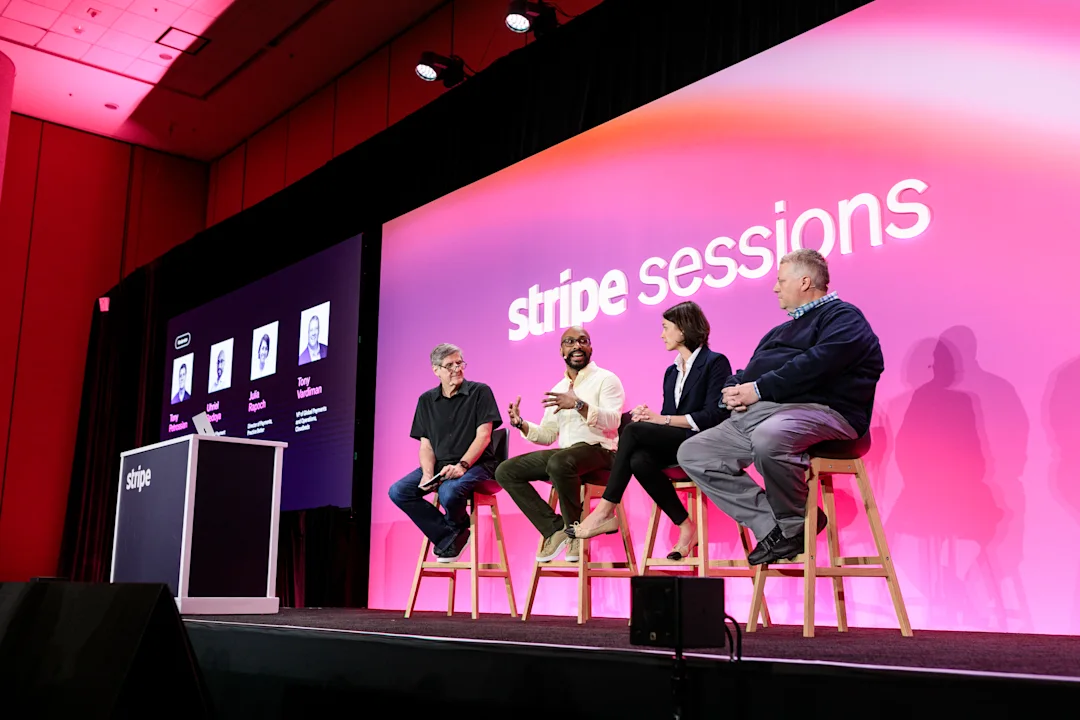
A payment flow that’s costing more than it should. An authorization rate that could be higher. A feature that’s been sitting unused. Businesses on Stripe that work with their technical account managers (TAMs) often find optimizations hiding in plain sight. Hear from a panel of users and a TAM about fixes that made measurable differences—and how they found them.
Speakers
Uhriel Bedoya, Director of Payment Operations, Clio
Julia Rapoch, Director, Payments, Practice Better
Tony Vardiman, VP, Global Payments and Operations, Cloudbeds
Tony Petrossian, Head of Risk and Support, Stripe
TONY PETROSSIAN: All right. Welcome, everyone. If you’re running a platform, you’ve probably faced a question of where to invest your resources in building your own stuff or maybe take a dependency on Stripe for some of that work. And it’s a tricky balance. And when you hit the balance just right, you get to use your resources to focus on growth. And if the balance is a little off, you end up doing a bunch of work that takes away from opportunities. The panel here, they have navigated these waters many a times. And between them, they process about $9 million a day on Stripe. They’ve been around the block, and we’re very excited to have them here helping us with the panel. And we’re going to talk through three phases of the process, which starts with building a good foundation, building that operational muscle you need to survive through incidents and good events and bad events, and then, ultimately, iterate and scale up.
So from the technical setup and onboarding, to getting your operational house in order, to scaling, at each phase, we’re going to explore how your technical account managers or TAMs can help you and guide you to optimize your resource allocation and give you the help that you need to build better and scale. So today we have Julia Rapoch from Practice Better. Julia has spent recently some time migrating a $60 million platform, and she’s been at it for some time.
JULIA RAPOCH: Seven years.
TONY PETROSSIAN: Seven years.
JULIA RAPOCH: Seven years of migrations. Yeah.
TONY PETROSSIAN: Yeah.
JULIA RAPOCH: Ask me about a migration.
TONY PETROSSIAN: We have Uhriel Bedoya with Clio, and you’ve spent some time enabling, what, 65,000 of your customers with Klarna? And more recently, you’ve spent some time launching Capital, Clio Capital, which provides flexible finances to your attorney clients that run on the platform, the law firms. And we also have Tony Vardiman, who is with Cloudbeds. And I think you just launched, what, 24 European countries with payments in how many weeks? Six?
TONY VARDIMAN: About six weeks.
TONY PETROSSIAN: Six weeks.
TONY VARDIMAN: A lot of work there.
TONY PETROSSIAN: Yeah. Nothing to sneeze at. And I’m also Tony. They call me “Tony Pet” just to keep it from getting mixed up. I lead the risk organization and the support organization at Stripe. And I’m really excited to have you guys here and to chat about these three phases.
TONY VARDIMAN: Thank you for having us.
TONY PETROSSIAN: Yeah. It’s nice to spend some time face to face. You can imagine that being in risk and support, I have inflicted some pain.
JULIA RAPOCH: We don’t talk about that.
TONY PETROSSIAN: Yeah.
JULIA RAPOCH: We won’t talk about that.
TONY PETROSSIAN: Yeah. Yeah. And you’ve called us to tow you out of the ditch once or twice. It’s a reasonably equitable exchange, but we’re old friends. So we’re going to explore this journey of setting things up and getting to learn how to run incidents to iterating and scaling. And we’ll talk through that. So I’m going to start with some questions. I’ve got some good ones here in these. We haven’t practiced this at all, so it’s going to be whatever it’s going to be. It’s going to be a conversation. I’m going to start with Julia. So before you were with Mindbody, so even longer stretch of time spending on Stripe. And with both places, what was the one thing that you think you got right? And what was the one thing that you think you should have done different or you wish you had done different? Tell us a little.
JULIA RAPOCH: Well, I’m happy to speak about one of the things that we absolutely got right at Practice Better. And that was our migration to the payment element, which we migrated to in the fall for enabling our Visa and Mastercard cards, so all of our credit cards. But what it really unlocked was our ability to offer six new bank debit options, as well as three new buy now, pay later options within a very, very short period of time. We launched those at the beginning of this year. We’ve seen incredible growth month over month in just the last couple of months that we’ve offered this. We’ve heard wonderful things for our customers. And the other thing that I’ll say about it is through our migration to that, was that it surfaces automatically the most relevant payment methods. So if you’re seeing customers in the US versus maybe you have one client that’s in the UK, they want to see the payment method that is most familiar to them, the one that they prefer and payments are very local. So I would say that that was absolutely one of the best decisions that we’ve made so far at Practice Better, for sure.
TONY PETROSSIAN: Nice. You have a TAM, you’ve been working with the TAM for about a year?
JULIA RAPOCH: The unsung heroes at Stripe. If you don’t have one, get one. So critically, our TAM has helped us with, you mentioned it before, migrations. Now, I’ve been doing migrations for about seven years. My life would be incomplete without a migration, I often say. And our TAM has been really critical in making sure that some of the things that you just need to do as part of the migration planning process, so critically, for the over 1,700 customers that we migrated, ensuring that their settlement terms weren’t delayed and that they were put on standard settlement terms when they made that transition, but also helping with some of the day-to-day struggles. So some of our merchants, they might make mention of certain restricted services on their websites. Now they are not selling those services through their website, but oftentimes that will throw up a flag. I’m sure you know about this. It might have been you that programmed that flag to come up. We’ll talk about—
TONY PETROSSIAN: I hang my head in shame.
JULIA RAPOCH: We will talk about that later. But our TAM is able to put a note on our account to help reduce the number of basically false flags by over 50% and the number of accounts that were actually getting disabled or having payouts disabled by over 75%. So hearing from us and knowing that this is a real problem, not just for the migrating cohort, but for other customers, and figuring out a way to address that for us.
TONY PETROSSIAN: So it’s that proactive engagement.
JULIA RAPOCH: Yeah, absolutely.
TONY PETROSSIAN: Knowing where the—
JULIA RAPOCH: Knowing what to do to make it better.
TONY PETROSSIAN: Nice. Uhriel, you joined Clio, what, two years ago?
UHRIEL BEDOYA: Yeah, roughly August 2024.
TONY PETROSSIAN: All right. And you inherited the Stripe migration there.
UHRIEL BEDOYA: Indeed, indeed.
TONY PETROSSIAN: I hope it was an inheritance with not too much debt. So how did you think about what you needed to do to scale?
UHRIEL BEDOYA: So that’s a great question because to the extent that, you’re right, it’s an inheritance, but in my case, it was a very special inheritance because in going back to the concept of the TAM and having a great one, Chryselle is nothing short of spectacular. One thing is she also inherited the relationship. We both started in our respective companies on the very same day in August 2024.
So to the extent that we’ve been there for each other, supporting each other in our learning, that’s incredibly important. Then there comes the vision of what you want to do. So there’s the company in the state that it’s at, but also where do you want to take it? Clap if you heard or like F1. I mention F1 because I absolutely love how they raise the bar every time. So if you think about 1.8, that number may mean something if you follow F1, that’s the fastest pit stop that’s ever been done in F1. And that was done in 2023, beating a record. So the reason they’re so good at what they do is not because they have vendors and suppliers and relationships, it’s because everybody’s part of the same team. So I see Chryselle as our TAM, as part of our F1 team. We have ambitions to really be best in class globally, and having that kind of relationship is key to that success.
TONY PETROSSIAN: Cool. It’s hard to talk about payments and not mention disputes and fraud and onboarding. So tell us about your focus on those spaces and how that’s going.
UHRIEL BEDOYA: So for us, it’s inevitable. It’s a painful part of payments, but a necessary one, chargebacks, disputes. It’s been an evolution. My team has been phenomenal in taking what before was a manual process. Now you inject AI. There’s no panel at this conference, I’m assuming, that won’t mention AI in one way, shape, or form. The team is starting to become creative and incorporating solutions that will help us manage disputes better. But in our partnership with Stripe, for instance, we’ve been able to now take what a manual process was around arbitrations, which is a painful part, but necessary.
Instead of having to go in and check on a daily basis, now we have an automation where directly from Stripe, we are fed into a tracker, each of the arbitration that we have to defend. So that efficiency is making us automatically better. In addition to that, one of those things is responsibility for anyone running a business is reporting to your senior executives how the business is going. It was a manual process until we decided to pull back and seek resources from Stripe and say, “Hey, there’s got to be a better way to do this.” And that better way is, again, automation. So we automated all the reporting that feeds into our system. So now, instead of focusing on scrambling to the finish line to put materials together, the focus can really be in seeing what the outcomes are, what the insights should be that should be shared with senior executives. So that those two things alone are a great progress in how we not only understand the business, but also support our customers and chargebacks and disputes.
TONY PETROSSIAN: Yeah. I’m sure you love all your customers, but they’re all law firms, right?
UHRIEL BEDOYA: They are. They are.
TONY PETROSSIAN: So how is it working with law firms when it comes to… All right. You don’t have to answer that.
UHRIEL BEDOYA: No, no, no. Lawyers are fantastic. Lawyers are, to the extent that in our specific vertical, people think about lawyers as a single thing, but they serve so many different segments of our community. It’s a great opportunity to learn about what their pain points are. So getting close to the customers helps you to create better products. In my specific case, in facilitating them getting paid, understanding their specific individual practice allows me to develop the empathy that’s needed to be able to better support them.
TONY PETROSSIAN: Yeah. Well, that’s one of the nice things about working with platforms that you get to learn about so many different businesses and… Thanks. Tony. CloudBeds. You have a TAM. And how do you leverage your TAM in doing engagement with Stripe and escalations? And I suspect travel business is tricky. So tell us a little bit.
TONY VARDIMAN: Tricky. Thank you. And before I get into that, just real quickly, I want to say how brave it is of Stripe to invite us up here, unscripted, having no idea what we’re going to say. So kudos. We leverage our Stripe, to answer, our TAM—to answer your question—we leverage our TAM in every which way we possibly can. What we identified is that prior to having the TAM, we at Cloudbeds struggled with being able to reach into the depths and the nooks and crannies of the Stripe ecosystem to be able to get the right problem in front of the right person at the right time. It wasn’t that Stripe didn’t care, because you do. It wasn’t that Stripe wasn’t capable, because you are, but because of the complexities of hospitality transactions and the nuances, without the TAM, we really struggled to say the right things and get the best outcomes.
Now that we have a TAM, and we’ve worked with a couple of them, they’ve both been incredible—Dylan and Alex—they’re not just a technical person. They’re actually a business partner. That’s what we have identified because now I feel completely confident that I can go to Alex and say, “This is the problem, this is the situation, this is what we’re dealing with, and I know that he will get it and will get the right person at Stripe to address the issue.”
TONY PETROSSIAN: So you think even if Stripe was perfect in every way, you’d still need someone to connect that—
TONY VARDIMAN: That’s right. Just because of the complexity, the web aspect of the network, because it’s such a large organization, even if everyone was perfect, you’d still need that connectivity tissue.
TONY PETROSSIAN: Yeah. Well, I think this is where we get into, you have a great foundation, and you built this stuff and it works, but of course, everything eventually fails. There’s always some incident somewhere. We won’t talk about whose fault it is. We will leave that out. We will be blameless here. But let’s talk about those moments where things go wrong. So let’s see. With your, customers expect the best from you. I hope that you expect the best from us, and you raise the bar on what you think is great service. So Tony, Uhriel, your platforms, you own the support experience for your users, and how are we helping you and how do you approach providing support to your users, and how do you leverage Stripe in that?
UHRIEL BEDOYA: Want to go first?
TONY VARDIMAN: You go first, sir.
UHRIEL BEDOYA: So I’m going to coin something that we shared earlier.
TONY PETROSSIAN: I love this. Go ahead.
UHRIEL BEDOYA: And that, I think, Julia, you were the one who said that: “Everyone has a plan until you get punched in the mouth.” That was your original quote from Mike Tyson, but evolved to “when you get punched in the face.” So to answer your question, Tony, for two launches, we’ve done a few launches with Stripe over time, but to do two in less than six months is impressive. So October 2025 was BNPL. Fast forward to February 2026, and it was Capital. And both posed some issues. And part of it came from, not from planning, it came from not planning for the unexpected.
TONY PETROSSIAN: No.
UHRIEL BEDOYA: And so, from that perspective, is that both launches: incredibly successful. We’re very happy on that front, but what we didn’t plan for was what would go wrong in both instances. So they have that common denominator. What went wrong was that we did not anticipate or leverage Stripe as we could have in figuring out exactly what were the experiences leading up to our launch and what the lessons and learnings were from those. But that problem notwithstanding, I see it as an opportunity for both organizations to continue partnering forward. So not just about the planning, but also how are we going to troubleshoot?
TONY PETROSSIAN: Yeah.
UHRIEL BEDOYA: Circling back to your comment and your question about serving our customers better, whenever something goes wrong in any implementation, the main thing at that point becomes triaging and supporting customers. Fortunately, I have a great team, and we stepped in to be able to provide that support. The one thing for the future is, let’s plan on our intervening if something goes wrong, and we already are having conversations around how we can do that better.
TONY PETROSSIAN: So don’t try to be perfect because that’s just going to be the wrong approach, but plan to mitigate, plan to have a playbook when things go wrong, and that’s just as important, and be proactive about that planning, for planning for failures. Tony, AI plays a role in your customer support?
TONY VARDIMAN: It does. Isn’t that the loaded question of the day? “How is AI shaping how we act and think with our customers?” To answer that, I believe that it’s an evolving process. And in the spirit of saying, “Don’t pretend to be perfect,” I think what we’ve learned is being honest and vulnerable when you’re dealing with a problem or a situation or a frontier such as AI, being able to sit up on stage and say, “We’re not sure. We don’t have it figured out.” It is on all of our minds, but it’s something we are engaging with daily. And I think we learn a lot. What we don’t want to do is put out a chatbot just because, “Oh, we’ve got a checkbox of… Yeah, we’ve got a chatbot.” Well, what is the chatbot doing? Why is it needed? Is it giving good answers? It’s more of how is AI enabling us to provide better quality?
And I think that that’s the piece that I hear that is missing a lot of times when people talk about AI because they’re always about the speed and the efficiency. Well, I’m sorry, but quality, where is that? Because that’s really what matters to the end user. Are they getting a quality experience? And so, when we’re looking at AI, we want to focus on that question, not necessarily getting it “fast” or getting it “right.” It’s about learning every day and improving quality.
TONY PETROSSIAN: Julia, tax season.
JULIA RAPOCH: Everybody’s favorite topic. Who wants to talk about taxes? Everybody. Yeah. It’s a great topic. It really does unite a crowd because we all love talking about taxes.
TONY PETROSSIAN: Everybody has to do it.
JULIA RAPOCH: Especially me. What went wrong? Well, we had to file 1099-Ks for the first time this year and about 1,500 merchants that we had to file on behalf of. And we did all this preplanning and figuring it all out. My first hint should have been that it was all going very smoothly. That should have been like an immediate light that went off in my… I think it might have, in a dream. And lo and behold, we had actually filed net processing volumes for the 2025 tax year. And as I’m sure all of you know, IRS experts in the room, you have to file gross processing volume. So the setting that we had configured when getting all of the forms ready, which we had already sent out, were wrong. And of course we discovered this on a Thursday afternoon at around 4:00 p.m. Pacific, which is typically when these things crop up, or it’s either that or it’s a Friday.
But fortunately, Chris, our TAM, we put a Slack message out, and Elise, I would be remiss not to mention our account manager who also jumps in regularly to pull us out of a ditch, alerted them that that was our hypothesis, that we had in fact filed net rather than gross processing volume. Yes, I know. I know.
TONY VARDIMAN: I’m sorry. I breathe a sigh of despair for you.
JULIA RAPOCH: Thank you. There’s a lot of trauma bonding that’s happened here, so we’re all very close now. But fortunately, Chris sprung to action. He organized a meeting with us with tax experts, and that’s really something, you mentioned it before, this connective tissue, right? Stripe does a lot of things very, very well technology wise, but in addition to that, they have incredible experts, subject matter experts, in all sorts of domains. I’m even looking right out at someone in marketing at Stripe who’s just absolutely phenomenal at what she does. And so he was able to organize people very, very quickly, less than 24 hours later into like an emergency meeting to confirm that that is, in fact, what we had done. And then, not only that, they fixed everything. Well, not everything, but they fixed all of the amounts for us. So we were able to reissue all of those forms very, very quickly.
We had to handle the communications, which actually went off without a hitch, which, thank goodness, most of our merchants were not thinking about taxes yet, so they hadn’t filed. A few had. But yeah, we were able to just confirm the hypothesis, get a solution, and get things fixed literally within less than 24 hours because our TAM was able to just jump in and fix.
TONY PETROSSIAN: So you’ve all experienced incidents, and I think at the end of the day, is it about the partnership that is the most valuable to you? Or what would you use as the one word in that, like when you’re in that situation, what are you looking for from Stripe and maybe even each other? Because I mean, you guys all know each other. There’s some kind of a cabal here.
TONY VARDIMAN: Oh yeah.
JULIA RAPOCH: The first thing that comes to my mind is “expertise.” And similarly, I mentioned at the beginning, right, standing up these new buy now, pay later bank debits, which I was already familiar with, but buy now, pay laters was a new domain for me too. A few things cropped up that we weren’t quite expecting. We should compare notes. But really being able to pull in the right subject matter expert to explain something when it goes off the rails, to give you that definitive answer, because, ultimately—and I think you touched on it before, Tony—you want to get the answer right. You want to get the quality answer to your customer to explain what has happened, why it’s happened, and how you’re fixing it. Because in payments, right, I think all of us in the room, in payments, know it starts at a spice level of a four, and it goes up quickly, because you’re talking about people’s money, and it’s very emotional.
And so anything that you can do to pull in the right people to get things resolved and answered quickly and explained quickly is why I enjoy the partnership so much.
UHRIEL BEDOYA: I would expand on what you were saying, Julia. If “partnership” is one umbrella, underneath that for me is “authenticity.” Having gotten to share some moments with each of you independently and collectively, this is my favorite panel in my career to the extent that basically it’s learning from just two very real individuals.
JULIA RAPOCH: How many panels has he done?
UHRIEL BEDOYA: As it relates to Stripe…
TONY PETROSSIAN: I’m trying to break into this…
UHRIEL BEDOYA: As it relates to Stripe specifically, “honesty” and “integrity,” those are the other two pieces. To be able to build a relationship, you have to really be honest. If something is working, great, say that. But if something is not working, you also have to—
JULIA RAPOCH: Own it.
UHRIEL BEDOYA: Own that, that it’s not working, and do it early. And testament to that is those, situation that we had where Stripe was providing something, and it just wasn’t what we expected. We stopped, and Stripe recalibrated and shifted. That’s exactly what you can get when you are really honest, could have had it to go all the way to the end and not done that. And then operating with integrity.
TONY PETROSSIAN: Yeah.
UHRIEL BEDOYA: If you don’t operate with integrity, just getting the sense from each of you and everybody here is, everybody’s passionate because we have integrity in the work that we’re doing.
TONY VARDIMAN: That’s right.
UHRIEL BEDOYA: And we have the same expectation from our partners.
TONY PETROSSIAN: Yeah.
TONY VARDIMAN: And I’ll briefly add on to that. I know the countdown to the singularity is happening right in front of us.
TONY PETROSSIAN: Yes.
JULIA RAPOCH: Pay no attention to that.
TONY VARDIMAN: Briefly add, the concept of what I call “radical vulnerability.” This is so difficult in the business today for a leader to be fully vulnerable and say, “I have a problem, and I don’t know how to fix it. Can you help?” And Stripe, to also, on their side say, “Oh, we may have been a part of that problem,” but instead of defending and deflecting and protecting, dive into the pit with us and help us solve it. And that is what has forged the relationship.
TONY PETROSSIAN: All right. So from setting up and building a great foundation to building your operational muscle to survive through these good times and bad times, and then, I think we get to scale and growth. So we’re going to do a speed round on how has it been in expanding and growing products, geographies? Tell us a few things, Tony.
TONY VARDIMAN: I’ll briefly say it because this is probably the best and juiciest experiences we’ve had with Stripe. So, in every single country, in every single payment method, in every single concept that Stripe has, Cloudbeds has basically adopted it as quickly as humanly possible. We launched in Europe, and we’re live in every single country in Europe within a few weeks, and we have launched with Capital, Instant Payouts. We are going to be launching Treasury very soon. And so we’re using everything. The ability for Stripe to allow you to scale with precision, I believe it’s the best financial technology company in the world to be able to allow you to do that. We’ve used others, and we found that Stripe was the best. So I’m not getting paid for that, but it is my honest opinion. So thank you.
TONY PETROSSIAN: Well, thank you for being with us, and I’m starting to get a little…
JULIA RAPOCH: Emotional?
TONY PETROSSIAN: Yes. Say something bad, Julia.
JULIA RAPOCH: Oh, okay. International expansion. Well, we did do a lot of international expansion at Mindbody in a very, very short period of time. And I am going to flip it to a slightly positive. Sorry. I saw it. I mean, it was done very, very quickly, and they were able to support us through that. Stripe was able to support us through that. But what I would say, at Practice Better, is that while we’re not super focused on international expansion—most of our customers are in the US and Canada—I mentioned at the beginning, the migration to the payment element, it positions us to be able to expand very quickly internationally by meeting the needs of all of those local markets. I started my career in international payments in the UK, working in Europe. So I’m very familiar with all of the specifics, and it’s only expanding. So yeah, Stripe is making it very, very easy to just turn those payment methods on, especially through that new integration.
So I’m feeling very excited about just that ability to switch those on and do some go-to-market work and not have to sit down with a developer and figure out, “Okay, how are we going to enable this specific one? And what information are we going to need to recollect? And then when are we going to surface it?” It’s all done very seamlessly in the background, so it can help us grow.
TONY PETROSSIAN: And…
UHRIEL BEDOYA: For us, it’s a little bit different. And let me explain why. So our—
TONY PETROSSIAN: Did you grill your TAMs about it though?
UHRIEL BEDOYA: Grill them on international?
TONY PETROSSIAN: Yeah.
UHRIEL BEDOYA: We always talk about international expansion, but here’s the complexity that legal brings. It’s not just about understanding payments in each of the jurisdictions in foreign markets. That’s something that definitely Stripe has already historically played a role. But it’s understanding what the requirements are from the legal system in each of these countries. So, in other words, defining what our competitive advantage is going to be and value propositions can be in each of these markets also ties into the intentionality of launching payments. So it’s a lot more complex. I wish it were as simple as yours, but there’s a lot of work that needs to be done in the background.
TONY VARDIMAN: You’re working with attorneys, so can’t be simple.
UHRIEL BEDOYA: No, it is not. But it also talks to a little bit about why our setup within Stripe is so unique in that sense, and why there are times in which something that may be as simple as some of these things that you’re facing may be very unique and presents learning opportunities for not just for us at Clio, but also for Stripe as our partner.
TONY PETROSSIAN: Yeah. Well, it’s definitely been a great learning experience, supporting so many different platforms and watching the learnings, traversing the network of platforms that are on Stripe and being able to find expertise and connect people. Well, thanks a lot for the good conversation, but before we wrap, I think we kind of covered how we really want onboarding to be a growth thing and not get in the way. And so building and the initial setup and doing it the right way ultimately will have lots of benefits in the long term. So it’s something worth really paying attention to. Catching problems early, finding the experts before you need them, having the right network, and having the playbooks, and assuming that something will go wrong is an important thing. And I guess the third one was when expanding internationally, get your ducks in a row, and figure out who’s going to help, and always be conscious about the local nuances. And I guess if you don’t use LPMs, you will hamper your growth.
TONY VARDIMAN: You will find out why you need to.
TONY PETROSSIAN: Yes. So I hope if you want to go dig deeper, the TAMs will be hanging out there. If you want to have a conversation, we’ll be out there for a few minutes. And thanks for coming and listening to us banter here. I hope you enjoyed it. I certainly enjoyed it, and thanks a lot.
TONY VARDIMAN: Thank you, Tony.
JULIA RAPOCH: Thanks, Tony.
TONY PETROSSIAN: Thank you.
UHRIEL BEDOYA: Thank you.