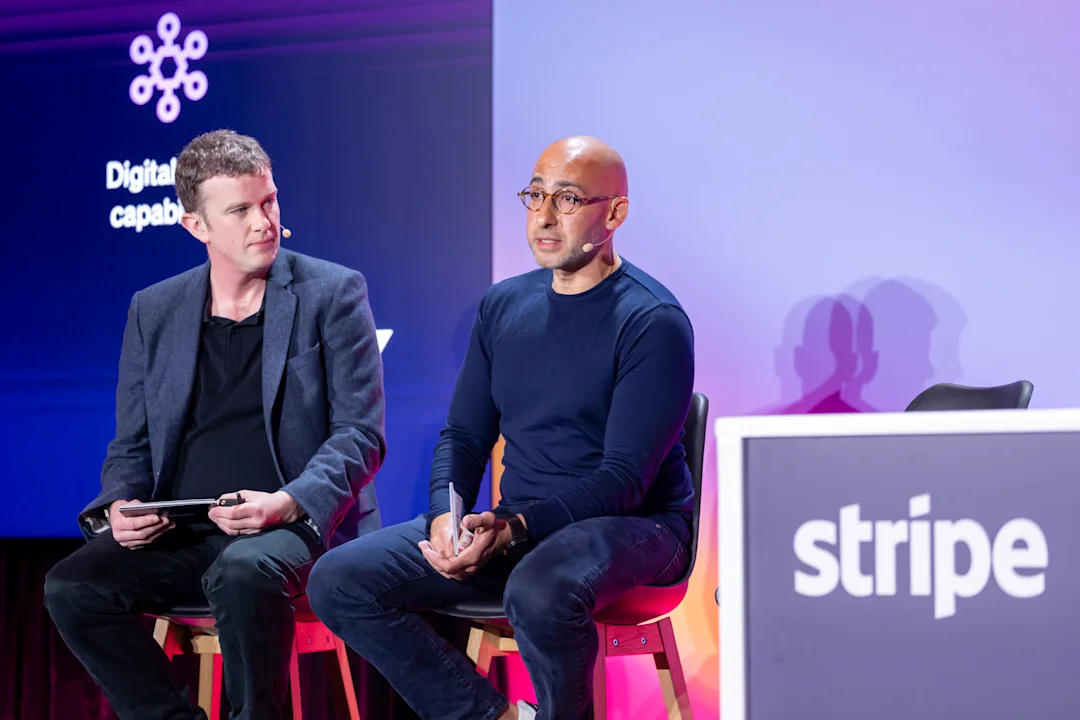
The stablecoin advantage: Faster growth, fewer borders
Reaching global markets with stablecoins and crypto
Durée
Remplissez le formulaire pour voir la vidéo en entier

Global businesses are using stablecoins to accept payments globally, pay out sellers in seconds, and provide borderless financial services. Hear from companies leading the way in using stablecoins to drive growth, reduce costs, and acquire new customers.
Speakers
Adam Sommer, Director of Product, Ramp
Luke Tuttle, Chief Product and Technology Officer, MoneyGram
Ravi Adusumilli, CRO, Money Management, Stripe
Sophie Sakellariadis, Product Lead, Payment APIs, Money Movement and Storage, Stripe
SOPHIE SAKELLARIADIS: One year ago, we stood on this stage and shared why every business needs a stablecoin strategy. Here’s the gist. Traditional financial infrastructure was designed decades ago for a pre-internet world, let alone the AI age that we live in now. The result has been that traditional financial rails are often slow, expensive, and just not available everywhere or every time that modern commerce needs to take place. Stablecoins, on the other hand, were designed for a global internet-driven economy. They directly address the pain points of traditional money movement. They’re fast, cheap, borderless, fully programmable, and they run 24x7, 365 days a year.
In the last few years, we’ve seen businesses worldwide take advantage of stablecoins across three key use cases, reaching customers everywhere, paying out globally, and building global-by-default financial services. Today, we’ll review how businesses on Stripe are driving growth and efficiencies across these use cases. And we’ll take a look at a new use case that’s emerging alongside the AI boom, unlocking agentic revenue. Let’s start with reaching customers everywhere. At Stripe, we often like to say that today’s companies are global from day one, but the data are really striking. On average, the top hundred AI companies on Stripe sold to customers in 69 countries in just their first year, and that’s before they do any proactive marketing or localization. At the same time, taking payments from all these customers can be hard. Card authorization rates outside major markets are 27% lower, and customers in many countries might not have a card in the first place.
But here’s the really cool part. Our data also show that the same buyers who struggle to pay with cards are more than twice as likely to have a stablecoin wallet, which means accepting stablecoin payments can help you to capture motivated buyers that are otherwise slipping through the cracks. And the kicker: stablecoin payments save you over 60% in processing fees.
Next, sending payments globally. If you’re in the US and you try to send money to someone in the UK or in Europe, it might be pretty fast and cost effective. But if you’re trying to move money somewhere in the Global South, the picture changes. Depending on the destination, the median end-to-end settlement time can jump from minutes to over 22 hours, and that’s if everything goes smoothly. And the average cost of sending just $200? 6.5%. That’s all because these payments are bouncing around a web of intermediaries, all with their own processing schedules, opening hours, holidays, and fees. But with stablecoins, cross-border payments arrive near instant and at a fraction of the cost. It’s no wonder that remittances were one of the first use cases where stablecoins got traction. In fact, more than 10% of remittances from the US to Mexico each year are already going over stablecoin rails.
That’s more than $6 billion a year. So clearly, this is an increasingly popular way to send money. And that’s why today, we’ve made it easy for anyone on Stripe to use Treasury to send money with stablecoins to over 160 countries, right from your Stripe Dashboard.
But we know not everyone in the world has a stablecoin wallet to receive these payments. And honestly, setting one up can be complex. So this year, we’re also making it possible for consumers to receive dollar-denominated payouts directly into Link. No wallet set-up required. Once consumers receive their funds on Link, they can hold them, cash them out to a bank account locally, or spend them on a Stripe-issued card. Enterprises like Meta are already partnering with Stripe today to pay creators in the Philippines and Colombia with Link. But what if a user does prefer to receive their local currency? Stablecoins help with that too. Through what’s often called a stablecoin sandwich. By combining a fast cross-border stablecoin transfer under the hood with a local offramp, businesses can send people their preferred currency much faster and more cost-effectively than before. Companies like Félix use this method to accelerate remittances. And even within Stripe, we’re using the stablecoin-sandwich model to cut settlement times and cost for fiat-to-fiat payouts worldwide.
Third, launching financial services globally. Historically, to offer even basic financial services for users, like an account that can hold a local currency balance, you’d have to go through a multiyear licensing process in each country. And for customers in countries with unstable currencies like Argentina, they’d much rather hold that value in dollars anyway. With stablecoins, businesses can instead build dollar-backed global-by-default financial services, and this is arguably the most transformative use case we’re seeing. Now, one place this is becoming very apparent is stablecoin-backed card issuing. Just this morning, you heard that by using stablecoins, we were able to expand our issuing capabilities to 30 new countries and will expand to a hundred new countries by the end of this year. This is the type of geo coverage that you just couldn’t do without stablecoins.
But how does this work in practice? Let’s take Gigbanc as an example. They use stablecoins to launch a dollar-backed neobank in over 50 African countries in just a few years, and now they support over 150,000 customers. Here at Stripe, we’re also using stablecoins to increase access to dollar-backed financial services. Just last month, we rolled out Treasury to all global founders incorporating with Atlas and already have businesses from over 70 countries worldwide managing their finances in stablecoins right out of the Stripe Dashboard. What’s more, mainstream platforms are also getting in on the game. Think about it this way: payouts have traditionally been a cost center for platforms like X. You’re paying all this money just to send funds out of your ecosystem. That’s kind of crazy. With stablecoins, payouts can become a powerful lever for monetization and retention instead. Here’s how.
Say you’re a marketplace with buyers and sellers all over the world. Rather than paying sellers into an external bank account, you can pay them instantly into a dollar-backed financial account that you can provision and white label, which now earns yield for you. And then, this is maybe the best part, you can give them a card so they can spend those funds locally and every time they swipe, you earn. But of course, they may also want to cash those funds out into a local currency bank account, and that’s okay. They can. In which case, you’re earning on FX. The point is that you can monetize engagement throughout, all while providing value for your users.
Last, our newest use case: unlocking agentic revenue. Agents are quickly emerging as new economic actors on the internet, and those agents need ways to pay. Cards are one way. That’s why we launched Issuing for agents, so you can create cards with detailed spend controls. But some of the most interesting emerging use cases for agents are the ones where cards don’t really make sense. Think agents buying small datasets for fractions of a cent, or securing compute reasons paid for a token by token.
Stablecoins are a natural fit. You can charge a fraction of a cent and still make it work economically. Together with Tempo, we built the Machine Payments Protocol to make this easy to do. You can now accept programmatic payments on Stripe with just a few lines of code. And using the Machine Payments Protocol, agents have already spun up headless browsers and paid per session with Browserbase. They’ve sent letters in the mail using PostalForm, and of course, perhaps most virally, they’ve ordered sandwiches through Prospect Butcher Co. Now, this is an exciting range of early use cases from the high tech and abstract to snail mail and sandwiches that points to how ubiquitous stablecoin-paying agents could become in our lives.
So let’s recap. Last year, we told you how companies were using stablecoins to reach more users, pay out globally, and offer financial services all over the world. This year, we’ve seen usage skyrocket among mainstream platforms, marketplaces, and fintechs. Companies like Gusto, Payoneer, Klarna, Ramp, they’re all building with stablecoins. And now you can get started too right from your Stripe Dashboard. To tell you more, please join me in welcoming Adam Sommer from Ramp, Luke Tuttle from MoneyGram, and our own Ravi Adusumilli.
RAVI ADUSUMILLI: Thank you for joining me. Thank you, Sophie, for setting it up for us. So we thought we’d be bringing a good mix of discussion here. Ramp obviously has more than 50,000 businesses, and MoneyGram obviously has 50 million+ consumers in 200+ countries.
LUKE TUTTLE: Territories and countries.
RAVI ADUSUMILLI: Territories and countries. So we get a good mix of answers between the two of them. So just to kick off, Adam, you’re building stablecoin-backed spend management for businesses. And look, you’re reimagining how money is sent for consumers across the borders all over the world. So with that context in mind, how are you thinking about using stablecoins today, and what are your plans? So maybe we’ll start with you, Luke.
LUKE TUTTLE: Right. So at MoneyGram, if you’re not familiar with us, we’ve been in business for about 85 years. As you said, we serve 50 million customers, 200 territories and countries. So we move a lot of money. Nearly $200 billion are moving around our network to serve our customers to send about $40 billion point to point. And a really important aspect of MoneyGram is we send money instantly today. So somebody here could go to a local shop and send money to a loved one in Bangladesh. And in minutes, it’s going to be in your loved one’s wallet in Bangladesh. It already works today from a user experience perspective in many cases. There was actually a talk about the fees being 6%, ours are under 3%. So from a customer perspective, many aspects of the experience they feel are good. The challenge to that though is that the cost to operate the network, to make this all work, requires well over a billion dollars of float positioned down around the world to enable us to do those instant transfers.
So something like stablecoin allows us to much more efficiently trade with our counterparties and to then provide a better service to our customers that can be lower cost. It can be instant or more quickly sent in more areas. And then it also allows us to provide additional services around the globe in a consistent way without having to rely on things like sponsor banks.
RAVI ADUSUMILLI: Got it. You want to go next?
ADAM SOMMER: Yeah. So at Ramp, our mission is to save companies time and money. In many ways, we’ve been building programmable money from the start, take a business’s policies and automate the payments that need to run their business. And so for us, a big part of the payment flows that we support are reimbursements to employees or invoice payments to vendors, and often those payments are cross-border. And so stablecoins for us have really been an unlock in two ways. The first is faster, cheaper cross-border payments. You’ll hear that theme to anyone you talk to about stablecoins, but they also give us a way to reach customers that we wouldn’t otherwise be able to reach in new markets. And that’s extremely exciting.
RAVI ADUSUMILLI: Awesome. In terms of the demand, is this something, are you building ahead of time? Customers are actually asking you, or someone like Stripe is telling you, what is the pull for why you guys are thinking of doing this?
ADAM SOMMER: Yeah. For us, it’s a bit of both. I mean, we work with a number of large crypto-native companies, Kalshi, Polymarket, Circle, who have been asking us for crypto payments and stablecoins for some time. But really stablecoins are an accelerant to our global vision that we’ve had for a long time. Sometimes I think about, what are we going to be doing in 2035? Who are we going to be serving? What are we going to be building? And then how can we do that in 12 to 18 months instead of 10 years? And stablecoins provide an avenue for us to accelerate our roadmap and get to new markets a lot faster than we would with traditional rails.
LUKE TUTTLE: And for us, MoneyGram, we’ve been using stablecoin and blockchain for several years. We have a close partnership with Stellar as an example, and have had a stablecoin wallet. A key part of using stablecoins is you need to trade with somebody. So that’s been evolving. It needs the ecosystem to adopt stablecoin, understand its use. For those of you that work in larger banks and institutions, that compliance is a piece of the puzzle to get going. The GENIUS Act helped accelerate things. So we have definitely seen a dramatic increase in the willingness for our counterparties in our trading to want to use stablecoin. We ourselves are now trading at about a $1 billion annual run rate on some FX trades. So we’re using it heavily internally. We’re prefunding with it. We’re settling with it as well. But from the customer’s perspective, the real demand that we see from them is more about we’d like access to US dollars.
And from an infrastructure perspective, stablecoin and blockchain allows us to deliver a service nearly in any country. There’s countries that, of course, that have blanket blockchain and crypto restrictions, but outside of that, it really enables us to have one infrastructure that allows us to provide this differentiated service to consumers, which is, I want to hold a US dollar and have the protection that that provides in a consistent way within our experience everywhere that we offer our service.
RAVI ADUSUMILLI: Got it. And let’s bring it to how customer pain points may be solved, maybe for you, Adam, to begin with. So Ramp lets use hold stablecoins and to power spend based on that, right? Can you talk to an example of how a business may be changing their behavior, how the finance team’s world has been transformed before and after? And are there any still pain points remaining in that experience from one of your customer’s perspective?
ADAM SOMMER: Yeah. So maybe I’ll actually give you two quick examples. Ostium is a global trading platform and they have payments that they need to make in fiat, which is a product that we’ve supported since the beginning, but they also have a significant portion of their payments that they make on stablecoin rails. Their vendors want to get paid in stables, they want to fund their payments in stables. And even though the majority of their payments historically have been fiat and Ramp has been able to automate those and make them extremely hands off, the small portion of stablecoin payments take a significantly outsized amount of their time because they don’t have the tooling to make those payments with the same sort of workflows and automations that Ramp has historically offered, but now Ramp supports all of that. And so by bringing fiat payments and stablecoin payments under the same set of automations, the same set of Ramp workflows, they’re able to fully automate their AP process.
And quick plug to go watch Andrew speak tomorrow with Asta from Privy as they unpack much more deeply how that product works. But I think it’s not just about the businesses that are holding stablecoins on Ramp. Really, stables are powering a lot of what we do completely transparently to our customers. And so you heard the name ElevenLabs earlier, very fast-growing AI voice business, and they make a significant portion of their payments cross-border to voice actors. They pay for compute cross-border, and we are able to power their payments in real time, 24x7. So their mission-critical payments don’t fail. And candidly, they don’t even know that those payments are running on stablecoin rails. So whether you are asking for stablecoins or whether we are using them to power your business invisibly, we’re able to sort of bring customers real value and they really care about where their payments are landing, and that’s the important part.
RAVI ADUSUMILLI: I got two examples. Thank you. And sorry, are there any pain points you still continue to solve?
ADAM SOMMER: Yes. So stablecoin rails are instant, but fiat rails are not, and there is still an interoperability challenge there. You heard Sophie mention the stablecoin sandwich earlier. If I want to make an instant payment to Brazil and you want to get paid out in BRL and not hold USDC, for example, there’s still an interoperability layer there where we are still constrained by fiat rails. And so there’s still some work to be done here. And I think the more we can make the fiat world and the stablecoin world play together, the better it will be for everyone.
RAVI ADUSUMILLI: Yeah. Sophie mentioned two kinds of sandwiches. So on the consumer side, Luke, how do you think stablecoins will change the remittance experience for consumers and for folks in the room who may still be using traditional banking rails to send money to wherever their loved ones are or whatever use cases, like how should the experience... Should we reimagine?
LUKE TUTTLE: Yeah. So the first thing of remittance is trust. So a key thing when a consumer goes to send money cross-border is that they’re wondering what’s going to happen to my money because they’re handing it over to somebody, whether it’s in our app or it’s at a retail store. So the trust needs to remain unchanged. And that’s kind of a cornerstone of our business. So stablecoin doesn’t change this trust, but it can improve the ability to deliver the service. So that consumer, particularly who’s receiving the money and an experience that we just launched in Colombia and El Salvador is that consumer that used to only receive their money in cash now has the opportunity to choose to receive that money into a stablecoin wallet. And now that receiver has control over their money. And one of the surprising things that I learned when I came to MoneyGram, I joined about 15 months ago, was that the receiver traditionally in remittance wasn’t really considered to be the customer of the remittance company, which as a in product that was mind blowing, is that was half of the experience not considered. So now that receiving customer can be part of the transaction and it can be done efficiently.
So if you’re using a sponsor bank infrastructure that’s expensive, it’s difficult to deploy. It also means that as a provider to us, you have to consider the risk and compliance policy of that sponsor bank without limits your rollout. Suddenly you’re in less countries. So stablecoin allows us to present this consistent service in all countries, which is important for any company with a single marketing message. But then now that receiver can have a balance, it can be of almost any amount because the cost of service is so significantly low and then we can add utility to the product. So now within those countries, they can have a stablecoin-connected card, they can choose to cash out when they wish, they can choose based on the FX conditions, whether they want to get the cash today or not. So it provides this underbanked consumer an opportunity to have a digital wallet that was completely impossible for cost or other onboarding reasons that existed in so many countries on the globe.
RAVI ADUSUMILLI: Got it. Yeah. I think one of the things Sophie mentioned is stablecoins kind of makes you global by default, global from day one. So from that perspective, we heard 50 million customers, 200+ countries, territories as well. Ramp started in the US to begin with and Europe and Asia and Africa expansion coming. From that perspective, how do you see stablecoins as a global business accelerant? And when I look at the Stripe world, some of the businesses used to take a long time to go global. Now a lot of the businesses we see more than 30% or 40% of revenues coming from the global mix of customers within no time. So these amazing times to be like global from day one. So how do you guys see it stablecoins as a global extra? And maybe you’re already global, but is it any trending?
LUKE TUTTLE: Yeah, it’s an accelerant in providing additional services. So to have contemplated a company like MoneyGram adding on the ability to store a balance with every receiver, that would’ve been a country-by-country slog.
There’s still challenges. Regulation varies around the world, of course, but you’re going to see from us many rollouts coming out precisely because the infrastructure’s the same. Some of the regulations are relatively in common, right? So the experience can be reused country by country, but this just would not have been possible before. And it’s the ecosystem as well. So the connected cards, the ramping that’s changing, the liquidity exchanges, there’s much more of these coming to market that provides you the ecosystem that you need to deliver, particularly as Adam said, in that last mile, because there is a bit of a mismatch between stablecoin and fiat. Even if that’s made faster, it will be. There’s also an extremely important role in this around compliance. So I always like to point out monetary policy and financial regulation is not going to be lessened. That does not mean we don’t need to continue to find ways, working with regulators, working with our customer to provide a friction-free service, but the more, particularly with AI and other tooling, we can improve that experience for the customer and to deliver an efficient product as well.
RAVI ADUSUMILLI: Got it. How about from you?
ADAM SOMMER: Yeah. So when we think about global expansion, we largely think about our customers in two cohorts, and these cohorts come together over time, but the first is our US multinationals. Our first customer many years ago was a US startup. Today we serve large multinationals like Uber, Airbnb, Stripe. And these companies operate in many countries. And so we can’t serve those businesses if we’re only operating in the US. And so the sort of first part of international expansion for us is how can we serve our largest customers with the wider and wider footprints that they have? And then more recently, we’ve started to serve customers outside of the US. About a year ago, we started serving small and medium-sized businesses in Canada, and that motion is really picking up steam. And if you read recently, we’ll be starting to serve businesses in the UK and Europe this summer, and we have plenty of ambition. We’re certainly not going to stop there.
RAVI ADUSUMILLI: So glad you mentioned UK and Europe. Obviously there is a strategy to expand into UK and Europe with the recent acquisition you guys made. How do you see that comparing with stablecoins in the... I mean, not asking you to tell us which companies you’re going to buy next, but in terms of expansion, how do you see that strategy over stablecoins?
ADAM SOMMER: Yeah, it’s a good question. Our customers, they care about a few things. They care that their employees get reimbursed and that the payments land on time. They care that their vendors are paid on time for critical services. They care that their cards work wherever they need to transact, and they care that their cash is getting the best yield possible. They don’t really care how the money moves. They care about outcomes, and we obsess about those outcomes. And so when we think about expansion, we think about, how can we serve customers for the things that they care about in the easiest and best way possible? And so we have a number of tools in our arsenal, right? We have bank relationships, we can acquire licenses, we can use stablecoins, and these are all different tools that we can deploy in the markets that need them. And so when we look at a market where we want to serve customers, we think about what is the best mix of tools to serve those customers and how can we most seamlessly and most efficiently serve those customers?
RAVI ADUSUMILLI: Yeah, they’re not all mutually exclusive.
ADAM SOMMER: Obviously. Correct, correct.
RAVI ADUSUMILLI: Got it. In terms of a little bit more forward looking, at least Sophie talked about some use cases on card issuing, Treasury, and Link agents and all these amazing things we could do with stablecoins. Are there trends that we’re missing? Are there things that you’re seeing that hasn’t been covered? What else could be great use cases for stablecoins to be able to provide more utility?
LUKE TUTTLE: So I think it’s a great question, but it leaps ahead of the fact that stablecoins work today. And it’d be great to poll the audience and know how many are using stablecoins in your operations? So look around the room.
RAVI ADUSUMILLI: A few hands, yeah.
LUKE TUTTLE: Right? So I think there’s some... I don’t know what those are going to be, but 90% of you aren’t using stablecoins today. And as I tell my team, I’m not going to have a debate on the value of AI tooling to do programming and development. We can debate on how well it can help with that. I’m also not going to debate the utility of stablecoin because Adam’s proved it at his business. We’re proving it at our business. We know it works, but people need to get started. And my concern, I think it’s a great question to be clear, but my concern is when you’re thinking too far ahead is the basics can help you today. It’s an ecosystem play, your trading partner, so you need to have conversations with your vendor. So we are outreaching to all of the people we pay and say, “We want to pay you in stablecoin on what chain, what asset. If you can’t do it, why can we help?” And the same with our agents. And our agents are the very largest, I think now the second largest company in the world, to the bodega on the corner. We’re having conversations now with them. Can you settle or can we prefund you in stablecoin? But you’ve got to get moving on it or it will pass you. Stripe’s tooling is here, Ramp’s is here, we provide it. Sorry, I’m not answering your question, but I just want to emphasize you need to get going. Why weren’t 90% of your hands up? That’s the question I want to leave you with.
RAVI ADUSUMILLI: It’s funny, only a few hands rose up here, but we also saw the stat that 10% of the largest remittance border, US, Mexico, is already happening on stablecoins, 10%.
LUKE TUTTLE: It works. Absolutely works.
RAVI ADUSUMILLI: It works. And yet several of you are on the sidelines, but what’s your perspective on this?
ADAM SOMMER: Yeah, I might take a somewhat sidestep answer as well. I don’t know about blind spots or things that we’re not thinking about, but it would be crazy for me to be sitting up here and not mention agentic payments. We’re spending a lot of time thinking about things. And if stablecoins are the digital money that is allowing us to move cross-border faster, well, machines can think now. And so they’re going to need to be able to spend money. And so we’re spending a lot of time thinking about, what does that mean for our customers today? What will that mean for our customers in the future? And how can we bring these technologies together to help our customers do what they care most about, which is run their business?
RAVI ADUSUMILLI: Got it. Last question before we run out of time. Before Sophie comes back here next year and talks about all the amazing trends we’ve seen from this year to the next year, what’s the one ask to the audience before we head out here? What does one ask for you to advise them to do, start building today? Or if they don’t, what are they missing out by the time we meet again next year?
LUKE TUTTLE: Yeah, it should be 50% of the hands go up or more next year, but A, you need to start, accept that it works, and also do some of the boring work. So one of the kind of quote boring things we did is we got software to manage our stablecoin treasury internally. Well, we integrated it with our ERP system, with our cash management system, so that finance has one view of cash. It’s not a separate rail. It’s just we have currencies, some are USD, some are USDC as an example, but we don’t operate in two worlds, we operate in one world. So that’s like an important way because then it’s not a different team, it’s not a different initiative. It’s just finance taking payments and you should be able to work in both. So that’s my main, get started today with it works.
RAVI ADUSUMILLI: You heard him.
ADAM SOMMER: Yeah. And I guess for those of you that are building companies, which I’m assuming is many of you, we spend all of our time thinking about how can we automate the finance workflow so that people can spend less time on their operations and more time doing the work that matters, the strategic work and the things that run their business and so we announced our procurement agent earlier today. We’re automating one workflow at a time. And so my ask to you would be stop spending time on the things that don’t matter and do spend time on the things that do matter. And yeah, it’s an incredible time to be building. So go build.
RAVI ADUSUMILLI: Awesome. Thanks for stopping by here today. Have a great rest of Sessions.