Open for agents: The programmable storefront
Charting the future of payments
Runtime
Complete form to watch full video
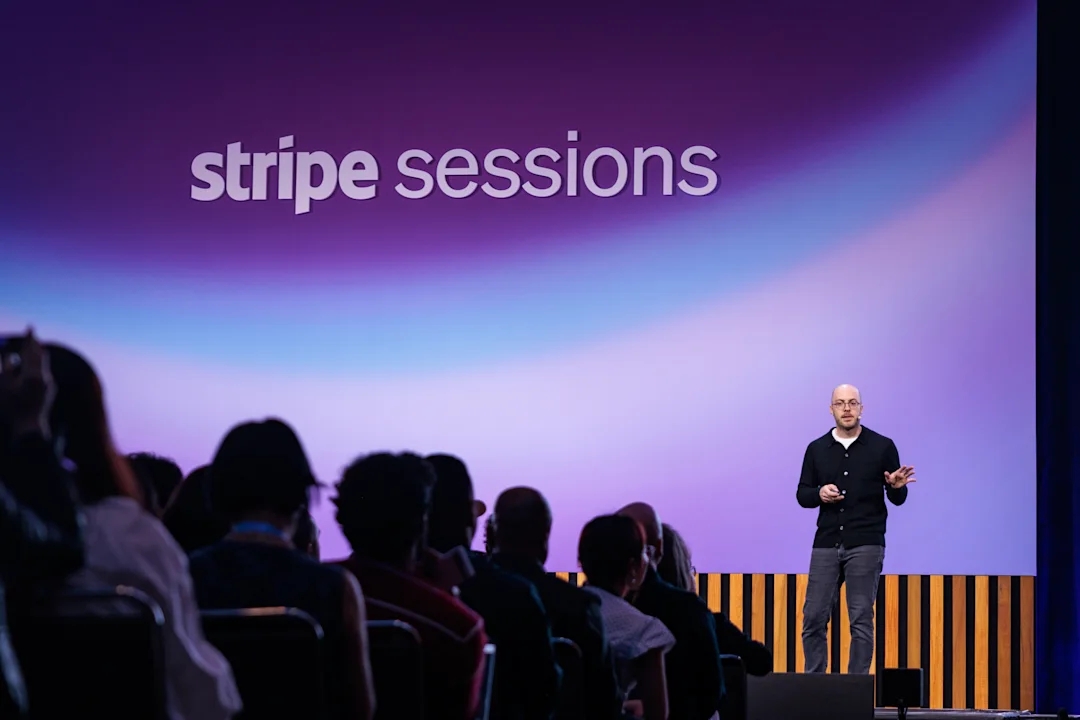
Your next website visitor might not scroll, click menus, or read your content. They might be an agent parsing your catalog and attempting to check out, or a customer expecting to converse in natural language. This session shows what agent-ready ecommerce looks like in practice—with live demos and real things you can do today to make your stack agent-ready. We also introduce the emergence of "commerce runtimes" that let merchants expose policies, business logic, and intelligent surfaces for both humans and AI.
Speakers
Jonathan Arena, Cofounder and CPO, New Generation
JONATHAN ARENA: Hello, Stripe Sessions. Everyone enjoying the show today? It’s like the best conference in the biz, in my opinion. My name is Jonathan Arena. I’m a cofounder of New Generation. See some friends in the audience. Thanks for coming. Today, I’m going to tell you a story about websites, about selling things online, and where we at New Generation think this is all headed. But first, a short step back into time. One of my heroes as a designer is this guy named Bill Atkinson: early Apple employee, and credited with inventing HyperCard, if you remember that. This was really one of the first primitives that was a card format in graphical user interface that combined images, buttons, links. Kind of like a product card on an ecommerce website.
No doubt that laid the foundation for one of the earliest screenshots I could find of an ecommerce website. I think Netmarket made the first one in ’94. Earliest screenshot, even the Wayback Machine and Internet Archive goes back to 2002, but it doesn’t seem like much has changed. It’s pixelated, but there’s still links, a familiar sidebar. Time is a little bit of a flat circle, which I think you’ll agree by the end of the talk. But it’s fun to see where we’ve been. Early ecommerce websites were largely designed actually for Google crawler and Googlebot, not for humans. Does anybody know what the first product sold on the internet is? Shout it out.
It was actually Sting’s album. It’d be fun to see if Sting knows that. All that is to say, leading us to present day, what should a commerce website be in the age of agents? That’s what we’re going to explore over the next few minutes. Let’s go shopping to find out. I’m going to take you on a little bit of a journey that I went through in preparing for this talk. And I’m going to go to a store that we at New Generation love. It’s called Quince. Now, I entered a search on Quince’s search bar. It was a very basic natural language search. I have a big stage talk, and I need a new top. What would be good?
What do you think Quince shows me? Skirts and a diaper pail. I don’t know if they’re trying to tell me that this is like a garbage talk. You can be the judge. Unfortunately, this problem is not unique to Quince. Quince is actually an exceptional website. And by the way, an exceptional company. You should go check them out. And the problem is deeper than a cosmetic or surface level search doesn’t work. It actually goes all the way to the infrastructure level. What about shopping for a mortgage? The beautiful Chase mortgage website. I see this H-roll carousel with features and perks. Who is going to click on that? Sorry, Chase. Nobody.
And then down below the fold, way below the fold is, “Why choose Chase.” Surely we can do better than this. What’s happening here? It’s because all these websites are built for the average customer, which everybody knows doesn’t exist. And as a consequence, it’s optimized for none of them. The website can’t understand your intention. It can’t easily get information to you. You have to go search for it. And as we’ve seen, the display of information doesn’t leave the best first impression. So I have a provocation for you. What if the website itself were intelligent? What might that be like?
Maybe it’s a website that allows you to talk naturally with your voice or with a natural language query. But let’s not forget that shopping is visual, right? People have eyes, they have judgment and taste. They want to see what they’re shopping for. What if an interface could be built for you, based on what you’re trying to accomplish? So let’s go back to Quince and imagine a world in which that website had 60 more IQ points. The first thing you’d probably see is a landing page that is aware of what’s happening. Maybe it’s trends on the internet. Maybe it knows that Mother’s Day is coming up, and you might be looking for a great gift. Probably an intelligent website would do this automatically.
So let’s try that same query on the version of Quince that went to grad school. And this was my experience. It’s qualifying me. It’s asking which gender I’m shopping for. And in real time, it’s generating a bespoke webpage for me, tailored to the intent I expressed. It could ask intelligent follow-up questions, generate and render dynamic filters. I like cashmere. That’s a soft thing, and Quince is, you know, good price. And I get made fun of all the time by my wife. My wardrobe is monochromatic, so I like black. This entire page is actually AI generated, and it’s contextually relevant to my search. It can help me qualify, “Is this product right for what I asked for?” It could even ask me smart follow-up questions. Like is this going to be too warm onstage? It says probably yes. Thankfully, I’ve been here before. I know they have AC, so I bought it anyway.
Yes, we dogfood our own products.
Shopping starts with intent, not a keyword. We like to say that now the internet is denominated in natural language. This is the primary interaction model that will be how we engage with websites and the internet at large. So “commerce agents” may or may not be a new term for you. This mythical creature of an AI agent—you’ve heard of coding agents, maybe customer service agents. Here’s a definition. The purpose of a commerce agent is to help retailers engage in selling things online with this new channel. We think AI is a brand new channel, and it can do things. It can save time. It can understand and engage with customers.
Interestingly, and I think this is pretty cool, an agent can also have its own address. There’s two reasons for this. One, obviously, if you’re a retailer and you’re experimenting with new technology, this provides a really wonderful way for you to partition what a commerce agent can do and compare it against your existing website in an A/B test. Number two, it acts as a dedicated endpoint to receive agentic traffic. Maybe this is where you expose your MCP tools or other tools that I’ll show you in a moment. What else can agents do? Let’s quickly revisit Quince and dive a little bit deeper.
So this is a different search I did around—I’m looking for some jewelry for an anniversary gift for my wife. Quince is great. They have many different verticals on their website. So again, bespoke webpage, this collection was dynamically assembled for me, and I’m not sure. I’m evaluating natural diamonds versus lab grown diamonds. What if it could render a dynamic comparison table perfectly built for the vector of comparison I’m interested in? I like that one. Let’s add it to the cart. Oh, interesting. So a smart website would know that I’ve added something to my cart and automatically generate a perfect bundle. This is what I mean. These are answer types, and this is UI that the agent is understanding because it knows about my customer journey. It knows where I am. It knows what I’ve said.
Are we giving the website a chatbot? Definitely not. This is at the substrate of the website itself. Not a little widget in the corner with just text. This is a fully immersive visual experience that a brand can now control. Let’s take a dive under the hood because I’m sure you’re wondering, how is this being built? And I’m going to show you. It all starts with knowledge. This first block is what we call the semantic knowledge layer. And the easy way to think about this is we just give the commerce agent all the information it needs to know about how to be an exceptional salesperson on your website. That means it knows about your catalog, your merchant rules, your policies. It can enrich your catalog with internet data if that’s relevant.
It can access a library of expertise. We can then feed that knowledge into what we call the “commerce runtime.” And this is a stateful environment that the agent lives in during an agentic commerce session. So in addition to having access to all this information and this knowledge, the agent can use tools. Some of these tools, as you’ve already experienced, are a natural language search API. State and memory. If you tell the agent something, it should remember. Think about that for logged in experiences in the future. You’re going to have this preference dataset that you allow to be stored with the merchant.
Composable UI, the ability for an agent to generate on-demand interfaces and a virtual cart, which we’ll get to in a moment. Lastly, the outputs. So we’ve seen some of these outputs already. The AI storefront hosted on maybe an AI subdomain on a brand’s website. Really, they could host that anywhere. But we know that many different outputs are racing towards us. Some of us have probably heard and seen ChatGPT Apps SDK or Claude MCP Apps. Imagine if you are a consumer shopping in Claude, wouldn’t it be great if Quince’s intelligent generative website could render right there before the customer? This is the type of consideration that I’m sharing with the audience today.
And it’s really this runtime that it’s, I think, the most interesting part. And diving even deeper yet still, what’s most fascinating to me—again, having spent my career designing software and interfaces—is composable UI. And we talk to hundreds of merchants around the world, and one of the things we keep hearing again and again is, how do you make sure that generative interfaces are on brand reliably? It would be kind of disappointing if Quince’s agent rendered UI that looked like Target. That’s a no-go. How can we prevent that? What we do is we send an agent to understand and extract the design system of any brand. They could also upload their design system if they have that, if it’s sophisticated company. But this is everything from the image style, the typography, the white space, the tone of voice, the buttons and the components, the motion.
All of this will be programmatic. We then normalize that and we give it as a tool to the agent. One metaphor that’s helpful to think about how this works is, we say to brands a lot, “The agent has a bag of Lego blocks. These are your components. These are your design systems. This is very partitioned, and these are the only pieces that the agent can use to assemble interfaces. That’s how we make sure it’s accurate and consistent and on brand.” And the purpose of all this, the big idea is we finally maybe have an opportunity to collapse and close the gap between human intent and a machine’s ability to take the right action. Everybody has experienced this gap, right? If you’ve ever been frustrated on a website, you’ve experienced this gap.
Commerce agents can help close this gap. The result is that humans can express themselves freely without constraint, without concern, and have delightful experiences where merchants and retailers can actually have, be the beneficiaries of a lot of new value. So one agent, five powerful new jobs the old website could not do. Generate bespoke answers for every customer at scale. Format catalogs, PDP data, policy information for agents and agentic systems. Provide incredibly rich first-party data. Use case here is now customers are trying to discover, evaluate, and buy your products in natural language. That’s information you’ve never had available to you.
Obviously, let’s not forget the business outcomes. Commerce agents know how to sell your products. Average order value goes up, conversion goes up. And these are learning systems. They learn what works, what doesn’t. They self-reinforce, they self-learn. And perhaps where it gets the most interesting is a commerce agent is actually, in our opinion, the future interface for consumer agents. So what happens when the visitor to your website is an agent? We know these are now first-class citizens of the web. I think recently last year, we crossed a 50% threshold where more than half of all internet traffic is nonhuman.
And it seems like every week, there’s a new type of agentic system that comes out. It’s really interesting. So we just saw what we like to call “AI shoppers.” That’s you or me using natural language. We’re now all AI shoppers. Of course, we have LLMs that are using crawlers and different methods to extract internet data. They’re trained on some of it, of course. Tool use agents like Claude or OpenClaw and agentic browsers and browser agents. Let’s take a look at one of these in detail. What happens when browser agents interact with websites? So about eight months ago, we sent an agent to Samsung’s website, and we also sent an agent to Samsung’s website that had the very early beginnings of a commerce agent. And I want to show you what happened.
Now it’s a little fast. You got to pay attention. On the left is regular Samsung, and on the right is the smart Samsung. Same query, same product catalog. And the smart website’s already finished. And if you have to take my word for it, it’s actually a really good answer. High quality. And even 8 months ago, this website was 10 times faster than Samsung.com at answering the agent’s question. Why? What’s happening? Well, agents don’t like human UI. They get stuck on pop-up windows. They have to go from PDP to PDP, extract all the data, reason over it, look for reviews. They get stuck on JavaScript. There’s all sorts of problems. Surely we thought there must be a better way. And so over the last eight months, we’ve been building that better way.
And as I mentioned, the pace of change here is so incredibly fast, that we actually think a wonderful use case for agents is simply abstracting all that complexity and helping you keep up and experiment with the efficient frontier. So I’ll show you where we are today. And before I play this, I want to set up what you’re about to see. This is Comet, Perplexity’s agentic browser, and this is a demonstration of that interacting directly with Quince’s commerce agent that we built. The last thing that’s very interesting about browsers here, is that they know who you are because they have your history and you can opt in to share preferences. So automatically, the browser can tell the conversation of Quince: “This is Jonathan. This is where he lives. These are his preferences, his shoe size, you name it.” And what happens is pretty remarkable.
And we asked a pretty tough question to test it out. My wife and I are going to Japan. We want capsule collections for both of us. We have a $1,000 budget. Go figure it out. What’s happening here is, the agents are working together to try to get me the best answer possible. And this is going to be groundbreaking for merchants, because this means that they can still maintain merchandising control and have an ability to share their expertise with the agent. It did its job. It printed me out a whole collection. It was under budget. It split the collection between my wife and I. I was actually pretty impressed with this. To be clear, this is completely impossible today with regular websites, or it would take way too long and you’d leave.
And of course, everyone’s wondering about checkout. This is Stripe conference after all, right? So what if I wanted to buy all that stuff after some back and forth, say, “Yeah, go pull the trigger.” Well, our point of view here is a little bit different and unique. In contrast to agentic checkout in a closed ecosystem, like within ChatGPT, what we’re describing here is how any agent with a tokenized credit card could go to the open web to any merchant that has a commerce agent and check out. What you just saw with Comet are these pieces. And the simple way that this works is, the commerce agent can now take the buy intent from the customer, given to it from the agent, and the credit card, and it can use those tools we talked about before—a virtual cart. It then goes and looks up, is this product in stock?
What’s the final shipping cost? All those ticky-tacky details. And it’s going to take that information and pass it through a checkout session, maybe similar to what Stripe is doing with Agentic Commerce Protocol, but it’s really this merchant-side infrastructure that allows any merchant to be ready for this at scale.
So how prepared is the average website to receive these new first-class visitors? These are three questions that we ask. And we were asking these questions so much that we built something called the “Agent Commerce Score.” And this is probably the most advanced evaluation of a website’s preparedness to receive agents and answer their questions. I’ll show you how it works. We send 100 agents to Quince, and we ask 100 different questions, and these questions are automatically generated to be very relevant for what Quince sells and who they are. We ask easy questions, we call them table stakes questions, and we ask data-intensive questions like, compare reviews across these variables. You can go all the way down to a single question and take a look at how the agent did. Which products was it served? Are these the right products? You can even click on a replay of the agent experience, and it can tell you how it thinks it did.
This provides incredible data again and very clear next steps for any brand to evaluate, “Here’s where we’re doing well, and here’s where we need to take next steps.”
And we found a really interesting one in looking at this report—a softball question. I think it’s a pretty easy question like, “Can I self-launder a suit?” No, you should probably dry-clean it, but we wanted to test if the website could answer a basic question like that. It didn’t do well. It says “Poor,” so we wanted to know why. Kind of a disappointing answer. It got stuck on a pop-up window that it could not dismiss. Now, I’m sharing this really to describe how brittle the standard website is. And of note, perhaps this was the modal that the agent saw and it says, “Hold on.” Maybe it just got stuck here and obeyed instructions. We don’t know.
So when you’re asking a question to a website, and the website can answer back effectively, you have a much better chance of converting that customer, be it an agent customer or a human customer. If you can’t, they’re going to bounce. This is what we call the bounce rate of the future, and we think every owner of every website needs to be paying attention to this, because it’s not like demand goes away. It just goes somewhere else. It goes to your competitor. You have a high-intent customer saying what they want. If you’re not ready to give a good answer, they’re going to find it somewhere else.
So I will leave you with a few takeaways that you can share back with your teams. The website becomes programmable. We are moving out of the era of static one-size-fits-all websites and into intelligence systems. The storefront becomes portable. Yes, everyone will still need a website. We believe that you will still have traffic to your website. But in addition, you probably need your website to go out and meet customers where they are. Maybe thousands, if not millions of AI surfaces where customers are shopping. Every brand gets their own commerce agent, and this allows teams to turn into orchestrators and directors, saving CapEx and overhead and time.
So here’s your checklist and your homework. I’m going to ground this again. Can you answer natural language questions? Can you receive these new customers? Are you aware of the intention of your customers and where they are in their shopping journey? And of course, can it dynamically bend and scale? If you’re curious, you can go get a score. It takes about 15 minutes for the agents to do their job. We’d love to hear from you if you do that. And if you think that this is interesting, and you’re struggling to answer these questions yourself, we think about this every day. Thank you so much.