When AI starts spending: Payments for the agentic era
Reaching global markets with stablecoins and crypto
Esecuzione
Compila il modulo per guardare il video completo
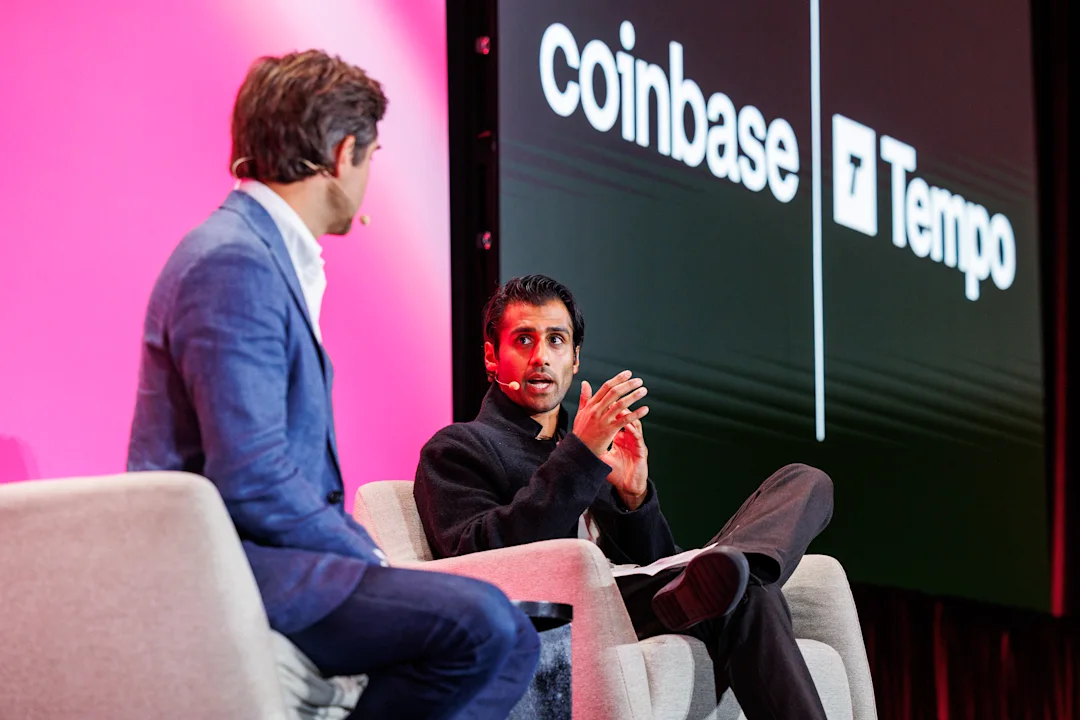
Today’s payment rails were built for humans, for banks, and for batch settlement, not software transacting around the clock. But agents are negotiating prices, moving funds across borders, and paying other agents all without human input. Coinbase explores why stablecoins are emerging as the programmable financial layer for agentic commerce and how to build payments infrastructure for a world that never logs off.
Speakers
Shan Aggarwal, Chief Business Officer, Coinbase
Dan Romero, Business Lead, Tempo
DAN ROMERO: All right. Quick question before we start: show of hands, who here has ever sent a Stablecoin transaction? Okay, pretty good. And then, who here has used an agent of any type? Okay, so a little bit more agent-heavy than stablecoin-heavy. So maybe we start, do stablecoins replace credit cards for agents?
SHAN AGGARWAL: Seems like the apt question to ask me.
DAN ROMERO: Yeah.
SHAN AGGARWAL: So my view is that stablecoins are not a replacement. They’re an expansion. And so it’s not really an and or an or situation. It’s more they can both be complementary and expand the ecosystem. And I think if you take a step back and zoom out, the internet basically has a whole new set of buyers. It’s a different profile of customer who’s showing up and purchasing, and that’s AI agents. And AI agents will outnumber humans on the internet. There’s literally going to be billions and billions of agents. And I think that they will actually be the core drivers of the internet economy.
And cards are a fantastic rail, but they were designed for human-initiated payments. And there’s a lot of bright spots around cards. They offer unparalleled consumer trust and protection, broad merchant acceptance, broad consumer adoption, and they perform all of those roles very well. And I think that agents in many ways will accelerate the adoption of cards as well. But with a new buyer profile, there’s net new payment flows, and agents will pay for things in different ways than humans do. So things like machine-to-machine payments, programmatic pay-per-use payments or streaming payments, those are things that card rails weren’t natively designed to handle. And stablecoins are programmable, always on global money. And so the architecture is natively designed to meet the needs of agents. And so I think that in many ways they’re well-suited to address a lot of those net new payment flows that you’ll start to see emerge from agents as they become a larger share of the internet economy.
DAN ROMERO: I bet a bunch of people would’ve expected to say stablecoins would replace agents or cards. So I’m curious, do you actually believe what you just said?
SHAN AGGARWAL: I could be a “maxi” and say yes, but no, I do genuinely believe that it’s not going to be that stablecoins rule the world, and it’s an end-all, be-all. I think that we’ll live in a multirail system, and the payments ecosystem will just get hyper, hyper efficient, and rails that meet certain use cases and certain payment types will succeed and they’ll thrive. So example would be, if an agent wants to make a very high-order value purchase, card rails are great for that because you have chargebacks, you have fraud protection, you have layers of consumer protection that, today, stablecoins don’t provide. But for machine-to-machine payments, or, like I was mentioning for paper use payments that will emerge, I think that agents will defer default to stablecoins over time.
DAN ROMERO: Well, maybe we should introduce ourselves. I’m Dan Romero. I lead go-to-market for Tempo, which is the blockchain that Stripe and Paradigm incubated. And Shan?
SHAN AGGARWAL: Shan Aggarwal, I’m the chief business officer at Coinbase.
DAN ROMERO: I actually had the pleasure of, I’d say, hiring you at Coinbase back in the day. And one thing it’s kind of worth noting is that Shan was in the room when you guys originally did USDC at Coinbase. So I mean, maybe stablecoins weren’t necessarily even a thing when we were thinking about it back then.
SHAN AGGARWAL: Yeah. I mean, back then, frankly, when we launched it, I was blown away by the number of people who asked me a question of, well, why do I need a programmable digital dollar? What’s the point of it? What’s it good for? And I think that these technologies, and the growth of the agentic economy and stablecoins now, you can very clearly see how programmability and open ecosystems work very symbiotically in a way that wasn’t so apparent back then. And so when we started USDC in 2018, the first use case that actually saw adoption was not payments-oriented. It was supporting crypto capital markets. There’s a lot of onchain protocols, and there’s a lot of exchanges around the world that don’t necessarily have seamless access to fiat rails. And so you can run those entire exchanges on stablecoin rails, and it looks a lot like a dollar.
And I think you’re starting to see similar things now happen with payments where you can have a virtual account that looks like a US dollar bank account, but it can be issued to anyone anywhere, and it’s inherently global. And so it’s interesting to now see this second use case expand and expand very quickly.
DAN ROMERO: And maybe to touch upon that, why do you think it’s shifted more towards payments and, given that it started at capital markets, and now we’re on stage talking about agentic payments?
SHAN AGGARWAL: Yeah. Well, it depends on what metric you look at. If you look at stablecoin supply versus stablecoin transactions, for stablecoin supply, still the predominant use case for stablecoins is in crypto capital markets. The vast majority of supply supports crypto trading, borrow/lend protocols, and credit markets, and things of that nature. But we’ve started to see significant pickup on the payment side. And I think a lot of that has really been sparked by the infrastructure pieces coming together in a way where a lot of the early adopters saw stablecoins as a lower cost, more efficient way to just move money across borders and even within their own company. And we still see significant demand from corporates and enterprises for those use cases, but where we’re seeing green shoots—and I say “green shoots” because it’s still like very, very early days, the infrastructure pieces are there, but the ecosystem is pretty thin still—is with agents that sort of organically looked to stablecoins as a payment rail because of the inherent elements of programmability and the fact that they’re always on, gives them a lot of flexibility for specific use cases that we’re starting to see.
DAN ROMERO: And maybe, why now with agents and payments? And you’ve talked about the intents becoming the interface. I’m curious if you can expand upon that a bit.
SHAN AGGARWAL: Yeah. So I think the way that humans interact with the internet is completely changing. So the flow today really involves UIs and a common flow where you browse, select, and then check out. You go to a website, you browse a bunch of options, you pick a thing, you put something in your cart, and then you check out. And going forward, intents are the new interface, where you express an intent through a terminal, and then an agent just figures it out for you. And the interesting thing about that is it sort of collapses that three-step transaction flow into one. Instead of browsing, selecting and checking out, you instruct through an intent, the agent, who can then fulfill that task. And from a payments perspective, the interesting thing—and we know this, it’s a common concept within the crypto space—is you can sort of embed the payment in the intent resolution.
So instead of having the checkout be the final step, the agent can say, “It’s a conditional payment. I will transact if these conditions are met, and therefore the payment is made in real time.” And so it’s all bundled into one transaction. And I think that’s just a very different way for how the internet is sort of architected today, where today it’s primarily a visual marketplace for humans, but in the future, it’s a programmable marketplace for agents, and stablecoins are very well-suited for that inherent need for programmability. And so that’s why I think that for agent-native transactions and these new payment flows that will get created, stablecoins are the native payment rail. Rather than retrofitting card rails to work for agents, stablecoins were built with these elements from the very beginning.
DAN ROMERO: Yeah. I mean, I think from the Tempo perspective, one of the demos, maybe you were watching the keynote when Will kind of walked through the example of an agent discovering the fact that the API endpoint that his demo was doing accepted payments over crypto and then the ability to actually do it at a very, very granular and small level, just not possible with other payment methods. At the same time, you can also accept other payment methods through programmable and protocol-based like x402.
SHAN AGGARWAL: Yeah. And I don’t think that’s a bad thing. To your first question, it’s growing the pie because those types of payments, they weren’t previously happening. So now they are happening, and I think a lot of them will be facilitated by stablecoins, but many transactions will continue to run on card rails as well.
DAN ROMERO: Do you think that there’s any specific differences between how an agent is kind of choosing, or kind of flowing through, with payments versus humans? We talked a little bit about this.
SHAN AGGARWAL: Yeah. So the first is agents are rational and ruthless optimizers. So we all have our friends, those friends who are like overoptimizers, and there’s kind of a negative connotation when a human is an overoptimizer. And humans tend to be loyal. We express brand loyalty, we value convenience, but agents just see through all of that. And it’s purely based on what is the lowest cost, most efficient service to provide or complete whatever task that I need to complete, and then payment rail that I can leverage. And so I think the implication of that is that switching costs are relatively low because there’s no embedded loyalty for subjective elements like, “I like this brand more than that brand, and I’m willing to pay a premium for it.” Historically, that has been a very important lock-in for human-based transactions. The second is agents don’t really have identity, and that’s obviously very important when you’re moving money.
There’s no bank account, there’s no home address, there’s no POA or anything like that, and that’s a key difference. And then I think the third key difference is that agents transact at machine speed and at machine scale. So it would break a human’s brain to make a thousand transactions in a day. You could do it, but how would you audit all of it? How would you keep track of all of it? You probably make 10 or maybe a hundred transactions max, but agents can make thousands or millions of transactions a day. And so I think that has implications for the cost structure of the ultimate underlying rails and where blockchains are very well-suited to serve.
DAN ROMERO: Yeah. One frame I always think about is if someone comes out with a brand new credit card that maybe is doing 4% cash back in Bitcoin, that seems interesting, but that’s like a lot of work to go get that new card, switch all of your subscriptions over to that. Where as an agent, that work could just happen.
SHAN AGGARWAL: Yeah.
DAN ROMERO: And so kind of that rational, ruthless optimization of, “Oh, if I get an additional 0.1% cash back here, I’m going to use this payment rail.”
SHAN AGGARWAL: Yeah, agents will make you a better optimizer in your life. It’s like when you’re dealing with all of these credit cards that have these embedded bundles and these schemes that no one likes around—“You can get this benefit in this quarter”—an agent can help navigate all of that for you and make you a better card user so you can optimize your reward spend, in your example.
DAN ROMERO: So let’s say agents take over and are doing a large percentage of transactions. Are we actually in a multirail world in that case, or is it that they’re going to all optimize for the same thing?
SHAN AGGARWAL: I think we’ll be in a multirail world because I think different rails will be best-suited for different use cases. And I think that that optimization function that agents go through will lead them to whichever rail is the best-suited. So I gave the example around card rails. Card rails, there’s a lot of good reasons for why you would transact with a card and a lot of different transaction types for where that will be well-suited. So, for ecommerce, I think that that will continue to be the primary or default modality that agents use as well. But for stablecoins, we think more about these net new use cases and consumption patterns that are starting to emerge. And, like I said, it’s very much the experimentation phase, but that’s kind of what we’re starting to observe and see. So, an example of this, to make it a little bit more concrete is: I have an agent, and I want it to be my financial analyst and say, “Hey, can you go build a report and put together a perspective on should I invest in Coinbase stock?” And the agent might need to consume data from Bloomberg, from Morningstar, from all of these different proprietary data sources that have paywalls.
And if you have a proprietary data source, you want to scale demand as much as possible. And so now a lot of these sites are starting to opt in by becoming agent-accessible, and that allows an agent to pay cents for specific points that it might want to access within the dataset, produce a very robust report that gives me a lot of utility. And so that’s one example that we see both in the traditional finance world and then also in the crypto-specific space.
DAN ROMERO: But some people might say that micropayments never have worked, too much friction. So do you think just because agents are hyper-rational, willing to deal with the schlep and the pain, that that actually does work?
SHAN AGGARWAL: I think they didn’t work because the rails and the infrastructure didn’t allow for them to work.
DAN ROMERO: I think there’s a narrative out there. Obviously Tempo is working on MPP, Coinbase is working in x402. It’s kind of this head-to-head agentic protocol. Do you think it’s actually the case where it’s kind of like this battle VHS/Betamax, or is it a kind of a multiprotocol world?
SHAN AGGARWAL: What do you think?
DAN ROMERO: Well, I think agents, to your point, they’re polyglots, right? So you can ask it to write a programming-type script and have it switch over to Python. So, in the world where there are multiple protocols, they can speak both. And I think in most cases, if you just kind of look at the history of technology, there are very few protocols or standards that is the only, kind of, winner. I do think the web and SMTP for email are two maybe rare examples, but I think, generally, agents don’t care. They just kind of want to get the job done, right? So if you hit an API endpoint and says, “Hey, I speak protocol X or protocol Y,” they’re just going to get the job done, assuming a stablecoin is interoperable with either protocol, right? And similarly, maybe use a different chain here or a different chain there. And in the case that it doesn’t accept stablecoins, they can issue a virtual card and solve it that way.
SHAN AGGARWAL: Yeah. I mean, we see it pretty similarly. So we built x402 last year just because we saw a gap in the market where there wasn’t a HTTP-native payment protocol that was built for machines. And so we felt like, hey, if machine transactions are going to increase, then there should be a way for machines to fulfill that payment request. And so that was the sort of genesis behind x42. But we, fundamentally, we don’t believe it should be proprietary, which is why we open sourced it with Stripe and Cloudflare and a number of others. And so if another protocol emerges that fits the agent’s use case, then that’s great. That’s totally fine. I think, from our perspective, we want to ensure that we try to avoid walled gardens and fragmentation that potentially limits the utility and ability for agents to transact on the internet.
DAN ROMERO: If I’m being totally intellectually honest, when I scroll Twitter, and I see a bunch of the kind of agentic protocols and some of the charts, there’s a lot of chart crime on crypto, Twitter, especially, where they put big volumes, and then it’s like, “Okay, well, what’s actually behind that volume?” Maybe if we just step back, what do you think is holding back the takeoff for agentic payments? I mean, you saw some of the charts that Patrick was showing in terms of just things kind of going vertical from the singularity standpoint, but I don’t feel like we’ve hit that for agentic payments. I’m curious, what’s the missing ingredient?
SHAN AGGARWAL: Yeah, we’ve definitely not hit that for agentic payments. I think it’s like inning one or maybe even the warm-ups in the bullpen or something like that. In terms of what’s missing, I think there’s a few components that come to mind. So, first, is we need broad payment acceptance. Just like when cards launched, cards had minimal utility if no merchants accepted cards. And so we need merchants, PSPs, et cetera, to make their services agent-accessible. And so x402, MPP, these are protocols that can help those businesses do that. So I think that’s one. The second is, I mentioned earlier: the identity component, but I do think that that is actually quite fundamental because if you think about an agent that comes and requests to make a payment or make a purchase, there’s no way right now to validate, is this like a legitimate transaction that that agent is doing on behalf of the human that it’s working for, or is it just going rogue?
And so I do think that we’ll need more portable and flexible identity layers for agents that are consumable on the acceptance side. And then the third is: I think the entire compliance layer and trust layer is very much like uncharted territories. And so we talked a little bit, that’s where cards really shine. And cards have invested a tremendous amount. And I think that’s been a huge driver of the success that cards have seen in terms of achieving broad scale consumer adoption. And for the most part today, stablecoin transactions are irreversible, and that puts us a bit of a ceiling in terms of, am I really going to be comfortable making this multithousand dollar purchase using stablecoins? I think back to when mobile phones came out, an interesting stat that I always noticed is there was a significant delta between the average order value on desktop versus mobile.
People felt comfortable spending more money on desktop than they did on mobile. And why was that? It’s a little bit of consumer behavior, I’m spending a lot of money, but that builds up over time. And so I think that entire trust layer is very much uncharted territory that needs to get solved.
DAN ROMERO: So if we rebuild that trust layer, are we just rebuilding the cost that exists in the existing system?
SHAN AGGARWAL: Well, if you can do it, I think if you can do it onchain with smart contracts in a more open software–forward way, then my hope is that the cost will be significantly reduced. And then, it’s not just a cost thing, but it’s also making sure that these things are apples-to-apples. They should be natively developed together, payments and identity, rather than retrofitting legacy identity systems for a new agent-led economy.
DAN ROMERO: Yeah. From my perspective, I think payments actually feel like at least the plumbing feels solved. It’s the identity piece that you mentioned. It’s like, okay, well, in order to pay for this service, you actually need to go sign up with an email address, and then come back because we don’t want anonymous agents paying for the APIs. And then I think the second component is how do you actually fund the agent, like the classic problem, which it always comes back to. And it’s like, okay, moving from fiat into something like stablecoins, there’s a fraud vector, and things like that as well as complete.
SHAN AGGARWAL: Yes.
DAN ROMERO: So, a bunch of folks in the audience, probably CEOs, developers. If you had a company right now, and let’s say you really only accept cards, how would you be thinking about agentic payments? Is this a P0, have the whole team work on it tomorrow or…?
SHAN AGGARWAL: Yeah. Well, it’s hard to comment on P0, P1 without knowing all your priorities. I think it’s something that you should start to experiment with for sure right now. And I think the two things that I would think about are: one, if you believe that agents will be a core driver of the internet economy, like they will be core purchasers, core… I think about them effectively as a new customer segment. It’s a new customer segment that didn’t exist previously that is coming to your door and is going to grow very significantly. And so, is my product accessible by this new customer segment? If you’re purely relying on a UI, then your product is effectively invisible to an agent. And so I would think about, again, how can I build my product so that it is natively agent-accessible because I do believe that they will become important actors in the economy.
The second is, I think, thinking keenly about pricing models, we live in a world right now where there’s a heavy preference towards bundled subscriptions, and bundling is like a very core strategy for a lot of large-scale businesses, but I think that’s fundamentally sort of at odds with agents that are ruthless optimizers because you think about what’s the calculus on, “Am I going to pay for this large, heavy bundle when I only need to consume one, two, three, four, five services, or am I going to look for an alternative?” And so I think starting to think early about different types of pay-per-use payment models will be really important as well.
DAN ROMERO: And just to maybe go back to Coinbase, as you guys think about the business model of Coinbase, is that changing any of your thinking?
SHAN AGGARWAL: Yeah, definitely. I mean, we’ve built out a new product line that’s called a Coinbase Developer Platform that’s purely API-first. And then we’re thinking about these elements for how agents ultimately end up accessing, for example, our crypto exchange. Historically, every customer that came to the crypto exchange had to complete KYC and set up an account and prefund the account, but that’s going to look very different. If you believe that demand for trading is not going to go away, but the people or the agents that are driving the trading activity changes, then we need to adapt our business to ensure that we reduce friction as much as possible and make that as seamless as we can.
DAN ROMERO: All right. I have two final questions. So the first would be: what is something you strongly believe will be the same 10 years from now?
SHAN AGGARWAL: The same?
DAN ROMERO: Yeah. With all these changes, right? What do you think is the same?
SHAN AGGARWAL: People are still going to use cash for offline payments. That’s not changing.
DAN ROMERO: Yeah, that’s definitely probably true.
SHAN AGGARWAL: Yeah.
DAN ROMERO: And then I guess the final question is: what’s a version of the future that maybe you’re thinking about or you’ve heard that you actually think is likely to happen as it relates to agents?
SHAN AGGARWAL: So one that I’ve heard, which is I noodle on, but I think we were talking about the UX layer for the internet being designed for humans natively. And the business model that has been applied on top of that has been an ads-based business model, where the largest companies in the world monetize on attention. But if the internet is no longer driven by humans engaging on the internet, but driven by intents and agents, then does that ad space business model hold? Do agents care about advertising, and does that influence their purchasing decisions or their direction? Facebook and Google’s entire business is based on directing flow of traffic through ads. And I think that in 10 years, that that will look very, very different. And again, I think that it will favor more granular- and programmable-type payments that allow agents to optimize the usage of different services. And again, I think that’s one of the ways that stablecoins is well-suited to serve.
DAN ROMERO: Well, Shan, thank you very much.