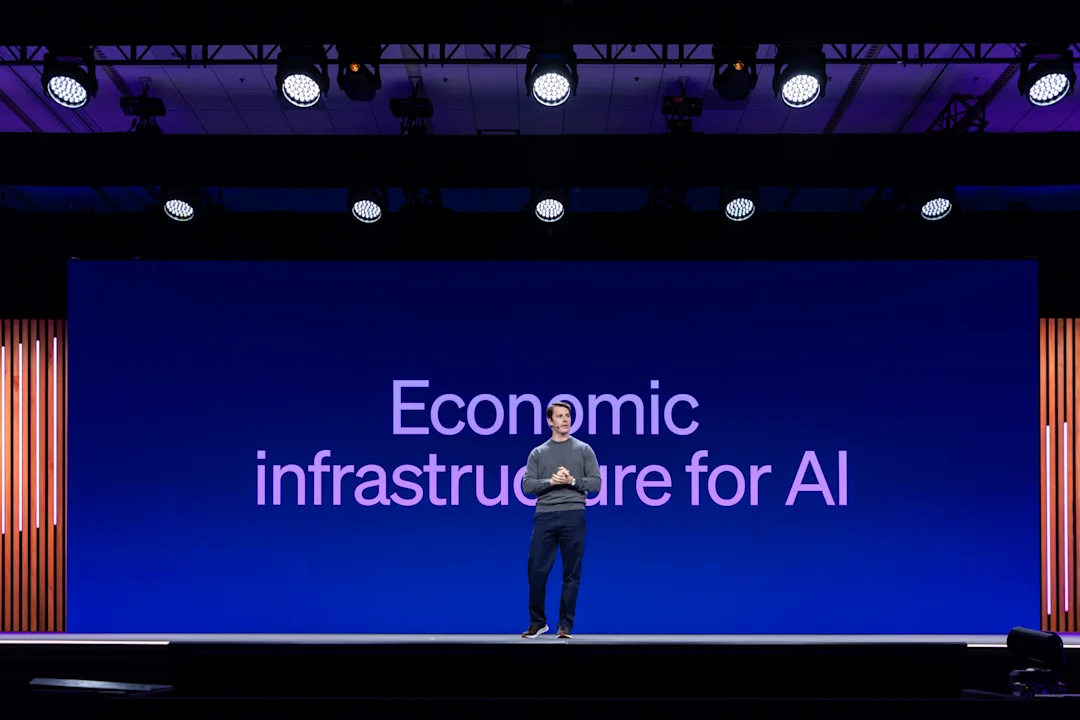
Indexing the economy
Discours d'ouverture
Durée
Remplissez le formulaire pour voir la vidéo en entier

Stripe cofounder John Collison shares a data-driven look at the state of the global economy—what’s happening today, how it’s shifting, and what it means for different business models and markets.
Speakers
John Collison, Cofounder and President, Stripe
JOHN COLLISON: Good morning. It is great to be back at Moscone. You can almost feel the tectonic plates shifting underneath us. Yesterday, Will walked you through the 288 new products that we’re launching to help you as the economy replatforms around AI. But today, I want to take you to my happy place, getting deep into the economic data and I have a few big trends that we’re seeing that I want to talk you through. But first, let’s take stock of what’s happened since we were together here at Sessions last year. So since we last got together, it’s been a little wobbly. In January, the software sector lost a trillion dollars of market value in under 30 days. You’re all familiar with the worry. AI makes software more abundant, more substitutable, potentially less sticky than prior models had assumed. But interestingly, this is a perspective worry. It’s not revenue softness that’s happening right now.
SaaS payment volumes and Stripe, they’re actually a good chunk higher today than before the sell-off. So SaaS is still growing just fine.
What does seem to have come back into fashion though is profitability and not just in software, but across the entire equity market. So this is a chart showing how much market cap has historically accrued to the most profitable and the least profitable companies in the index. So you see in the middle here, this is the dot-com boom where the markets went a bit mad for a moment, and briefly, the least profitable companies were worth more than the most profitable ones. But if you go forward to today, now, despite all the talk about bubbles, it’s the opposite. The markets are being tediously rational. The most profitable companies are the ones being rewarded with outsize valuations.
We heard a lot about trade policy over the past year. Believe it or not, it’s only been a year since Liberation Day. It feels like eight years, but one year. And the common wisdom by now is that the tariffs were kind of economically speaking “a nothing burger,” the dog that didn’t bark. And you can make that case. Trade flows ended the year only a little bit below 2024 levels, but there were higher prices to absorb as a result of tariffs. And what happened is early on, you had businesses eating the higher costs, but now quarter by quarter, they’re starting to pass them through. So we can throw up durable goods prices here. And this is how they behave intrayear in normal years. You might be wondering, “Why is there this downward trend?” It’s because you have deflation in durable goods. Manufacturing productivity generally increases, global trade adds competition, and your flat-screen TV gets cheaper or your washing machine gets better for the same price.
So you usually, in most years, get this gentle, predictable slope downward. And you see this only goes up to ’24. If we add ’25, totally different. Bucks the trend. And if we add ’26, it’s only three months in, but same thing is happening and even more so. So our view is that tariff costs are still working their way through to the consumer. The story is not written yet.
Another phenomenon you might’ve heard about is this K-shaped economy. The idea that wealthy consumers are holding things up. They’re an increasingly large share of the spending. So maybe you saw this go viral on Twitter. This is the new United 787-9 seat map. And you can see that most of the cabin is now dedicated to business class seats. Or you can look at Delta’s ticket revenue. So they reported that premium seat revenue is now bigger than economy for the first time. This stuff gets a lot of retweets, but we don’t actually see it in Stripe’s data. So if we look at the ratio of high-income to low-income consumer spending in our data, in a K-shaped economy, you’d expect this chart to be going up, but it’s the opposite. The line is trending gradually downwards. The gap between high-income and low-income spending has been shrinking. So we don’t actually see, when we look for it, this overreliance of the economy on high-end consumers that everyone has been talking about.
The other major economic topic is the worry that AI is taking all the jobs. And if you look at the numbers, it’s true the labor market is cooling slightly. US unemployment rates are ticking up about a percentage point over the past three years. But you can ask the question: how much of that is actually AI? Part of it is the delayed pandemic hangover. If you look at the hiring rate, companies really binged on hiring in ’21 and ’22, and they’re still unwinding that, and tighter immigration played a bit of a role. And then of course, you have interest rates. So the Fed’s latest forecast for the end of 2026 is half a point higher than they predicted at this time two years ago. So money is tighter and tight money slows hiring. So AI is in the mix. It’s presumably going to have a big future impact, but it’s one force amongst many and probably not the dominant one in the labor market numbers you’ve seen to date.
Now, you’re probably wondering what we’re seeing at Stripe and how it corresponds to what’s going on in the wider world. Stripe now processes almost 2% of global GDP, so we’ve a really useful window into the forefront of the entire economy. There’s three areas that I want to dive into deeper with you.
The first is that we’re seeing a structural increase in economic dynamism. More firms are getting started. They’re keeping head count lean for longer, but they’re scaling revenue faster than we’ve ever seen before. To explore this more, I’d like to call on some help from an actual economist, Stripe’s head of data and AI, Emily Sands.
EMILY GLASSBERG SANDS: Thanks, John. There’s plenty of talk about AI not showing up in the macrodata yet, like the labor stats we just saw. If you’re as AI-pilled as most of us in this room, that probably creates some cognitive dissonance. But here’s the thing: AI actually is showing up in the macrodata. You just have to know where to look. Here’s US business formations over the past 20 years. You can see a huge bump during the pandemic, not surprising, but you can also see it reaccelerating now. Basically, all of the recent growth is coming from what the Census Bureau calls nonemployer firms, or what we all call solopreneurs. That’s the blue line here. Now, these didn’t used to be considered serious businesses, but AI means more of these businesses are getting to real scale. This is the number of solopreneurs in the US doing over $100,000 in revenue.
Yes, solopreneurism is now how close to five million Americans earn their living. And we’re fortunate to have many thriving solopreneurs building with Stripe. It’s a great crew. This isn’t just an American story. New business registrations are up 40% in Australia, up 70% in Finland, up 80% in France. So the surge in dynamism is happening across advanced economies. At Stripe, we’re seeing this firsthand.
JOHN COLLISON: Yeah. Stripe Atlas is the simplest way to get incorporated in the US. And last week, we celebrated our 100,000th Atlas-founded business. So somewhat topically for this talk, that business is Amperical, which is building AI software that optimizes profitability for battery energy storage systems. Sounds like something we’re going to need. And I actually think Rachana, the founder, is here today. But the point is, we hit 100,000 Atlas incorporations way earlier than we expected. The number has exploded. There’s more of them and they’re scaling up like crazy.
EMILY GLASSBERG SANDS: They really are. So in aggregate, Atlas companies incorporated in 2025 are raking in twice as much revenue as the class of ’24 was by this point. Nothing shabby about a doubling, but it’s the class of ’26 that’s really cooking. So let’s zoom in a little bit and you can see that just a few months into the year, the class of ’26 is tracking to five times the revenue of last year’s cohort. These are very unusual growth rates, and they’re driven in part by a generational shift in how companies grow internationally. So one simple way to see this is to ask, “Across Stripe, how many companies are earning most of their revenue outside their home country?” Five years ago, that was 11.6%. Since then, it’s doubled. And they aren’t just selling in the obvious places. Among companies making most of their money cross-border, around a quarter are making most outside the top 10 global markets. It’s a real long tail story.
The international pecking order has also flipped. It used to be that young companies sold mostly at home and only ventured out to the open sea of global commerce once they’ve gotten big. Now, it’s the newborns on Stripe who are globetrotting their way through the long tail of markets. Take the top 100 AI startups on Stripe. The median earns most of its revenue internationally and sells into 55 countries within its first year of existence. Emergent Labs was founded in the US in 2024, but already nearly 70% of their revenue comes from abroad. They’re doing material business in many markets. No less than 16 countries drive at least 1% of Emergence revenue. So this is a totally new startup playbook. You launch globally on day one, you keep head count very lean, and you automate aggressively. But not every business can be a solopreneur or a top AI startup.
So what does all of this mean for the median firm? Despite the fact that one of us has a PhD in economics and the other dropped out of college and now hosts a podcast in a pub, John is going to teach us a little bit about economic history.
JOHN COLLISON: I think you might be surprised to learn just how many economic theories have been devised over a pint, Dr. Sands. OK. Some economic history. Are we ready? In 1931, a 21-year-old British student took a road trip across Depression era America. And back then, as now, a bunch of young people—pretty into communism. Central planning had this real intellectual prestige at the time. A lot of smart people thought that top-down coordination might be the way to do things much better than messy, chaotic markets. And the student noticed something interesting. Within a firm, resources aren’t allocated by prices. There’s no little market inside the company. Companies themselves are centrally planned. And so he wondered, “If markets are so efficient, why do we keep building little islands of central planning inside markets?” His name was Ronald Coase, and his answer was that firms exist because coordinating inside a company is often actually cheaper and easier than coordinating through markets. And that answer won him the Nobel Prize… 60 years later. They don’t rush into decisions over there in Stockholm.
EMILY GLASSBERG SANDS: I know what you’re thinking. John’s little economic story is heavy on story and light on economics, but here’s where we’re going. What’s the Coasean reading of AI? In the near term, the within firm effect is the most obvious. Companies have shared context and systems of record and aligned incentives, and all of that allows for easier coordination with AI. You’re probably feeling this in all your own companies already. But in the medium term, external markets are likely to get even more efficient. Agents are already great at discovery. They make it trivially easy to integrate a new piece of software. They make contracting much more straightforward. And, as we’ll discuss in a minute, they can transact much more frequently and for smaller amounts than humans can. Together, all of this should bring coordination costs between firms down by quite a bit. Now, some of these changes will take a little while to play out, but some of them are already here.
So on net, with AI, we expect fewer people per firm, more output per firm, just more firms, and more coordination happening through market-like mechanisms. Coase would have liked that idea. He always thought firms were an inefficient setup. The more we can do via markets, the better.
JOHN COLLISON: An indie hacker from another era. Yeah. Thanks, Emily. OK. So that was the explosion in business dynamism that we’re seeing. The second trend I want to talk about is how commerce itself is becoming agentic. At Stripe, we think about this in increasing levels of autonomy in the purchasing flow from simple help all the way up to significant agency. But you might be wondering, “Where have we actually gotten to in 2026?” Well, level one is already here. This is software schlepping through forms on your behalf. The in-app checkout experience we’re doing with Meta is actually a good example of this. So maybe you find something, maybe in an ad, you express interest, and the agent, it has your details already, and it can complete the checkout for you. Super handy, really convenient, but not exactly science fiction. I mean, you mightn’t even think of this as agentic, even though strictly speaking, the software is doing the purchasing for you. It is your agent.
Level two is the shift from plain old keyword search that we’ve had for decades to a shopping assistant that can actually reason within constraints and find products accordingly. Think about when you do some shopping on ChatGPT. Imagine totally hypothetically you say, “I need a birthday gift for my brother.” He’s 38 and has kind of weirdly at this late age gotten very into calisthenics, but he already actually has a lot of calisthenics gear. And so what’s a nonobvious gift that I could get for him for under $100, hypothetically. It’s not obvious what keywords you would put in to get these results. Wayfair does something similar. You can describe a room or a style or a feeling, and the agent rummages through the catalog for you. And you’re still in control here. You’re making the buying decision. You don’t have some awful vase you didn’t want showing up unexpected, but you’ve better ways to find what you’re actually looking for.
Most people say they already shop this way. I mean, you’ve probably all already done this. But what does it take to get to levels three, four, and five, where agents are making and executing purchasing decisions with real autonomy? Well, one way to peer into the future is OpenClaw, and there, the demand for autonomous commerce is really palpable. This is the cumulative downloads of payment-related skills on ClawHub, 125,000 in 12 weeks. And this is despite the fact that OpenClaw is still pretty hard to use for regular folks. So the question isn’t whether there’s demand; there is. It’s how do we get what’s already live at the frontier to go mainstream?
Will talked yesterday about how we need the economic infrastructure for AI. Agents need to be able to pay, businesses need to be able to accept payments from those agents, and the whole thing needs a trust layer, and Stripe is working hard and getting all of this deployed. There’s actually one corner of commerce where things are already moving quickly, which is software buying from software. Let me show you what I mean.
So previously, yesterday you saw buying stuff, but here, just imagine we have an agent that we want to help us do some research. So I have a question I’ve been wondering.
Hey, Claude, how is AI demand affecting commodity prices and supply and demand for different energy sources? You guys are probably still typing to your Claude, but you can just talk to it. So what’s going on here? You’ve probably heard so much about how the AI build-out is this massive CapEx boom. We’re building all these new data centers, and at various points in the past, it’s actually been power-constrained. And so we need to plug these data centers into something, but for many, many years, we haven’t actually expanded the US grid and now we’re adding all this new demand. And the electricity grid is a market. It’s got a supply and demand equilibrium. And so just when you have this equilibrium that’s existed for many years, and then you plunk, this new demand comes on and cannonballs into the pool, just what happens? And so I asked Claude to go research this and it’s going off and it’s like finding things.
And here, OK, it said its picture is striking. I’m going to need some commodity and equity data to ground this analysis. Alpha Vantage has what I need. I’d like to buy this stuff. Total is 4¢. Yes, that is within our budget.
OK. And it is blanching. So what did you see here? The agent analyzed my question. It looked for the relevant sources. It found a paid source, and now it’s off buying and downloading that data autonomously. And you’re probably used to your AI doing lots of thinking and building, but then it’s asking you to carry out the grunt work. It wants you to do the deployment or the checkout flow or the sign-up. But where we’re rapidly headed is the agent doing that work for you. In his demo yesterday, we used the Link CLI to pay the API reviewer. Here, as you can see from some of the Tempo requests at the top, we’re actually using the Tempo CLI because my agent has a stablecoin wallet. Machine payments can use fiat, but for these tiny purchases, for micropayments, you need a different type of infrastructure. You need stablecoins, which have near zero transaction costs, making it viable for the first time.
So it’s blanching away here. See, this is where you really need a fellow with a guitar. Just wrong timing. But while we did splurge for fast mode for you guys, it’s still blanching away there. And so I just thought I’d show you some cool tabs while we’re waiting. This is from <em>Works in Progress</em>, Stripe’s magazine about progress. You’ve probably seen it at the cafe out there and everything. And just, to the discussion of all these new energy sources, we have this cool article about how Britain made a lot of progress and then forgot it all in nuclear. What else do we have? We have the Guinndex, the first real-world application of AI, where an AI agent called every pub in Ireland to have a real-time tracking of the cost of a Guinness. So finally, something useful.
Oh, OK. We’re done. So Claude has given me my output. It’s opened in my browser. And so you see here, again, I gave it a single prompt here, just my kind of one-word question, and it spat out this report. And what’s it saying? US data center electricity demand is projected to nearly triple by ’28. Hyperscaler CapEx expenditure has surged 62%. Natural gas prices have surged 104%. Natural gas is actually picking up a lot of this. So anyway, super interesting. We don’t have time. I would love to just actually read all this. I’m not going to read all it in front of you, but I’ll be interested to read it later. You guys will probably be interested to read it later. And so what I can actually do is go back to my Claude and say, “Hey, Claude, publish and sell this report. Price it as you see fit for other agents and humans to find and buy it.”
Great. So it’s off working and you saw our vibe-deploying yesterday, and so it’s going to go off and make a website where any of you can buy it. And actually, now that I say that, I should maybe check. Check the licensing terms for this Alpha Vantage dataset. Do I actually have the rights to commercially redistribute the final report? Phew! OK. Yes. Check the terms of service, blah, blah, blah, blah, blah. We’re fine. OK, so it’s doing its thing there, but while we wait for the report to get published, what should you take away from this? Well, agentic commerce, again, it is here, and we think there’ll be a really big first mover advantage or an early mover advantage. It’s one of the reasons we’re moving so quickly at Stripe to enable you to do this. If your product or your platform can possibly support machine-to-machine payments, we think you should build for it now.
And it’s still going. It’s blanching.
And again, previously you probably had to go get API keys or go poke around in the Vercel interface or anything like this. Again, now, thanks to Stripe Projects, it can orchestrate all of this for you. Do you have any other good tabs here? These are some of the companies that already support agentic commerce. This is Parallel and Browserbase for agentic web browsing. You have PostalForm, which your agent can mail a letter for you. So if you want some compatibility between the new way of working and the old way of working. OK, here we go. It is live at johnsreport.vercel.app. So if I just open that, you see here, you can go to johnsreport.vercel.app. You can click “purchase report,” and I see I’m getting a Link confirmation there. That’s great. That’s all working. Stripe Checkout. But also if I go to llms.txt, you see here it also constructed an llms.txt for us with instructions for how, with a single Tempo request, agents can buy the product.
So I would welcome you, indeed, I would encourage you, I would beseech you to please buy my report for the princely sum of $5. That will help me with my token budget.
There we go. That is it. Give them the confetti. These are Gen Zs. They need… There we go. Yeah. So that’s agent commerce live today. You can go check it out.
And it raises a really interesting question, which is my third topic. In a world where intelligence can do all of that and everyone has access to that kind of intelligence, what actually becomes more valuable? There’s an old rule in economics. When something gets cheap, its complements get more valuable. So when containerized shipping collapsed the cost of moving goods, ports that could handle the ships became much more valuable. The first radio spectrum auctions in the 1990s raised hundreds of millions of dollars, but then mobile phones got cheap, loads of people had them, and the same airwaves were suddenly worth orders of magnitude more. Governments started auctioning them off for tens of billions of dollars. So these things have joint demand curves.
And so one question we should be asking about AI is, what are AI’s complements? What are the complements to intelligence? What becomes more valuable as intelligence becomes cheaper? Some of the answers are obvious. For example, you can see this effect very clearly in chips. GPUs were really useful before AI, but it’s clear from NVIDIA’s deliveries and market cap that chips have become much more useful recently. They were previously majority gaming, and now you see the compute networking segment take off. Same goes for energy. Power is more valuable if you have intelligence to plug it into. Nuclear power is undergoing a renaissance, largely because we need nuclear power to power data centers. In the meantime, we’re going to need a lot of gas turbines, which you can read about in the report. You can see the order volumes taking off here. It’s also reflected in the market value of the handful of companies that make them. This is Siemens Energy, one of the big gas turbine makers.
But a less-discussed complement to AI is proprietary data, which gets much more valuable when you can let superintelligent agents reason over it. One way you can tell data’s getting more valuable is that companies that used to give it away for free have stopped doing that. This chart shows the percentage of various parts of the internet that have been shut off to AI crawling, and instead, those companies are starting to monetize it. Reddit has always had a ton of data, all the comments and the subreddits were always there, but before AI, it was a dormant asset on the balance sheet. And today their non-ad revenue, which comes from data agreements, is $35 million a quarter. We see the same dynamic with our own data. Take Stripe Radar. So Stripe Radar has always been able to reason across Stripe’s entire corpus of data, but in recent years, as the AI models have gotten better, the underlying data is then more valuable.
Network effect is another one we should talk about. Buyers and sellers still need places to meet, and if switching costs are low, the network effects are even more important. To understand this better, we took a look at the public take rate for 10 top marketplaces. What you see is take rates flat for a few years, and then you get this bump up during the pandemic, and then a steady increase over the past three years as marketplaces see higher returns to better AI techniques. The last complement I want to call out is just companies that have figured out the complex interactions between software systems and real-world execution. I think we’ll see that that is an enduring moat. Take John Deere. If I asked you to name an AI beneficiary, John Deere might not be the first name that you’d think of, but they’ve spent years integrating GPS guidance and machine vision and sensor arrays into their equipment. And the defensible part, the most here, it’s not the AI. Lots of people could build the AI. It’s having the tractors in the fields across 130 countries.
So those are five things we think probably increase in value alongside AI and therefore create even more durable competitive advantages in the years ahead. And for all of you, AI should change how you think about your own competitive advantages. You might previously have built the best software in your space, but you might be finding that software is not the name of the game anymore. But what you do have is powerful proprietary data, interesting network effects, real-world operations and tools that took a decade to get right, all sorts of advantages that hold their value or even become more valuable in a world of abundant intelligence. So as we wrap up, will you indulge me in just a little more economic history? I can’t resist. In 1882, Thomas Edison lit up 82 customers in lower Manhattan using 6 dynamos. Finally, electricity in Manhattan. And for decades after, even as electricity adoption grew, productivity growth barely budged or even slowed down as the railroad investment boom started to wear off.
And the economists were confused initially. I mean, we had this awesome technology and electricity. Why wasn’t it showing up in the statistics? And the problem wasn’t the technology. The electricity did work. It was the economy had to digest it. You see, factories, they’d been built around steam, the shafts and the belts and the floor plans. It was all wrong for electricity, and it wasn’t until we redesigned factories from scratch that the productivity gains finally appeared. And people sometimes forget, but this took a full 30 years from 1882 all the way to the late 1910s. And then in the 1910s, in that single decade, the growth rate of output per worker more than doubled, but there was this big lag. We saw the same phenomenon again with the birth of computing. In fact, economists have since dubbed this whole phenomenon the Solow paradox, after Robert Solow’s 1987 quip that computers were everywhere to be seen except in the productivity statistics.
And he was right, and they weren’t to be seen and they wouldn’t be until the mid-1990s. Transformative technology looks for a long time like it’s not doing much. If you’re looking at the economic gauges, you’re kind of sitting there and you’re tapping the gauge, is this thing on? I think this is what we’re actually watching in real time with AI. You see the seeds of this in the phenomena I already mentioned. The minimum efficient size of a serious business is collapsing. Solopreneurs are scaling to seven figures and beyond. Agents are buying from agents. Companies are launching globally from day one, but none of that fits in the old model. These changes might yield productivity dividends tomorrow because we have to digest them. But they’re the early indicators of an economy that’s replatforming itself.
The businesses you’re all building now, they’re not a footnote to AI history. They are the AI history. They’re the story of the economic and productivity gains. Electrification took 30 years to reorganize the economy, but I suspect we won’t need to wait anywhere as long as that for AI.
Thank you so much for being here. I hope you’re getting a ton out of Sessions. Enjoy the rest of your morning, and I will see you back here for our final fireside with Daniel Gross and Nat Friedman this afternoon.