Global by default
Charting the future of payments
Runtime
Complete form to watch full video
Building a global business from the outset requires managing localized checkout experiences, cross-border payments, and tax compliance across multiple jurisdictions. Learn from companies that launched internationally from the start—their expansion strategies, the challenges they faced, and the lessons that shaped their growth.
Speakers
Mark Fernandes, Product Lead, OpenAI
Raman Malik, VP, Product, Perplexity
Peter O’Malley, VP of Products, Payments, Xero
Conor McNamara, Chief Revenue Officer, EMEA, Stripe
Abhi Tiwari, Business Lead, Global Product, Stripe
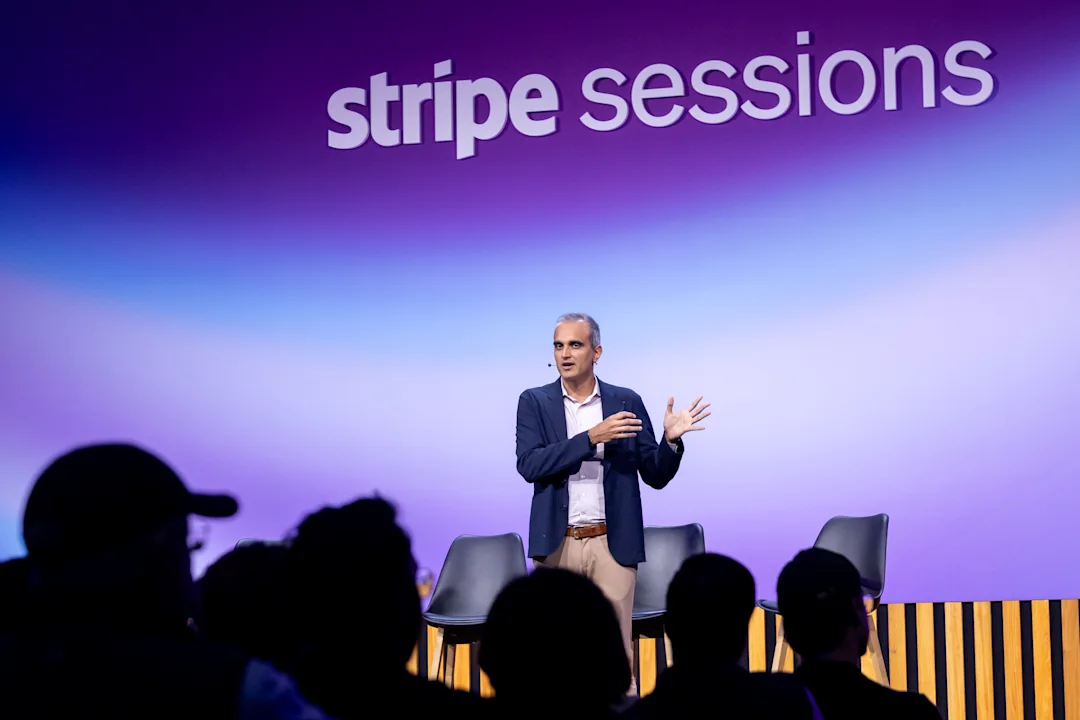
ABHI TIWARI: My name is Abhi Tiwari and I lead our global product team here at Stripe. Today we’re going to talk about global expansion. Think about what it used to take to sell internationally. You would typically start in your home market, let’s say the US. You would spend time building your products, looking for customers, and really focus on winning in your domestic place. Then you might decide that you want to go to the next market, and you’ll pick the UK because the language is the same. Then you would have to go set up a legal entity. You’d have to hire a country manager, set up a bank account, start winning customers locally, and maybe six months later, you might get your first transaction. And then when you decide to go to your next market, you would have to do this whole thing all over again. Now, let’s look at what’s happening today.
In the last five years, the number of businesses on Stripe that are selling in more than a hundred countries has quadrupled. And much of this is down to AI companies like OpenAI, Anthropic, Perplexity, and Midjourney. But it’s not just AI. We see companies of all shapes and sizes going along this trend. For example, Halara, a B2C athleisure brand that saw tremendous traction on social media. They partnered with Stripe to expand into seven new countries with each country taking only three days to launch. What’s replaced the old playbook is a fundamentally different starting point. Your domestic market isn’t just your home country anymore, it’s the entire internet.
But converting reach into revenue requires solving three important problems. First, you have to start with localizing the buyer experience. And then you need to move money across borders efficiently. And finally, you need to manage tax and regulatory compliance. Let’s start with localizing the buyer experience. These are table stakes. These are the basics of going into a new country, and everyone here knows that this is important. We start by talking about currencies and showing a local currency to a buyer is extremely important. We see that 76% of buyers choose to pay in their local currency when presented that option. Then think about payment methods. When we offer an additional payment method beyond cards, we see an increase in cross-border revenue of 12%.
Now, this sounds super simple, but in practice, it rarely is. Exchange rates fluctuate constantly. Payment methods don’t work with certain types of transactions and currencies, and your checkout has to determine in real time what to show each buyer. These choices can really impact whether your buyer feels like they’re getting a local experience. Pricing is a great example. A simple currency conversion is never enough, and we have to think about how the number comes across to the buyer. Let’s say you’re pricing something in 99.99 US dollars, and a Japanese buyer comes to look at this. A straight conversion might make this look something like this, 15,956 yen. Now, this is accurate, but in Japan, this is not the norm. Most prices often end in 80 or 90 yen below a major threshold like 100. So instead of feeling intentional, a straight conversion feels random. And the same principle applies to payment methods.
Now, here in the US, cards are extremely popular. But in Japan, PayPay is a popular payment method used by up to 72 million users. And if PayPay isn’t supported in your checkout, you are creating friction at the very moment that your buyer is ready to pay. And that’s often when you lose the sale. This is the challenge of selling globally. Pricing norms, payment methods, and buyer expectations all vary. Businesses that get this right can truly offer a localized experience leading to higher conversion. This used to be months of work going market by market by market. And today, it no longer takes a dedicated localization team to make this happen. Stripe’s Optimized Checkout Suite can deliver an optimized, localized, frictionless experience to improve your conversion. This includes Adaptive Pricing, where you can present prices in over 150 different currencies. And we’ve seen that Adaptive Pricing increases cross-border revenue by 17.8%. Stripe handles all of the FX and allows you to expand and create a localized currency.
And to help prices feel more local, like I talked about with our Japanese example, we are going to introduce the ability to round prices automatically into a much more localized state. But as we discussed, this is only part of the experience. You need to offer payment methods that buyers want to pay with. The Optimized Checkout Suite also supports over 125 payment methods globally, and our AI models constantly optimize the exact right payment method to show to a buyer at the exact right time. So instead of starting from scratch with every market, you can now go live with a localized checkout experience globally in days, not months.
Now, money coming in should be a really good wins, but this is where complexity starts in terms of how you move money across borders. Let me show you why. Let’s say that you’re a company in the US selling to a buyer in Spain. You’ve localized your currency into the euro. You’re also offering Bizum as a payment method, which is popular with buyers in Spain.
Let’s say you also have a bank account in the UK to manage your pounds. There’s an operational reality that exists here when you have bank accounts across multiple countries. Revenue is coming in, but your treasury is fragmented across multiple currencies and rails. If you want to centralize and manage your funds in the US, you now have to pay foreign exchange to bring it back into your US bank account. Then comes payouts. Let’s say that you have a supplier or a vendor in France or Germany, and now you need to pay foreign exchange again to get this money to them. And then you layer on settlement times and delays and cutoffs, and this whole process becomes expensive and delayed. So that’s money lost on the way in and money lost on the way out. Instead, here’s what money management can look like with Stripe. With Stripe, businesses can settle, hold, and pay out funds within a single system across multiple currencies. If you’re collecting euros in Spain or pounds in the UK, you can manage it all in a single place while settling everything back into your domestic country.
As you heard in the keynote today, this coverage is expanding. By the end of this year, Stripe Treasury will support storage in 15 different currencies, and you can keep more of your operation tied to the currency that you prefer. And from the same account, you can now move funds to vendors, customers, or any third party in more than 150 countries. Part of what makes all this possible is stablecoins, which are creating faster, more flexible ways to move money across borders. For a long time, global businesses had to work across fragmented systems, and the result was added cost, complexity, delays. And now you have access to a global infrastructure that allows you to operate like a local.
Even when money is moving efficiently and you’ve localized your currency and you’re offering the right payment methods, there’s a third problem that quickly creeps up, which is tax and regulatory compliance. It is not the first priority for most businesses, but it very quickly adds to your to-do list as your business starts to grow. Let’s say that you’re on top of your sales tax in the US. You have gone and figured out these 16,000 combinations of jurisdictions and tax rules, and you have a very efficient system in place. But when you expand to India, India’s GST is a completely different system altogether with its own set of rules and regulations. In some cases, e-invoicing requires you to report transactions to the government in real time. Disputes is another place where there are differences. In the US, you have 30 days to respond to a dispute, which is usually done through established chargeback processes. In India, you are required to respond to a dispute in 48 hours, and that doesn’t just stop with taxes and disputes.
Other differences include fraud patterns, which can vary across different types of markets, and that compliance just becomes a limiting factor in your global expansion. The rules don’t just multiply, they vary dramatically from market to market. So how do you stay on top of all this? There are two ways to tackle compliance, and it really sort of comes down to a very critical decision that you need to make, which is, who is the merchant of record in my transaction? That usually is the entity that’s responsible for tax, disputes, and refunds and customer support in a particular market. And that choice does not have to look the same everywhere. More businesses are taking a blended approach. In large markets where you have a significant presence, businesses choose to be their own merchant of record. And in emerging markets where you’re potentially taking a bet, businesses can offload that merchant of record responsibility to someone else.
If you want to stay the merchant of record, tax is often the first place to start. Stripe Tax can help monitor your obligations across all geos, whether it’s sales tax in the US or GST in India. More than 67,000 businesses use Stripe Tax today to automate their collection, registration, and filing for growing businesses that could remove very significant complexity. Retell AI used Stripe Tax to automate compliance across more than a hundred countries, but tax, like I said, is only part of the problem. We talked about how disputes vary, how fraud can vary, and if you don’t want to take that on yourself, Stripe Managed Payments offers a different model. Here, Stripe can become your merchant of record for eligible digital goods transactions. We can handle tax compliance, fraud prevention, dispute management, as well as customer support. So instead of learning regulations on a country-by-country basis, you can now offload all of this to a different merchant of record.
And we see this in our data. 77% of merchants using Stripe Managed Payments today have a cross-border transaction. And most merchants who start with Stripe Managed Payments accept a cross-border payment on their very first day. Compliance is on everybody’s to-do list, and the reality is that with every market, the burden grows. And the good news is that businesses now have many tools to help solve this for them. So whether you own compliance with [Stripe] Tax or offload it to a merchant of record like Managed Payments, both approaches help to reduce your operational load.
Now, the question used to be when to go global. Now it has quickly turned into, how do I quickly turn global demand into revenue? And that comes down to three things: localizing the experience, moving money efficiently, and managing your tax and regulatory burdens. These used to be separate problems with their own solutions and teams that you used to have to put together. And now with Stripe, this infrastructure comes together into a single operating system. The companies you’re about to hear from now have been through this very journey themselves. So please, welcome to the stage, Mark, Raman, Peter, and my colleague, Conor.
CONOR MCNAMARA: Thank you, Abhi. Good afternoon, everyone. My name’s Conor. I lead the EMEA business at Stripe. Delighted to be here with you today to talk a bit more about global. Hopefully you’ve gotten it from the entire messaging over the course of the last two days, but going global by default is a key cornerstone of our messaging at Sessions this year. And of course, we want to turn this now from a conceptual into real-world talk by hearing from leaders who are doing this every day in their day-to-day lives. So thank you guys for joining us. Mark, I might start with you. Maybe just give a bit of an insight in where you are today at OpenAI in your globalization journey.
MARK FERNANDES: Yeah. I think today we are effectively a very global company. I think from day one, our stance was that to be true to our mission, we want to provide intelligence to effectively anyone in the world. And so we’ve been on the journey to take products basically from zero to one, starting with free tier, then moving into a paid tier, and effectively being everywhere we can all at once. Yeah, that’s where we are today.
CONOR MCNAMARA: Raman, great. Thank you, Mark. Raman, where are you from a Perplexity standpoint?
RAMAN MALIK: We are as global as you can get. We, what, about three years ago, Perplexity launched with essentially a tweet merging search and LLMs and a little bit of a prayer. And luckily it took off globally. So the initial launch, the product adoption had no borders to it. On the monetization side, we had to move very fast to meet that adoption across every single country. And so we are now fully rolled out with Stripe across almost every single country where we are served and localized with payment methods.
CONOR MCNAMARA: Yeah. Awesome. Awesome. Peter, Xero, obviously slightly different age of company than the two here on the left-hand side, but you guys are around since 2006. Maybe tell the story about what was going global like back in 2006 for Xero versus maybe where you are today on your journey.
PETER O’MALLEY: Yeah. Yeah. So we’re celebrating our 20th anniversary this year. And if you go back to 2000... Thank you. Yeah. If you go back to 2006, I wasn’t at the company at the time, but it was a very different world back then. Cloud was still a novelty and particularly accounting and business software in the cloud, that was definitely an oldie. And so launched in New Zealand, quickly saw demand in Australia. So moved to Australia in 2008, through 2010 to 2015, scaled out to the US and the UK. And then if you skip forward where we are today, we have offices all around the world. We’re in the US, the UK, Australia, Canada, Hong Kong, Singapore, South Africa. We’re serving five million small businesses and operating in 180 countries around the world. And a lot of that was driven by the demand. There wasn’t a lot of providers, as I said, at that time that were doing what we’re doing, and there’s still only a few players.
And we have a really strong distribution network that drives that global flywheel. We have local advisors in each of our markets, which is accountants and bookkeepers, and they’re like the heart of it. They recommend Xero to their customers. Then we have distribution partners with Stripe and Monzo, so Stripe with the Atlas program. So you get payments and accounting with Monzo in the UK, you get banking and accounting. And all of that works together to continue to grow and drive our flywheel.
CONOR MCNAMARA: Awesome. Awesome. Thank you very much. Raman, maybe go to you next. But we heard a lot this morning in the keynote as well and John’s indexing the economy session about the long tail of globalization and that it’s not enough just to go into maybe five of big global markets that there’s such a long tail. So maybe one, is that true from a Perplexity standpoint? And then second of all, when you were looking at maybe some of the markets that you were looking to expand into, what surprised you or maybe created surface challenges that you didn’t really expect from the outset?
RAMAN MALIK: Yeah. I mean, I think there are a couple layers here. One is just on the competition side. Obviously, this is the fastest adopted technology in mankind history, and we have to move fast to get this as quickly as possible out to every single customer regardless of country. One of the challenges early on was part of our distribution strategy was landing in a global country with a partner to help us distribute. So this could be like a Telco, for example, and a Telco would distribute out Perplexity. The problem was is that there’s a lot of friction in the actual checkout flow if it’s not localized, if it doesn’t have the right payment methods. So not only were we getting inbound levels of support tickets, but we also were getting friction on the partnership side of, “Hey, we want the local currency here. This is what our customers actually [expect].” And so that’s where we actually spent so much time working with you guys, of course, on actually how do we localize these checkout pages? How do we localize the actual end-to-end experience, which just feels like a very straightforward flow to checkout. And then also it enables all these partnerships to actually come to life now faster.
CONOR MCNAMARA: Was there any specific geography that maybe gave you challenges or gave you unexpected hurdles that you hadn’t foreseen at the outset? I’m sure there was a few.
RAMAN MALIK: Yeah, of course. I mean, the one that quickly comes to mind is geographies where the actual payment method, there’s a clear preference outside of credit cards. Out of the box, we had credit cards, but it was tough for us to convince a partner to launch with us if we weren’t serving the most common payment.
CONOR MCNAMARA: So, we’re talking like UPI—
RAMAN MALIK: Exactly. Pix in Brazil, I think is one that immediately comes to mind where as soon as we turned on Pix, you saw all the adoption start to flow right through it.
CONOR MCNAMARA: Yeah, yeah, yeah. And Mark, for your perspective, maybe similar question, maybe talk about that. I know, obviously, mission, like when we spoke beforehand, you often anchored back to mission and the importance of having monetization aligned to the mission of OpenAI. Talk a bit about that and the importance of getting this technology into the hands of everyone and how that links into building a monetization strategy that enables that mission.
MARK FERNANDES: Yeah, for sure. So we launched ChatGPT November 30 of 2022. At the end of the year, at the end of 2022, we were already at a hundred million MAUs. And at that point, we were really putting stress on the systems, primarily our compute, but our infrastructure in general. And it became a worse experience for some of our most engaged users. They were getting slower responses. The infrastructure was just not as reliable. So it effectively became incumbent on us to figure out how we could serve our users and especially our most engaged users. And having a paid model became a way for us to really segment that population in a place that they could then pay for getting what they wanted, but also as a result of that, for us to capture revenue that we can then use to subsidize the usage of our product across all of our free user base.
And so that’s the playbook that we have taken. We’ve really expanded. And what we’ve faced is that it’s really pushed us in terms of this mission of providing intelligence to everyone, but the tension of compute costs being very, very material on a marginal basis for us to think about, what is the SKU structure that allows for us to achieve that mission, and has forced us really to become much more complex, I think, on the SKU side. So we have a plus SKU at $20. We launched a pro SKU at the end of 2024 at $200, and we launched a go SKU, which is in the $5 range. We two weeks ago launched a $100 pro SKU. So these are the things that we need to think about when we’re thinking about expanding globally, is how do we match the SKU structure to the demand that exists in that market and do so in a way that people actually have the ability to pay and willingness to pay.
CONOR MCNAMARA: Yeah. And when you look, maybe a follow-up question, when you look at the path forward, and obviously we had Sam here yesterday with Patrick as part of the afternoon session, what are the type of challenges you think you’re going to face on a monetization standpoint as you continue to see the next evolution of OpenAI?
MARK FERNANDES: Yeah, I think it’s really getting very, very good at understanding what are the local nuances of a market that mandate us positioning our pricing and localization in a unique way to face those customers. For example, once you have a payment method live, that’s really the beginning of the work. There’s a lot of local nuance that you have to appreciate. How is this payment going to recur? Can you support retrials for this payment? Should you have a dunning experience if you’re on a renewing subscription? Should that dunning length be the same as any other country? If the payment method requires you to do a step up for the user to sign a mandate, what should that mandate amount be? How is that mandate affecting the UX of a recurring payment? Should you have a higher mandate to allow for upgrade paths? There’s just a ton...
CONOR MCNAMARA: Not at all complex then. Not at all complex.
MARK FERNANDES: There’s a ton of nuance, and I think it’s on us to just get very, very good at understanding that. To be quite frank, AI has really helped us do that. This has been a solved problem in many cases, and so getting the value of the knowledge that has been bestowed on other companies that have gone through this journey and for us to plug into that and really quickly understand what we need to do to scale is how we approach this.
CONOR MCNAMARA: Awesome. Thank you for those insights. Peter, maybe turning to you, Abhi talked a bit about the tax compliance, regulation, et cetera. So I mean, one aspect of it is collecting the money and having a localized experience, but then the back-office complexity that maybe has come with a truly global offering. Can you maybe talk about that through the lens of Xero or maybe your prior experience in terms of what you’ve seen there and some of the challenges you’ve encountered and any advice you have for the audience in terms of how to untangle that complex web.
PETER O’MALLEY: Yeah. So prior to Xero, I was leading product for global expansion for Cash App. And so Cash App’s obviously huge in the US. We had a growing product in the UK, and we’re aiming to launch in, at the time, launch in three new markets within 12 months [of] one another. And the cost to build is obviously getting compressed. And product like eng capacity was a challenge to localize the product, especially a product as dense as Cash App. But if you look at what was outside of our control, there was two big things. So one, which was like Abhi was talking about setting up local banking relationships, and the second was engaging with regulators and getting licenses in each region as well. And so when you think about banks and regulators, they are not moving at the same pace as a fintech or like an AI company today.
So each of those, they have a lead time. So you do not underestimate the lead time to get your local bank relationships set up or your licenses as well. Because you start to engage with regulators, as you start to engage with those bank partners, they’re going to want to know, who are your customers, how are they using your product, how are you keeping bad actors off your product? What are your AML controls? All of those things, they take time. And then as you start to scale out and go live, as you’re holding funds as well, how do you manage cross-border flows? Who’s managing FX hedging? All of that stuff starts to grow with complexity as the businesses scale.
CONOR MCNAMARA: Yeah. Yeah. No, super interesting. Okay. And we’re almost up on time here. So maybe just Raman, we’ll go to you and the two-sided maybe question to close. So if you had to go back in time and give yourself advice a number of years ago on what you would’ve done differently as you embarked on this journey, what would that be? And then the second part to the question is, as you look over the next 12 months, I know we talked about this as well, what are your top priorities from a globalization standpoint as you look to the future?
RAMAN MALIK: Yeah. Oh man, if I could go back. I mean, I think the first piece is, can we get that monetization platform up faster, and then can we actually globalize faster on the localization front? When we look at our checkout flow, there’s a beautiful kink in the graph. You can tell when we launched localization, the earlier we could have pulled it up, the much better, especially just given that there’s a lot of—
CONOR MCNAMARA: Was that because you didn’t fully understand the value that localization would present it or was it just that you weren’t aware of the technology that was there to enable localization sooner or was it a combination?
RAMAN MALIK: I mean, I think it was also just a team at some point of like, do we have the right resourcing here to invest in this, especially when we knew that certain products were on the roadmap on the Stripe side, which is candidly, all of us up here, team-constrained in terms of what we can do and what’s the next big initiative to work on. And so that—
CONOR MCNAMARA: Prioritization.
RAMAN MALIK: It’s the big piece of it. Yeah. So I think moving that up to be as early as possible is key. And then on the localization front more broadly, we are essentially now starting to really build more of a footprint in specific countries, build more partnerships on the B2B front. And so as we look ahead, it’s now having enterprise catch up to where consumer is in terms of localization, in terms of a footprint globally, and starting to build those inroads in terms of how do we manage seats, how do we manage checkout flows? How do we manage usage-based billing all globally?
CONOR MCNAMARA: And is the work done on the consumer front highly replicable onto the enterprise side? There’s a lot of...
RAMAN MALIK: It is. I mean, there are a lot of learnings you have to transfer over and then it’s a little bit of a different system. But yeah, I mean, a lot of it is our roadmap’s pretty clear because we’ve now done it on consumer already.
CONOR MCNAMARA: Yeah. Okay. Makes sense. Mark, same question, same two set of question to you.
MARK FERNANDES: Yeah. I think I echo Raman’s sentiment getting localized earlier. We launched our go SKU, which is our $8 SKU in 2025, which is three years after we launched our paid-plus SKU and reflecting, I think we should have been a lot quicker. I think the reality was that we were really focused on expansion and getting users to really understand the value of this technology, especially in our free tier. So it wasn’t as important, but if we did it again, it would be quicker.
I think the thing that I’m excited about in the future is how do we think about fully automating the process to expand globally? Just to talk, our book on OpenAI with Codex, you really can automate the end-to-end production release of new features in a way that is very, very powerful. So I think the push to our teams are, how can you just sort of ask Codex to reference our Figma mock of our localized checkout page, say that we want to optimize it in this market, have it then use the connector on Stripe to then turn on payment method, then launch that into a layer in Statsig, have the experiment run, Codex review the experiment, show where it is optimized or not optimized, and then just ship it. And I think we can do that in a very, very automated way. I think the things that prevented us from doing that as a sort of industry before is that you needed to have local integrations with local rails and payment methods, but now that’s largely solved by companies at Stripe where you just have one central plugin point and you get access to all these. So I really do think we have all the ingredients together to get this fully automated and experiments running and show where it’s incremental and then just shipping it and having the best experience for it.
CONOR MCNAMARA: And a time horizon for that is, is that—
MARK FERNANDES: I think we can... If folks on my team are here, we should start doing this this week.
CONOR MCNAMARA: Nice.
MARK FERNANDES: But I think it’s possible now. I think we just need to put our minds to it.
CONOR MCNAMARA: Wow, that’s exciting, exciting. Peter, your perspective, so again, looking back, what’s the key learnings and what’s priorities for Xero into the future?
PETER O’MALLEY: Yeah, exactly as Raman was saying. So key learning would just be get your prioritization framework now right from the start because there’s going to be people that are shared across a bunch of different things, so legal compliance, data science, thinking about your existing markets and new markets as well. So how do you prioritize that capacity alongside all of your product and eng? And then what we’re super excited about is like everyone, embedding more and more AI deeper into our customers’ workflows to give them time back. And so that power of accounting plus payments plus AI, there’s a massive opportunity that we’re undertaking at the moment.
CONOR MCNAMARA: Yeah. Awesome. Awesome. Well, thank you guys. Thank you, Peter, Raman, Mark. Thank you so much for your time. Thank you everyone. Hopefully this gives you further insight into the criticality of global. And remember, don’t wait. You can’t wait to go global. It’s a day one thing. So thank you so much everybody. Enjoy the rest of your Sessions experience.